Math Is Fun Forum
You are not logged in.
- Topics: Active | Unanswered
- Index
- » Science HQ
- » Radiator
Pages: 1
#1 2026-01-13 22:03:12
- Jai Ganesh
- Administrator

- Registered: 2005-06-28
- Posts: 53,791
Radiator
Radiator
Gist
Radiators are heat exchangers used for cooling engines (car, aircraft) or heating spaces (homes, buildings), working by passing a fluid (coolant or water) through tubes with fins, allowing heat to transfer to air flowing over them, and are controlled by valves or fans to regulate temperature, with uses ranging from preventing engine overheating to maintaining comfortable room temperatures.
A radiator is a heat exchanger, a device that transfers heat from a fluid (like engine coolant or hot water/steam) to the surrounding air, preventing overheating in engines or heating spaces in buildings. In cars, it cools the engine by circulating coolant through tubes and fins, releasing heat as air passes over it, while in homes, it's a series of pipes radiating heat from hot water or steam. The term also broadly refers to anything that radiates energy, including radio antennas.
Summary
“A radiator is a component of the engine’s cooling system that disperses a mix of antifreeze and water, which releases some of the heat while taking in cool air before returning to the engine.”
The Definition of a Radiator
A radiator is the key component of the engine’s cooling system. Its main role is to disperse a mix of antifreeze and water throughout its fins, which releases some of the engine’s heat while taking in cool air before continuing to pass the rest of the engine. Alongside the radiator is the spur line, water pump, and fan clutch. Each of these plays a different role in aiding the radiator to keep the engine cool. The spur line dispatches warm coolant to the heater core to produce hot air when needed, while the water pump sends the coolant to flow throughout the engine. Most importantly is the role of the fan clutch, which is to bring more air into the radiator and help lower the temperature of the antifreeze and water mixture.
Parts and Operating Principles of a Radiator
Within the radiator itself, it has 3 main parts, known as the outlet and inlet tanks, the core, and the pressure cap. Each of these 3 parts plays its own role within the radiator.
The main role of a radiator hose is to connect the engine to the radiator and allow the coolant to run through the respective tank. The inlet tank is in charge of guiding the hot coolant from the engine to the radiator to cool down, then it circles back out to the engine through the outlet tank.
After the hot coolant comes in, it circulates through a huge metal plate that contains multiple rows of thin metal fins that help cool down the incoming hot coolant, called the core. Then, it is returned to the engine through the outlet tank once the coolant is at the appropriate temperature.
While the coolant undergoes such a process, there is also the pressure or radiator cap, whose role is to tightly secure and seal off the cooling system to make sure it stays pressurized till a certain point. Once it reaches that point, it will release the pressure. Without the pressure cap, the coolant might overheat and cause an overspill. Thus, causing the radiator to work inefficiently.
Details
A radiator is a heat exchanger used to transfer thermal energy from one medium to another for the purpose of cooling and heating. The majority of radiators are constructed to function in cars, buildings, and electronics.
A radiator is always a source of heat to its environment, although this may be for either the purpose of heating an environment, or for cooling the fluid or coolant supplied to it, as for automotive engine cooling and HVAC dry cooling towers. Despite the name, most radiators transfer the bulk of their heat via convection instead of thermal radiation.
History
The Roman hypocaust is the early example of a type of radiator for building space heating. Franz San Galli, a Prussian-born Russian businessman living in St. Petersburg, is credited with inventing the heating radiator around 1855, having received a radiator patent in 1857, but American Joseph Nason and Scot Rory Gregor developed a primitive radiator in 1841 and received a number of U.S. patents for hot water and steam heating.
Radiation and convection
Heat transfer from a radiator occurs by two mechanisms: thermal radiation and convection into flowing air or liquid. Conduction is not normally a major source of heat transfer in radiators. A radiator may even transfer heat by phase change, for example, drying a pair of socks. In practice, the term "radiator" refers to any of a number of devices in which a liquid circulates through exposed pipes (often with fins or other means of increasing surface area). The term "convector" refers to a class of devices in which the source of heat is not directly exposed.
To increase the surface area available for heat exchange with the surroundings, a radiator will have multiple fins, in contact with the tube carrying liquid pumped through the radiator. Air (or other exterior fluid) in contact with the fins carries off heat. If air flow is obstructed by dirt or damage to the fins, that portion of the radiator is ineffective at heat transfer.
Heating
Radiators are commonly used to heat buildings on the European continent. In a radiative central heating system, hot water or sometimes steam is generated in a central boiler and circulated by pumps through radiators within the building, where this heat is transferred to the surroundings.
In some countries, portable radiators are common to heat a single room, as a safer alternative to space heater and fan heater.
Heating, ventilation, and air conditioning
Radiators are used in dry cooling towers and closed-loop cooling towers for cooling buildings using liquid-cooled chillers for heating, ventilation, and air conditioning (HVAC) while keeping the chiller coolant isolated from the surroundings.
Engine cooling
Radiators are used for cooling internal combustion engines, mainly in automobiles but also in piston-engined aircraft, railway locomotives, motorcycles, stationary generating plants and other places where heat engines are used (watercrafts, having an unlimited supply of a relatively cool water outside, usually use the liquid-liquid heat exchangers instead).
To cool down the heat engine, a coolant is passed through the engine block, where it absorbs heat from the engine. The hot coolant is then fed into the inlet tank of the radiator (located either on the top of the radiator, or along one side), from which it is distributed across the radiator core through tubes to another tank on the opposite end of the radiator. As the coolant passes through the radiator tubes on its way to the opposite tank, it transfers much of its heat to the tubes which, in turn, transfer the heat to the fins that are lodged between each row of tubes. The fins then release the heat to the ambient air. Fins are used to greatly increase the contact surface of the tubes to the air, thus increasing the exchange efficiency. The cooled liquid is fed back to the engine, and the cycle repeats. Normally, the radiator does not reduce the temperature of the coolant back to ambient air temperature, but it is still sufficiently cooled to keep the engine from overheating.
This coolant is usually water-based, with the addition of glycols to prevent freezing and other additives to limit corrosion, erosion and cavitation. However, the coolant may also be an oil. The first engines used thermosiphons to circulate the coolant; today, however, all but the smallest engines use pumps.
Up to the 1980s, radiator cores were often made of copper (for fins) and brass (for tubes, headers, and side-plates, while tanks could also be made of brass or of plastic, often a polyamide). Starting in the 1970s, use of aluminium increased, eventually taking over the vast majority of vehicular radiator applications. The main inducements for aluminium are reduced weight and cost.
Since air has a lower heat capacity and density than liquid coolants, a fairly large volume flow rate (relative to the coolant's) must be blown through the radiator core to capture the heat from the coolant. Radiators often have one or more fans that blow air through the radiator. To save fan power consumption in vehicles, radiators are often behind the grille at the front end of a vehicle. Ram air can give a portion or all of the necessary cooling air flow when the coolant temperature remains below the system's designed maximum temperature, and the fan remains disengaged.
Electronics and computers
As electronic devices become smaller, the problem of dispersing waste heat becomes more difficult. Tiny radiators known as heat sinks are used to convey heat from the electronic components into a cooling air stream. Heatsinks do not use water, rather they conduct the heat from the source. High-performance heat sinks have copper to conduct better. Heat is transferred to the air by conduction and convection; a relatively small proportion of heat is transferred by radiation owing to the low temperature of semiconductor devices compared to their surroundings.
Radiators are also used in liquid cooling loops for rejecting heat.
Spacecraft
Radiators are found as components of some spacecraft. These radiators work by radiating heat energy away as light (generally infrared given the temperatures at which spacecraft try to operate) because in the vacuum of space neither convection nor conduction can work to transfer heat away. On the International Space Station, these can be seen clearly as large white panels attached to the main truss. They can be found on both crewed and uncrewed craft.
Additional Information
There’s an entire cooling system at work under the hood of your car, preventing it from overheating.
That system includes the car radiator, which helps eliminate heat from the engine to maintain and prolong the longevity of your vehicle.
But how exactly does this mechanism work?
Keep reading to find out more about how a radiator works and why it’s so important to the operation of your vehicle!
Key Summary Points
* The radiator is an essential part of a car's cooling system that helps regulate the engine's temperature and prevent damage.
* It works by venting excess heat away from the engine through a process of releasing coolant and water, absorbing heat and then cooling it down with air from outside the vehicle.
* The radiator is located under the hood and in front of the engine, with the coolant reservoir located nearby.
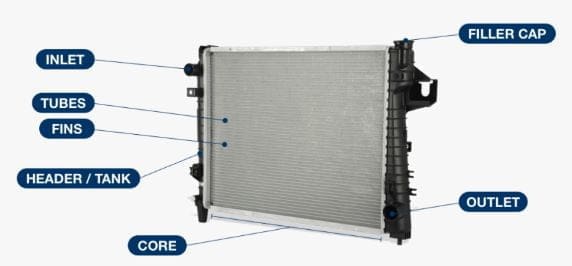
* The main parts of a radiator include the core, pressure cap, inlet and outlet tanks and radiator hoses.
* Signs of a failing radiator can include leaking coolant, discolored coolant or sludge, overheating and bent or damaged fins.
What is a Radiator in a Car?
Long story short, the answer to “What’s a radiator in a car?” is simple — it is a heat exchange that cools fluid, which cools down the engine.
The engine burns fuel and creates energy, which generates heat. For that reason, it gets very hot while running, so the temperature must be regulated to prevent overheating. Venting this heat away from engine parts is important to prevent damage.
Car radiators work to eliminate heat from the engine. The process begins when the thermostat in the front of the engine detects excess heat. Then, coolant and water get released from the radiator and sent through the engine to absorb this heat.
Once the liquid picks up excess heat, it is sent back to the radiator, where air blows across it to cool it down.
The radiator utilizes thin metal fins during the process, which are effective at allowing heat to quickly escape to the air outside the car. These fins are often working alongside the fan that’s blowing air across the radiator.
Where is the Radiator in a Car?
The radiator is located under the hood and in front of the engine. The coolant reservoir is located next to these components as well.
What Does a Radiator Look Like?
Here’s a diagram of a vehicle’s engine cooling system, including what a radiator looks like:
Parts of a Radiator
There are a few main parts that make up the radiator, and each plays a role in the cooling process. They are:
* Core: The core is the largest part of the radiator. It’s a metal block that features the metal cooling fins that help vent the air. The core is where hot liquid releases heat and gets cooled before being sent through the process again.
* Pressure cap: The pressure cap works to help seal the cooling system so it can remain pressurized. Coolant in the radiator is pressurized to prevent the coolant from boiling. It also keeps the system more efficient.
* Inlet and outlet tanks: These tanks are where coolant flows in and out of the radiator and are located in the radiator head. Hot liquid flows from the engine through the inlet tank, and once it is cooled, goes out through the outlet tank and back into the engine.
* Radiator hoses: Coolant moves to and from the engine via the radiator hoses. They are important for connecting the inlet and outlet tanks to the radiator and the engine.
Other Important Cooling System Parts
There are other important cooling system parts that work alongside your radiator, including the water pump and the thermostat.
As mentioned earlier, the thermostat helps regulate the engine’s temperature. If the engine needs to be cooled, the thermostat will open to allow an influx of coolant. It closes if the engine is at the proper operating temperature.
The water pump pushes the coolant through the system. This component is usually operated by the engine drive belt, which turns on the pump, and spinning blades force liquid through the system as needed. Gaskets and seals keep the coolant contained.
Coolant is also extremely important — it’s the fluid that gets pumped through the cooling system to prevent the engine from overheating. It also helps lubricate the different parts it contacts. You can read more about how coolant works here.
Signs of a Failing Radiator
Over time, different parts of the cooling system can begin to wear down. For a more general overview, read up on the most common cooling system problems.
A few signs that your radiator specifically is having issues can include:
* Excessive vibration: If there’s excessive vibration while driving, it could be due to the radiator mounts becoming loose or worn out. This can cause the radiator to shake excessively during operation, potentially leading to further damage.
* Rattling or clunking noises: Strange noises coming from the front of your vehicle could indicate that the radiator is no longer properly secured or that internal components are failing. These sounds can also suggest that there may be air trapped in the cooling system.
* Irregular tire wear: Although not immediately obvious, irregular tire wear can be related to issues with your cooling system, including your radiator. When parts of the cooling system are not functioning properly, it can cause poor vehicle handling, leading to uneven tire wear.
* Vehicle pulling to one side: If your vehicle consistently pulls to one side while driving, it may signal a cooling system imbalance, which often roots back to radiator problems. This can impact overall vehicle safety and should be inspected promptly.
It appears to me that if one wants to make progress in mathematics, one should study the masters and not the pupils. - Niels Henrik Abel.
Nothing is better than reading and gaining more and more knowledge - Stephen William Hawking.
Offline
Pages: 1
- Index
- » Science HQ
- » Radiator