Math Is Fun Forum
You are not logged in.
- Topics: Active | Unanswered
Pages: 1
#1 2026-01-30 21:33:45
- Jai Ganesh
- Administrator

- Registered: 2005-06-28
- Posts: 53,831
Microprocessor
Microprocessor
Gist
A microprocessor is a silicon-based, multi-purpose, programmable integrated circuit (IC) that acts as the central processing unit (CPU) of a computer or embedded system. It executes stored binary instructions, performing arithmetic, logic, and control operations for devices ranging from calculators to smartphones. It consists of an Arithmetic Logic Unit (ALU), registers, and control circuitry.
The microprocessor is a multipurpose, clock driven, register based, digital- integrated circuit which accepts binary data as input, processes it according to instructions stored in its memory, and provides results as output.
How does a microprocessor work?
It does these three steps at incredible speeds of billions of times per second: Fetch: The microprocessor gets a software instruction from the memory telling it what to do with the data. Decode: The microprocessor determines what the instruction means. Execute: The microprocessor performs the instruction.
Summary
A microprocessor is a computer processor for which the data processing logic and control is included on a single integrated circuit (IC), or a small number of ICs. The microprocessor contains the arithmetic, logic, and control circuitry required to perform the functions of a computer's central processing unit (CPU). The IC is capable of interpreting and executing program instructions and performing arithmetic operations. The microprocessor is a multipurpose, clock-driven, register-based, digital integrated circuit that accepts binary data as input, processes it according to instructions stored in its memory, and provides results (also in binary form) as output. Microprocessors contain both combinational logic and sequential digital logic, and operate on numbers and symbols represented in the binary number system.
The integration of a whole CPU onto a single or a few integrated circuits using very-large-scale integration (VLSI) greatly reduced the cost of processing power. Integrated circuit processors are produced in large numbers by highly automated metal–oxide–semiconductor (MOS) fabrication processes, resulting in a relatively low unit price. Single-chip processors increase reliability because there are fewer electrical connections that can fail. As microprocessor designs improve, the cost of manufacturing a chip (with smaller components built on a semiconductor chip the same size) generally stays the same, according to Rock's law.
Before microprocessors, small computers had been built using racks of circuit boards with many medium- and small-scale integrated circuits. These were typically of the TTL type. Microprocessors combined this into one or a few large-scale ICs. While there is disagreement over who deserves credit for the invention of the microprocessor, the first commercially available microprocessor was the Intel 4004, designed by Federico Faggin and introduced in 1971. (TTL: Transistor–transistor logic).
Continued increases in microprocessor capacity have since rendered other forms of computers almost completely obsolete (see history of computing hardware), with one or more microprocessors used in everything from the smallest embedded systems and handheld devices to the largest mainframes and supercomputers.
A microprocessor is distinct from a microcontroller including a system on a chip. A microprocessor is related but distinct from a digital signal processor, a specialized microprocessor chip, with its architecture optimized for the operational needs of digital signal processing.
Details:
Introduction of Microprocessor
A Microprocessor is is a programmable device that takes in input, performs some arithmetic and logical operations over it and produces the desired output. In simple words, a Microprocessor is a digital device on a chip that can fetch instructions from memory, decode and execute them, and give results. It is an important part of a computer architecture without which you will not be able to perform anything on your computer.
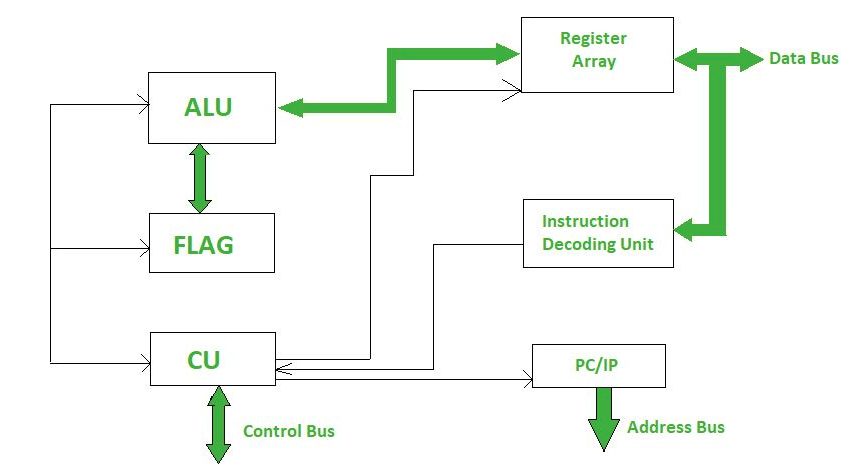
Block Diagram of a Microprocessor
A Microprocessor takes a bunch of instructions in machine language and executes them, telling the processor what it has to do. The microprocessor performs three basic things while executing the instruction:
* It performs some basic operations like addition, subtraction, multiplication, division, and some logical operations using its Arithmetic and Logical Unit (ALU). New Microprocessors also perform operations on floating-point numbers.
* Data in microprocessors can move from one location to another.
* It has a Program Counter (PC) register that stores the address of the next instruction based on the value of the PC, Microprocessor jumps from one location to another and makes decisions.
A typical Microprocessor structure looks like this.
Clock Speed of different Microprocessor:
* 16-bit Microprocessor
** 8086: 4.7MHz, 8MHz, 10MHz
** 8088: more than 5MHz
** 80186/80188: 6MHz
** 80286: 8MHz
* 32-bit Microprocessor
** INTEL 80386: 16MHz to 33MHz
** INTEL 80486: 16MHz to 100MHz
** PENTIUM: 66MHz
* 64-bit Microprocessor
** INTEL CORE-2: 1.2GHz to 3GHz
** INTEL i7: 2.66GHz to 3.33GHz
** INTEL i5: 2.4GHz to 3.6GHz
** INTEL i3: 2.93GHz to 3.33GHz
We do not have any 128-bit Microprocessor at work at present one of the reasons for this is that we are a long way from exhausting the 64-bit address space itself, we use it at a constant rate of roughly 2 bits every 3 years. At present we have only used 48 bits of 64 bits so why require 128-bit address space. Also, 128-bit Microprocessor would be much slower than the 64 bit Microprocessor.
Types of Processor:
Complex Instruction Set Computer (CISC)
CISC or Complex Instruction Set Computer is a computer architecture where instructions are such that a single instruction can execute multiple low-level operations like loading from memory, storing into memory, or an arithmetic operation, etc. It has multiple addressing nodes within a single instruction. CISC makes use of very few registers.
Example of CISC are
* Intel 386
* Intel 486
* Pentium
* Pentium Pro
* Pentium II
* Pentium III
* Motorola 68000
* Motorola 68020
* Motorola 68040 etc.
Reduced Instruction Set Computer (RISC)
RISC or Reduced Instruction Set Computer is a computer architecture where instruction is simple and designed to get executed quickly. Instructions get completed in one clock cycle this is because of the optimization of instructions and pipelining (a technique that allows for simultaneous execution of parts, or stages, of instructions more efficiently process instructions). RISC makes use of multiple registers to avoid large interactions with memory. It has few addressing nodes.
Example of RISC are
* IBM RS6000
* MC88100
* DEC Alpha 21064
* DEC Alpha 21164
* DEC Alpha 21264
Explicitly Parallel Instruction Computing (EPIC)
EPIC or Explicitly Parallel Instruction Computing permits computers to execute instructions parallel using compilers. It allows complex instructions execution without using higher clock frequencies. EPIC encodes its instruction into 128-bit bundles. each bundle contains three instructions which are encoded in 41 bits each and a 5-bit template field(contains information about types of instructions in a bundle and which instructions can be executed in parallel).
Example of EPIC is
* IA-64 (Intel Architecture-64)
Evolution of Microprocessors
The Evolution of Microprocessors are categorize as
* First Generation (4-bit Microprocessors): The Intel Corporation first introduced the microprocessor in 1971-1972, naming it the Intel 4004. This initial microprocessor could perform basic arithmetic and logical functions. It also contained a control unit capable of fetching, decoding, and executing instructions.
* Second Generation (8-bit Microprocessor): The intel corporation first introduced the 8 bit microprocessor in 1973 with the intel 8008. This was followed by an enhanced model, the intel 8088.
* Third Generation (16-bit Microprocessors): The Third Generation introduced microprocessors capable of performing 16 bit operations. Introduced in 1978, this generation was represented by processors like the Intel 8086, Zilog Z800 and 80286.
* Fourth Generation (32 - bit Microprocessors):The most Used and famous 32 bit microprocessor was intel 80386.
* Fifth Generation (64 - bit Microprocessors):Since 1995, microprocessors with 64-bit processors which features 64 bit processors like Intel's Pentium pro which allows multiple CPU's in one.
Basic Terms used in Microprocessor
Given below are the some basic term used in the microprocessors
* Instruction Set: Instruction set is a group of instructions in the microprocess which can be executed. It is the Interface between hardware and software.
* Bus: Buses are used to carry data, address and control information within a microprocessor. There are three types of Bus which are data buses, address buses, and control buses.
* IPC (Instructions Per Cycle): It is Measured as the number of instructions that a CPU can execute in a Single clock cycle.
* Clock Speed: It refers to the number of operations a processor can perform per second. It is Measured in megahertz (MHz) or gigahertz (GHz).
* Bandwidth: It is measured as is the number of bits processed during a single instruction.
* Word Length :It Shows the number of bits a processor can handle at a time.
* Data Types: It Supports various formats such as binary, ASCII, Signed and Unsigned Bits.
Applications of Microprocessor
Given below are the Applications of the Microprocessors
* Computer: The Microprocessors are the CPU's in computers.
* Embedded Systems: It is utilized as the main processing block in the Embedded systems such as Washing machines, microwaves and other equipments.
* Industrial Automation: It can be used to control Industrial machinery and equipments.
* Automotive: The Modern day Vehicles uses Microprocessors in there ECUs.
* Telecommunications: The Microprocessors are utilized in the Telecommunications systems such as routers, modems, and switches.
Conclusion
In the following article we have gone through the Microprocessor, we have seen its definition along with its block diagram and different types, we also gone through Evolution of Microprocessors with its Applications.
Additional Information
A microprocessor is the predominant type of modern computer processor. It combines the components and function of a central processing unit (CPU) into a single integrated circuit (IC) or a few connected ICs.
Like CPUs, microprocessors are commonly thought of as the “brain” of the computer. Unlike traditional CPUs, microprocessors integrate the arithmetic, logic and control circuits of more traditional CPUs into a single multipurpose, clock-driven and register-based digital circuit.
While the terms CPU and microprocessor are often used interchangeably, a microprocessor is essentially an all-in-one CPU on a single chip. This single-chip design reduces the number of vulnerable electrical connections, improving reliability by reducing potential points of failure. As such, microprocessors have almost completely replaced traditional, multicomponent CPUs.
Before microprocessors, computers used racks of ICs to accomplish the computer’s main computing functions. In 1971, a significant shift occurred in computing technology with the introduction of the Intel 4004, the first commercially available microprocessor. This groundbreaking device, designed by Federico Faggin, was not just a response to a request for 12 custom microchips for a calculator from Japanese electronics maker Busicom. It was a landmark moment that revolutionized the way we think about computing, as Intel, instead of producing 12 individual chips, created a general-purpose logic device.
Underpowered by today’s standards, the Intel 4004’s architecture operated at a clock speed of 740 kHz and could only process data streams with a maximum of 4 bits, also known as a “nibble.” While the 4004 is weak compared to modern 8-bit to 64-bit microprocessors, it is universally considered to be a revolutionary breakthrough in circuitry. As predicted by Moore’s law, rapid semiconductor technology development led to major processing power improvements. Manufactured by leading suppliers, such as Intel and Pentium, and used by all major tech companies, such as IBM®, Microsoft and Apple, microprocessors power thousands of systems and applications from TV remote controls to the International Space Station.
How do microprocessors work?
Modern microprocessors combine millions of small transistors, resistors and diodes assembled on a semiconductor material to create the key components of a CPU. These components are arranged into various types of unique computer architecture to perform computations and run instructions. An average microprocessor's functions can be broken down into four main steps.
Key microprocessor steps
1. Fetch: The microprocessor retrieves (or "fetches") instructions from computer memory. The fetch process can be initiated by automatic or manual input.
2. Decode: The microprocessor "decodes" the instructions, essentially interpreting the input or command into a request and instigating a specific process or computation.
3. Execute: Simply put, the microprocessor performs the required or requested operation.
4. Store: The result of the execution is committed to the computer’s memory.
Microprocessor components
Microprocessors can complete these processes by combining the main components of a CPU into a singular circuit. The key components of a microprocessor are the following:
* Arithmetic logic unit (ALU): The main logic unit of the CPU, this component performs logical operations, including mathematical calculations and data comparisons.
* Control unit (CU): The CU circuit interprets instructions and initiates their execution, directing the processor's basic operations.
* Registers: Registers provide small, fast memory storage used by a CPU to temporarily hold data and instructions during computational processes.
* Cache memory: Microprocessors and CPUs use cache memory, a high-speed form of memory located close to the CPU, to store frequently accessed data to accelerate performance.
* Busses and bus interfaces: Bus interfaces provide entry and exit points for data to travel across various groups of wires (referred to as busses), such as the address bus or data bus. Busses and interfaces physically connect different internal components, enabling and facilitating communication within the CPU and other peripherals like input/output (I/O) units.
* Transistors: One of the main building blocks of ICs, transistors are small semiconductors that regulate, amplify and generate electrical currents and signals. They can also act as simple switches or be combined to form logic gates. The number of transistors is a common indicator of microprocessor power.
* Processor cores: Individual processing units within microprocessors are known as cores. Modern processors frequently incorporate multiple cores (dual-core, quad-core) allowing for parallel processing by enabling the performance of multiple tasks simultaneously.
* Clock: Although not all microprocessors contain an internal clock, they are all clock-driven. Some rely on external clock chips, which are known for improved accuracy. Whether internal or external, a microprocessor's clock cycle determines the frequency at which it will carry out commands. Modern clock speeds are measured in megahertz (MHz) and gigahertz (GHz).
Microprocessor architecture
The architecture of a microprocessor refers to various design and organization methodologies of the processor’s various CPU components. These are the key architectural elements of a microprocessor:
* Instruction Set Architecture (ISA): The microprocessor’s ISA defines the instruction set that the processor can perform. ISAs like the Reduced Instruction Set Computer (RISC) and Complex Instruction Set Computer (CISC) architectures provide various methods for data processing, offering varying levels of performance, reliability and speed suitable for different types of applications.
* Data path: A microprocessor’s data path dictates the order in which data moves through the microprocessor’s components (buses, ALU, registers), influencing overall performance.
* Control path: Similar to the data path, the control path element of a microprocessor’s architecture instructs the sequence of operations and manages data transmission within the CPU.
* Memory hierarchy: The memory hierarchy is a critical component of the processor’s architecture, providing a structure for different levels of memory (cache, registers, RAM) to optimize for efficient data access and retrieval speed.
It appears to me that if one wants to make progress in mathematics, one should study the masters and not the pupils. - Niels Henrik Abel.
Nothing is better than reading and gaining more and more knowledge - Stephen William Hawking.
Offline
Pages: 1