Math Is Fun Forum
You are not logged in.
- Topics: Active | Unanswered
- Index
- » Science HQ
- » Kidney
Pages: 1
#1 2026-03-18 16:04:09
- Jai Ganesh
- Administrator

- Registered: 2005-06-28
- Posts: 53,854
Kidney
Kidney
Gist
Kidneys are two bean-shaped organs, about the size of a fist, located behind the abdomen, which filter blood to remove waste, excess water, and toxins, forming urine. They are essential for balancing electrolytes, regulating blood pressure, producing red blood cells, and maintaining bone health.
The kidneys are vital organs that perform seven major functions, including filtering metabolic waste (creatinine, urea) from blood, balancing electrolytes, regulating fluid levels, controlling blood pressure, regulating pH balance (acid-base), activating Vitamin D for bone health, and producing hormones like erythropoietin to manage red blood cell production.
Summary
In humans, the kidneys are two reddish-brown bean-shaped blood-filtering organs that are a multilobar, multipapillary form of mammalian kidneys, usually without signs of external lobulation. They are located on the left and right in the retroperitoneal space, and in adult humans are about 12 centimetres (4+ 1/2 inches) in length. They receive blood from the paired renal arteries; blood exits into the paired renal veins. Each kidney is attached to a ureter, a tube that carries excreted urine to the bladder.
The kidney participates in the control of the volume of various body fluids, fluid osmolality, acid–base balance, various electrolyte concentrations, and removal of toxins. Filtration occurs in the glomerulus: one-fifth of the blood volume that enters the kidneys is filtered. Examples of substances reabsorbed are solute-free water, sodium, bicarbonate, glucose, and amino acids. Examples of substances secreted are hydrogen, ammonium, potassium and uric acid. The nephron is the structural and functional unit of the kidney. Each adult human kidney contains around 1 million nephrons, while a mouse kidney contains only about 12,500 nephrons. The kidneys also carry out functions independent of the nephrons. For example, they convert a precursor of vitamin D to its active form, calcitriol; and synthesize the hormones erythropoietin and renin.
Chronic kidney disease (CKD) has been recognized as a leading public health problem worldwide. The global estimated prevalence of CKD is 13.4%, and patients with kidney failure needing renal replacement therapy are estimated between 5 and 7 million. Procedures used in the management of kidney disease include chemical and microscopic examination of the urine (urinalysis), measurement of kidney function by calculating the estimated glomerular filtration rate (eGFR) using the serum creatinine; and kidney biopsy and CT scan to evaluate for abnormal anatomy. Dialysis and kidney transplantation are used to treat kidney failure; one (or both sequentially) of these are almost always used when renal function drops below 15%. Nephrectomy is frequently used to cure renal cell carcinoma.
Renal physiology is the study of kidney function. Nephrology is the medical specialty which addresses diseases of kidney function: these include CKD, nephritic and nephrotic syndromes, acute kidney injury, and pyelonephritis. Urology addresses diseases of kidney (and urinary tract) anatomy: these include cancer, renal cysts, kidney stones and ureteral stones, and urinary tract obstruction.
The word "renal" is an adjective meaning "relating to the kidneys", and its roots are French or late Latin. Whereas according to some opinions, "renal" should be replaced with "kidney" in scientific writings such as "kidney artery", other experts have advocated preserving the use of "renal" as appropriate including in "renal artery".
Details
Your kidneys are organs that filter your blood. They remove waste and balance your body’s fluids, among other tasks. Most people have one kidney on either side of their spines (in their lower back). Common kidney conditions include kidney disease, kidney infections and kidney cysts.
Overview:
What is a kidney?
The kidneys are two fist-sized organs that filter your blood. Your kidneys are part of your urinary system.
Your kidneys filter about 200 quarts of fluid every day — enough to fill a large bathtub. During this process, your kidneys remove waste, which leaves your body as urine (pee). Most people pee about 2 quarts daily. Your body reuses the other 198 quarts of fluid.
Each kidney also helps balance your body’s fluids (mostly water) and electrolytes. Electrolytes are essential minerals that include sodium and potassium.
Function:
What do kidneys do?
Your kidneys have many important functions. They clean toxins and waste out of your blood. Common waste products include nitrogen waste (urea), muscle waste (creatinine) and acids. They help your body remove these substances. Your kidneys filter about half a cup of blood every minute.
In the process:
1. Blood flows into your kidneys through a large blood vessel called the renal artery.
2. Tiny blood vessels in your kidney filter the blood.
3. The filtered blood returns to your bloodstream through a large blood vessel called the renal vein.
4. Pee travels through tubes of muscle called ureters (yer-it-ters) to your bladder.
5. Your bladder stores pee until you release it through urination (peeing).
The kidneys also:
* Control the acid-base balance (pH balance) of your blood
* Make sugar (glucose) if your blood doesn’t have enough
* Make a protein called renin that increases blood pressure
* Produce the hormones calcitriol and erythropoietin. Calcitriol is a form of vitamin D that helps your body absorb calcium. Erythropoietin helps your body make red blood cells.
How do my kidneys filter blood?
Each kidney contains more than a million filtering units called nephrons. Each nephron consists of:
* Glomeruli: These are groups of tiny blood vessels that perform the first stage of filtering your blood (glomerular filtration). They then pass filtered substances to the renal tubules.
* Renal tubules: These tiny tubes reabsorb and return water, nutrients and minerals your body needs. The tubules remove waste, including excess acid and fluids. Waste goes through your kidneys’ collecting chambers and leaves your body as pee.
Anatomy:
Where are your they located?
Your kidneys sit just below your rib cage and in your lower back. Typically, one kidney sits on either side of your spine. Your kidneys are between your intestines and diaphragm. A ureter connects each kidney to your bladder.
What are the parts of your kidney?
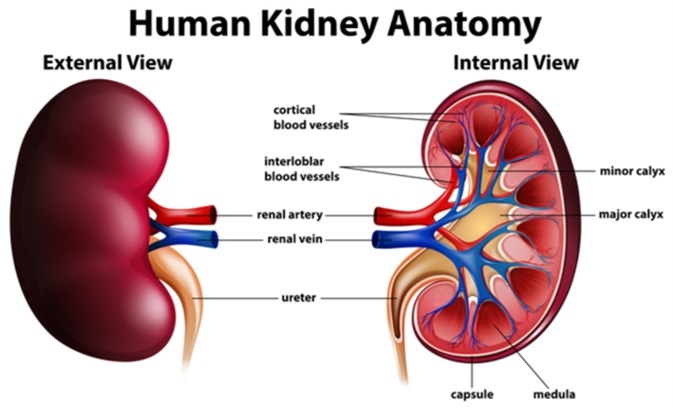
Your kidneys are highly complex organs with many parts. The main parts of your kidney anatomy include:
* Kidney (renal) capsule: This has three layers of connective tissue or fat that cover your kidneys. It protects your kidneys from injury, makes them more stable and connects your kidneys to nearby tissues.
* Renal artery: This large blood vessel controls blood flow into your kidneys. For most people at rest, the renal arteries pump a little over 5 cups (1.2 liters) of blood to your kidneys every minute.
* Renal cortex: This is your kidney’s outer layer, where the nephrons (blood-filtering units) begin. The renal cortex also creates the hormone erythropoietin.
* Renal medulla: This is the inner part of your kidney. It contains most of the nephrons with their glomeruli and renal tubules. The renal tubules carry urine to the renal pelvis.
* Renal papilla: These pyramid-shaped structures transfer urine to the ureters. Dehydration and certain medications may damage your renal papilla.
* Renal pelvis: This funnel-shaped structure collects urine and passes it down two ureters. Urine travels from the ureters to the bladder, which stores it.
* Renal vein: This vein is the main blood vessel that carries filtered blood out of your kidneys and back to your heart. Each of your kidneys has a renal vein.
What does a kidney look like?
Your kidneys are reddish-brown. They have a shape like a kidney bean. Each kidney is about 4 or 5 inches long, about the size of a fist.
The weight of your kidneys varies. It depends on your height, weight, age and body mass index (BMI). Your kidneys may weigh as much as one to five tennis balls.
An adrenal gland sits on top of each kidney. It produces hormones, including cortisol, which helps your body respond to stress.
Conditions and Disorders:
What are the common conditions and disorders that affect your kidneys?
Common diseases that impact your kidneys include:
* Chronic kidney disease (CKD): This may lessen your kidney function. Diabetes or high blood pressure usually causes CKD.
* Kidney cancer: Renal cell carcinoma is the most common type.
* Kidney failure (renal failure): This may be acute (worsen suddenly) or chronic (long-term). End-stage renal disease is a complete loss of kidney function.
* Kidney infection: This can occur if bacteria enter your kidneys by traveling up your ureters. These infections cause sudden symptoms.
* Kidney stones: Crystals can form in your urine and join together to form a stone, which may block urine flow.
* Kidney (renal) cysts: Fluid-filled sacs can grow on your kidneys. They may be benign or malignant.
* Polycystic kidney disease (PKD): This genetic condition causes cysts to form on your kidneys. It may lead to high blood pressure and kidney failure.
Countless other disorders can affect your kidneys. Some of these conditions include:
* Acidosis: Excess acid collects, and your kidneys don’t get rid of it. This may cause many health problems and can be life-threatening.
* Acute or interstitial nephritis: Your kidneys become inflamed, sometimes from certain antibiotics. This may lead to kidney failure.
* Azotemia: Nitrogen waste builds up in your blood and your kidneys don’t get rid of it. Without treatment, azotemia may be fatal.
* Hydronephrosis: Blockage of your urinary system causes urine to back up in your kidneys. Without treatment, hydronephrosis may result in kidney failure.
* Diabetes-related nephropathy or hypertensive nephropathy: Unmanaged diabetes or chronically high blood pressure causes kidney damage.
* Glomerular diseases: These cause inflammation or damage to your glomeruli. Glomerular diseases may cause kidney failure.
* Minimal change disease and nephrotic syndrome: These cause your kidneys to release excess protein in your pee. Over time, this can damage your kidneys.
* Papillary necrosis: Chunks of kidney tissue die in the medulla and papilla. The tissue can break off and clog your kidneys, leading to kidney failure.
* Proteinuria: This is a high level of protein in your pee. It can be a sign of kidney damage.
* Uremia: Your kidneys don’t clear toxins that normally leave your body through your pee. They end up in your bloodstream. Without treatment, uremia can be fatal.
Who is at the greatest risk of problems?
People with diabetes or high blood pressure have the highest risk of kidney problems. Accidents or trauma can also harm your kidneys, like car accidents or sports injuries.
Signs and symptoms of a problem
Most kidney problems don’t have signs in their early stages. As kidney damage progresses, you may notice:
* Cramping muscles: Electrolyte imbalances cause your muscles to stiffen.
* Dark urine or urine with blood in it: Damage to your kidneys’ filters lets blood cells leak into your urine.
* Foamy urine: Bubbles in your pee can signal excess protein.
* Itchy, dry skin: An imbalance of minerals and nutrients in your blood leads to itchy skin.
* More frequent urination: Problems filtering waste cause you to pee more often.
* Puffy eyes or swollen ankles and feet: Reduced kidney function can cause your body to hold onto protein and sodium, resulting in swelling.
* Sleep problems, fatigue and lack of appetite: If toxins build up in your blood, your sleep, appetite and energy levels may be off.
* Stomach pain or vomiting.
What are common tests to check the health of my kidneys?
Healthcare providers use several tests to measure kidney function and diagnose kidney problems. Your provider may recommend:
* Urinalysis: A urinalysis analyzes your pee. It measures certain substances, like protein or blood.
* Blood tests: These can show how well your glomeruli filter your blood.
* Kidney biopsy: Your healthcare provider removes a small amount of your kidney tissue to examine it under a microscope.
* Ureteroscopy: Your provider passes a tube (endoscope) through your urethra into your bladder and ureters to look for anything unusual.
* Advanced imaging: An X-ray, CT scan, MRI, ultrasound or nuclear medicine image can show kidney anomalies or blockages.
Care:
Simple tips to keep your kidneys healthy
It’s important to have regular checkups and blood and urine tests to measure your kidneys’ health. You can reduce your risk of developing a kidney problem by:
* Avoiding tobacco products
* Cutting out excess salt, which can affect the balance of minerals in your blood
* Drinking water
* Increasing daily physical activity, which can reduce high blood pressure
* Limiting your use of NSAIDs, which can cause kidney damage if you take them too often (Nonsteroidal Anti-Inflammatory Drugs)
* Maintaining a weight that’s healthy for you
* Monitoring your blood pressure levels
* Watching your blood sugar levels if you have diabetes
You should have your kidney function regularly tested if you have:
* A family history of kidney disease
* Diabetes
* Heart disease
* High blood pressure
* Obesity or overweight
* Regular use of certain medications, like blood pressure medicine.
Additional Information
Kidney, in vertebrates and some invertebrates, is an organ that maintains water balance and expels metabolic wastes. Primitive and embryonic kidneys consist of two series of specialized tubules that empty into two collecting ducts, the Wolffian ducts (see Wolffian duct). The more advanced kidney (metanephros) of adult reptiles, birds, and mammals is a paired compact organ whose functional units, called nephrons, filter initial urine from the blood, reabsorb water and nutrients, and secrete wastes, producing the final urine, which is expelled.
Reptilian and avian kidneys are made up of many tiny lobules that, in birds, are combined into three or more lobes. Collecting tubules from each lobule empty into a separate branch of the ureter. Reptiles have relatively few nephrons (from 3,000 to 30,000 in lizards), while birds have a great number (around 200,000 in a fowl, twice as many as in a mammal of comparable size).
Mammalian kidneys have a somewhat granular outer section (the cortex), containing the glomeruli and convoluted tubules, and a smooth, somewhat striated inner section (the medulla), containing the loops of Henle and the collecting tubules. As the ureter enters the kidney it enlarges into a cavity, the renal pelvis; urine passes into this pelvis from the collecting tubules. Nephrons are numerous (20,000 in a mouse).
In humans the kidneys are about 10 centimetres long and are located beneath the diaphragm and behind the peritoneum. Each kidney contains 1,000,000–1,250,000 nephrons that filter the entire five-quart water content of the blood every 45 minutes—an equivalent of 160 quarts a day. Of this, only 1 1/2 quarts are excreted; the remainder is reabsorbed by the nephrons.
Damaged kidneys secrete an enzyme called renin that stimulates constriction of the blood vessels. When the damage has been caused initially by high blood pressure, the increase in pressure from the constricted vessels causes more kidney damage.
It appears to me that if one wants to make progress in mathematics, one should study the masters and not the pupils. - Niels Henrik Abel.
Nothing is better than reading and gaining more and more knowledge - Stephen William Hawking.
Offline
Pages: 1
- Index
- » Science HQ
- » Kidney