Math Is Fun Forum
You are not logged in.
- Topics: Active | Unanswered
- Index
- » Science HQ
- » Duodenum
Pages: 1
#1 2026-03-23 16:48:34
- Jai Ganesh
- Administrator

- Registered: 2005-06-28
- Posts: 53,853
Duodenum
Duodenum
Gist
The duodenum is the first, shortest (approx. 25–30 cm), and most fixed "C"-shaped section of the small intestine, connecting the stomach to the jejunum. It neutralizes acidic chyme and breaks down fats, proteins, and carbohydrates using bile and pancreatic enzymes, playing a critical role in nutrient absorption.
What is the main function of the duodenum?
The first part of the small intestine. It connects to the stomach. The duodenum helps to further digest food coming from the stomach. It absorbs nutrients (vitamins, minerals, carbohydrates, fats, proteins) and water from food so they can be used by the body.
Summary
The duodenum is the first section of the small intestine in most vertebrates, including mammals, reptiles, and birds. In mammals, it may be the principal site for iron absorption. The duodenum precedes the jejunum and ileum and is the shortest part of the small intestine.
In humans, the duodenum is a hollow jointed tube about 25–38 centimetres (10–15 inches) long connecting the stomach to the jejunum, the middle part of the small intestine. It begins with the duodenal bulb, and ends at the duodenojejunal flexure marked by the suspensory muscle of duodenum. The duodenum can be divided into four parts: the first (superior), the second (descending), the third (transverse) and the fourth (ascending) parts.
Overview
The duodenum is the first section of the small intestine in most higher vertebrates, including mammals, reptiles, and birds. In fish, the divisions of the small intestine are not as clear, and the terms anterior intestine or proximal intestine may be used instead of duodenum. In mammals the duodenum may be the principal site for iron absorption.
In humans, the duodenum is a C-shaped hollow jointed tube, 25–38 centimetres (10–15 inches) in length, lying adjacent to the stomach (and connecting it to the small intestine). It is divided anatomically into four sections. The first part lies within the peritoneum but its other parts are retroperitoneal.
Details
The duodenum is the first part of your small intestine. Its main job is to transform the partially digested food it receives from your stomach into nutrients your body can use. Digestive juices from your liver, gallbladder and pancreas empty into your duodenum, helping with digestion and absorption.
Overview:
What is the duodenum?
The duodenum is the first part of your small intestine. Despite what the name suggests, your “small” intestine is the longest part of your digestive tract and plays a big role in your digestive system. Inside its many coils, digestive juices transform food into the nutrients (like proteins, fats, vitamins and water) that power your body.
The duodenum is a short, “C”-shaped chute. It’s the first stop food makes as it travels from your stomach to your small intestine. The other parts of your small intestine are your jejunum (the middle part) and ileum (the last part).
Function:
What is the function of the duodenum?
The duodenum continues the process of digestion (breakdown of food into nutrients) that starts in other parts of your gastrointestinal (GI) tract, like your mouth and stomach. It also begins the absorption process (moving the nutrients into your bloodstream). Think of it this way: Before reaching your duodenum, saliva and stomach acid have transformed food into food slush. Inside your duodenum, the slush becomes nutrients your body can use.
Your duodenum:
* Makes food traveling from your stomach less acidic. The partially digested food that travels from your stomach to your duodenum is called chyme. Chyme is highly acidic, thanks to stomach juices that break down food. Your duodenum releases a hormone (secretin) that triggers the release of an enzyme called bicarbonate that makes chyme less acidic. The breakdown of acid helps your digestive system absorb nutrients. It prevents the acid from damaging your small intestine.
* Transforms chyme into nutrients. Your duodenum releases a hormone (cholecystokinin) that triggers your pancreas, gallbladder and liver to release substances that help turn chyme into nutrients. Your liver and gallbladder release bile, which breaks down fats. Your pancreas releases lipase, which also breaks down fats, amylase to break down carbohydrates and protease to break down proteins. Your bloodstream absorbs these nutrients.
* Moves food molecules along. The duodenum pushes food molecules that don’t get absorbed into the next section of your small intestine, the jejunum. The duodenum squeezes and relaxes, creating a wave-like forward motion called peristalsis.
Anatomy:
How big is the duodenum?
It’s the shortest section of your small intestine, approximately 10 inches long — just 2 inches shy of a foot. “Duodenum,” translated from Latin, means “12 fingers,” a reference to its size. The length of your duodenum is approximately the width of 12 fingers placed side by side.
To put this in perspective, your entire small intestine is 22 feet long. If you stretched it out, it would be the length of a tennis court. Your duodenum wouldn’t be a single foot of the total length. Yet, important nutrient absorption happens in these 10 inches of your small intestine.
Where is the duodenum located?
Your duodenum starts just below your stomach. It curves to the right and back, down and then to the left in a “C” or horseshoe shape. It slants upward slightly before joining with the next part of your small intestine, your jejunum. The head of your pancreas (the widest part) sits inside the “C.”
What are the parts of the duodenum?
There are four basic parts. They get their name from their location and shape.
* Superior segment
The superior segment is the top part of the duodenum that connects with your stomach. It’s about 2 inches long. The part of the superior segment that connects directly with your pylorus (the stomach valve that opens to allow food to travel to your small intestine) is called the duodenal bulb. Most ulcers in your small intestine form here, where stomach acid is most likely to come into contact with your duodenum.
* Descending segment
As the name suggests, the descending segment is the part of the “C” shape that goes downward. It passes in front of your right kidney and is about 4 inches long.
This part of your small intestine connects to your pancreas (via the pancreatic duct) and your gallbladder and liver (via the common bile duct). “Ducts” are like tiny canals that allow substances to travel from one organ (like your liver) to another organ (like your small intestine). These organs produce substances that empty into the descending segment, breaking down fats, proteins and carbohydrates.
* Horizontal (inferior) segment
The horizontal segment is about 4 inches long. It extends from right to left and passes over essential blood vessels, including your aorta and inferior vena cava.
* Ascending segment
This is the smallest part of your duodenum, at just under an inch. It extends slightly upward and is located to the left of your aorta. It connects to your jejunum.
What is the duodenum made of?
The duodenum has four layers. Its cell makeup is the same as other organs in your GI tract. From the innermost layer to the outermost layer, the duodenum consists of the:
* Mucosa: It contains glands and fingerlike projections called microvilli. The microvilli increase the surface area of your duodenum, allowing it to absorb more nutrients than if it were flat.
* Submucosa: This layer consists of blood vessels and connective tissue. The submucosa contains Brunner’s glands. Brunner’s glands release a substance that makes chyme less acidic.
* Muscularis: This layer is mostly smooth muscle. Its job is mixing and moving. As it contracts, it blends the enzymes and bile that break down chyme. It also moves the chyme along the length of your duodenum, so it reaches your jejunum.
* Serosa: This layer consists of squamous epithelial cells that serve as your duodenum’s protective barrier.
Conditions and Disorders:
What problems can occur in the duodenum?
As the part of your small intestine closest to your stomach, your duodenum is especially susceptible to injury if you have excess stomach acid. The acid can lead to open stores in your stomach (peptic ulcers) and in your duodenum. The most common causes of these ulcers are H. pylori infection and overusing medicines called NSAIDs (nonsteroidal anti-inflammatory drugs). NSAIDs, like aspirin and ibuprofen, can ease symptoms like aches and pains but can cause ulcers if you use them too much.
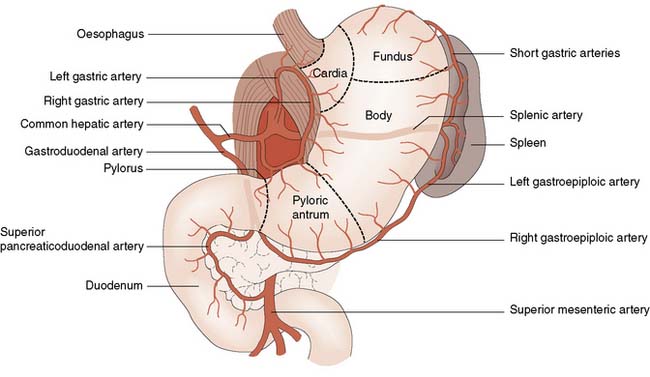
If an untreated ulcer breaks down too much of your duodenum’s protective barrier, its contents can leak out and damage the gastroduodenal artery behind it. This can cause severe bleeding that requires emergency care.
Many of the same conditions that affect your small intestine, in general, can affect your duodenum specifically. Conditions that can affect your duodenum include:
* Brunner’s gland adenomas: Benign (noncancerous) growths that start in Brunner’s glands.
* Crohn’s disease: A type of irritable bowel disease (IBD) that causes irritation and inflammation.
* Celiac disease: A disorder that causes problems in your digestive system when you eat gluten.
* Duodenal atresia: A condition that causes a baby to be born with a closed duodenum.
* Duodenal stenosis: A condition that causes a baby to be born with a narrowed (but not completely closed) duodenum.
* Duodenal cancer: Cancer that starts in your duodenum.
* Duodenal diverticulum: A small, pouch-like structure that pushes outside the wall of your duodenum. Diverticula (plural of diverticulum) usually don’t cause issues or require treatment unless they become infected and inflamed (diverticulitis).
* Duodenitis: Inflammation in your duodenum.
* Small bowel obstruction: A medical emergency that happens when part of your small intestine (including your duodenum) is entirely or partially blocked.
Common signs or symptoms of issues with the duodenum
Symptoms depend on the specific condition. In general, symptoms of a condition affecting your duodenum are similar to problems with your GI tract. Signs and symptoms include:
* Abdominal pain.
* Bloating and gas.
* Constipation.
* Diarrhea.
* Nausea and vomiting.
* Indigestion (stomach discomfort after you eat).
* Bloody vomit or poop (a sign of a bleeding ulcer).
Common tests to check the health of the duodenum.
Common tests include:
* Breath test to check for H. pylori infections.
* Imaging procedures — like ultrasounds, X-rays, CT scans (computed tomography scans) and MRIs (magnetic resonance imaging) — that look for growths and inflammation inside your duodenum.
* Procedures that use a scope to see inside your duodenum, including enteroscopy and upper endoscopy.
* Biopsies to check abnormal growths, including cancer.
What are common treatments for conditions affecting the duodenum?
Common treatments include:
* Antibiotics to treat infections (like H. pylori).
* Corticosteroids to reduce severe inflammation.
* Medicines to reduce the amount or acidity level of stomach acid, like proton pump inhibitors (PPIs), histamine receptor blockers (H2 blockers) and antacids.
* Surgery to correct structural issues or treat cancer, including the Whipple procedure.
Care:
How can I keep my duodenum healthy?
Putting healthy habits into place to prevent irritating or overworking your digestive system is good for your entire GI tract, including your duodenum.
Choose a diet that keeps your digestive system running smoothly. Eating lots of fiber and drinking lots of water can help you have regular bowel movements so things don’t get backed up in your small intestine. Eating lots of vegetables and nonacidic foods can help you maintain a healthy acidity level in your gut.
Avoid substances that can irritate your gut. Smoking and drinking too much alcohol can irritate organs in your digestive system, including your small intestine. Taking too many NSAIDs (Nonsteroidal anti-inflammatory drugs) can lead to painful ulcers that require treatment.
Don’t ignore signs of digestive system issues. Changes in your bowel habits and unpleasant symptoms, like an upset stomach or indigestion, can be temporary. Or they can sound the alarm bells that you need to change your lifestyle or see a provider. Don’t delay getting help if you’ve got unpleasant digestive symptoms that aren’t improving.
Additional Information
Duodenum is the first part of the small intestine, which receives partially digested food from the stomach and begins the absorption of nutrients. The duodenum is the shortest segment of the intestine and is about 23 to 28 cm (9 to 11 inches) long. It is roughly horseshoe-shaped, with the open end up and to the left, and it lies behind the liver. On anatomic and functional grounds, the duodenum can be divided into four segments: the superior (duodenal bulb), descending, horizontal, and ascending duodenum.
A liquid mixture of food and gastric secretions enters the superior duodenum from the pylorus of the stomach, triggering the release of pancreas-stimulating hormones (e.g., secretin) from glands (crypts of Lieberkühn) in the duodenal wall. So-called Brunner glands in the superior segment provide additional secretions that help to lubricate and protect the mucosal layer of the small intestine. Ducts from the pancreas and gallbladder enter at the major duodenal papilla (papilla of Vater) in the descending duodenum, bringing bicarbonate to neutralize the acid in the gastric secretions, pancreatic enzymes to further digestion, and bile salts to emulsify fat. A separate minor duodenal papilla, also in the descending segment, may receive pancreatic secretions in small amounts. The mucous lining of the last two segments of the duodenum begins the absorption of nutrients, in particular iron and calcium, before the food contents enter the next part of the small intestine, the jejunum.
Inflammation of the duodenum is known as duodenitis, which has various causes, prominent among them infection by the bacterium Helicobacter pylori. H. pylori increases the susceptibility of the duodenal mucosa to damage from unneutralized digestive acids and is a major cause of peptic ulcers, the most common health problem affecting the duodenum. Other conditions that may be associated with duodenitis include celiac disease, Crohn disease, and Whipple disease. The horizontal duodenum, because of its location between the liver, pancreas, and major blood vessels, can become compressed by those structures in people who are severely thin, requiring surgical release to eliminate painful duodenal dilatation, nausea, and vomiting.
It appears to me that if one wants to make progress in mathematics, one should study the masters and not the pupils. - Niels Henrik Abel.
Nothing is better than reading and gaining more and more knowledge - Stephen William Hawking.
Offline
Pages: 1
- Index
- » Science HQ
- » Duodenum