Math Is Fun Forum
You are not logged in.
- Topics: Active | Unanswered
- Index
- » Science HQ
- » Pleurisy
Pages: 1
#1 2026-03-29 17:50:50
- Jai Ganesh
- Administrator

- Registered: 2005-06-28
- Posts: 53,853
Pleurisy
Pleurisy
Gist
Pleurisy is the inflammation of the membrane surrounding the lungs (pleura), causing sharp, stabbing chest pain that worsens with breathing, coughing, or sneezing. Primarily caused by infections (viral, bacterial pneumonia), it is treated by managing the underlying cause and reducing pain with NSAIDs. Recovery varies, often lasting a few days to weeks depending on the cause, with a generally good prognosis upon prompt treatment.
Pleurisy is inflammation around the lungs, which causes sharp chest pain. It's easy to treat and usually gets better in a few days, but can sometimes be a sign of something more serious, like pneumonia.
Summary
Pleurisy, also known as pleuritis, is inflammation of the membranes that surround the lungs and line the chest cavity (pleurae). This can result in a sharp chest pain while breathing. Occasionally the pain may be a constant dull ache. Other symptoms may include shortness of breath, cough, fever, and weight loss, depending on the underlying cause.
Pleurisy can be caused by a variety of conditions, including viral or bacterial infections, autoimmune disorders, and pulmonary embolism. The most common cause is a viral infection. Other causes include bacterial infection, pneumonia, pulmonary embolism, autoimmune disorders, lung cancer, following heart surgery, pancreatitis and asbestosis. Occasionally the cause remains unknown. The underlying mechanism involves the rubbing together of the pleurae instead of smooth gliding. Other conditions that can produce similar symptoms include pericarditis, heart attack, cholecystitis, pulmonary embolism, and pneumothorax. Diagnostic testing may include a chest X-ray, electrocardiogram (ECG), and blood tests.
Treatment depends on the underlying cause. Paracetamol (acetaminophen) and ibuprofen may be used to decrease pain. Incentive spirometry may be recommended to encourage larger breaths. About one million people are affected in the United States each year. Descriptions of the condition date from at least as early as 400 BC by Hippocrates.
Details:
What is pleurisy?
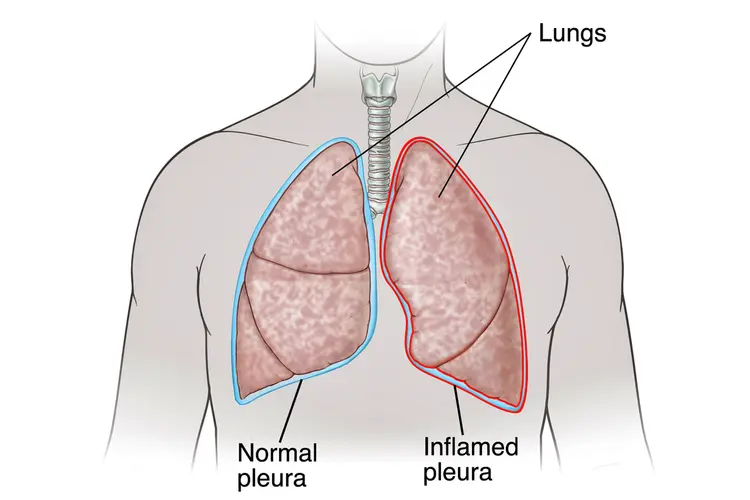
Pleurisy is an inflammation of the pleura, a large, thin sheet of tissue that wraps around the outside of your lungs and lines the inside of your chest cavity. Between the layer of the pleura that wraps around your lungs and the layer that lines your chest cavity is a very thin space called the pleural space. Normally this space is filled with a small amount of fluid that helps the two layers of the pleura glide smoothly past each other as your lungs breathe air in and out. Pleurisy occurs when the two layers of the pleura become red and inflamed, rubbing against each other every time your lungs expand to breathe in air. Infections like pneumonia are the most common cause of pleurisy.
Symptoms
The main symptom of pleurisy is a sharp or stabbing pain in your chest that gets worse when you breathe in deeply or cough or sneeze. The pain may stay in one place or it may spread to your shoulder or back. Sometimes it becomes a fairly constant dull ache. Depending on what's causing the pleurisy, you may have other symptoms, such as:
* Shortness of breath
* A cough
* Fever and chills
* Rapid, shallow breathing
* Unexplained weight loss
* A sore throat followed by pain and swelling in your joints
Diagnosis
Your doctor will find out if you have pleurisy or another pleural disorder by taking a detailed medical history and doing a physical exam and several diagnostic tests, including:
* Chest X-ray to show air or fluid in the pleural space, and what's causing the condition (for example, pneumonia, a fractured rib, or a lung tumor)
* CT scan that can show pockets of fluid, signs of pneumonia, a lung abscess or a tumor
* Ultrasound, which can show where fluid is located in your chest
* Magnetic resonance (MR) scan, which can show pleural effusions and tumors
* Blood tests, which can show whether you have a bacterial or viral infection, pneumonia, rheumatic fever, a pulmonary embolism or lupus
* Arterial blood gas tests, which show how well your lungs are taking in oxygen
Treatment
A procedure called thoracentesis is used to remove fluid from the pleural space. The doctor inserts a needle or a thin, hollow, plastic tube through the ribs in the back of your chest into your chest wall. A syringe is attached to draw fluid out of your chest.
To relieve symptoms, your doctor may recommend:
* Acetaminophen or anti-inflammatory agents, such as ibuprofen, to control pain
* Codeine-based cough syrups to control a cough
* Lying on the painful side to make you more comfortable
* Breathing deeply and coughing to clear mucus as the pain eases
Your doctor will look at the fluid under a microscope to determine what's causing the fluid buildup. If the fluid is infected, treatment involves antibiotics and draining the fluid. If the infection is tuberculosis or from a fungus, treatment involves long-term use of antibiotics or antifungal medicines. If the fluid is caused by tumors of the pleura, it may build up again quickly after it's drained. Sometimes antitumor medicines will prevent further fluid buildup. If they don't, the doctor may seal the pleural space.
Additional Information
Pleurisy is a condition in which the pleura — two large, thin layers of tissue that separate your lungs from your chest wall — becomes inflamed. Also called pleuritis, pleurisy causes sharp chest pain (pleuritic pain) that worsens during breathing.
One pleural layer of tissue wraps around the outside of the lungs. The other pleural layer lines the inner chest wall. Between these two layers is a small space (pleural space) that's usually filled with a very small amount of liquid. These layers act like two pieces of smooth satin gliding past each other, allowing your lungs to expand and contract when you breathe.
If you have pleurisy, these tissues swell and become inflamed. As a result, the two layers of the pleural lining rub against each other like two pieces of sandpaper. This causes pain when you breathe in and out. The pleuritic pain lessens or stops when you hold your breath.
Treatment of pleurisy involves pain control and treating the cause.
Symptoms:
Signs and symptoms of pleurisy might include:
* Chest pain that worsens when you breathe, cough or sneeze.
* Shortness of breath — often from trying to limit breathing in and out.
* Cough — only in some cases.
* Fever — only in some cases.
Pain caused by pleurisy might worsen with movement of your upper body and can spread to your shoulders or back.
Pleurisy can occur along with pleural effusion, atelectasis or empyema:
* Pleural effusion. In some cases of pleurisy, fluid builds up in the small space between the two layers of tissue. This is called pleural effusion. When there is a fair amount of fluid, pleuritic pain lessens or disappears because the two layers of pleura are no longer in contact and don't rub together.
* Atelectasis. A large amount of fluid in the pleural space can create pressure. This can compress your lung to the point that it partially or completely collapses (atelectasis). This makes breathing difficult and might cause coughing.
* Empyema. The extra fluid in the pleural space can also become infected, resulting in a buildup of pus. This is called an empyema. Fever often occurs along with an empyema.
When to see a doctor
Call your healthcare provider or seek emergency care right away if you experience unexplained, intense chest pain during breathing. You might have a problem with your lungs, heart or pleura or an underlying illness for which you need prompt medical care.
Causes
A variety of conditions can cause pleurisy. Causes include:
* Viral infection, such as the flu (influenza).
* Bacterial infection, such as pneumonia.
* Fungal infection.
* Autoimmune disorder, such as rheumatoid arthritis or lupus.
* Lung cancer near the pleural surface.
* Pulmonary embolism.
* Tuberculosis (TB).
* Rib fracture or trauma.
* Certain inherited diseases, such as sickle cell disease.
* Certain medications and recreational drugs.
Risk factors
The risk of pleurisy increases if you get certain infections, such as the flu or pneumonia. Some medical conditions, such as lupus, TB and sickle cell disease also can increase your risk. And taking certain medicines or certain recreational drugs raise the risk of pleurisy.
Diagnosis
Your healthcare provider will likely start by asking about your medical history and doing a physical exam that includes listening to your chest with a stethoscope.
To determine if you have pleurisy and identify the cause, your healthcare provider might recommend:
* Blood tests. A blood test might tell if you have an infection. Other blood tests might detect an autoimmune disorder, such as rheumatoid arthritis or lupus. In these conditions, pleurisy can be the first sign.
* Chest X-ray. A chest X-ray can show if your lungs are fully inflating or if there is air or fluid between the lungs and ribs.
* Computerized tomography (CT) scan. A CT scan combines a series of X-ray images taken from different angles around your body. It uses computer processing to create cross-sectional images that look like slices of your chest. These detailed images can show the condition of the pleura. They can also show if there are other causes of pain, such as a blood clot in the lung.
* Ultrasound. This imaging method uses high-frequency sound waves to produce precise images of structures within your body. An ultrasound might be used to determine whether you have a pleural effusion.
* Electrocardiogram (ECG or EKG). This heart-monitoring test might be recommended to rule out certain heart problems as a cause for your chest pain.
Diagnostic procedures
In some cases, your healthcare provider might remove fluid and tissue from the pleural space for testing. Procedures might include:
* Thoracentesis. In this procedure, a local numbing agent (anesthetic) is injected between your ribs to the area where fluid was seen on your imaging studies. Next a needle is inserted through your chest wall between your ribs to remove fluid for lab analysis. Removing fluid can also help you breathe better. The needle is usually inserted with the help of ultrasound guidance.
* Thoracoscopy. If TB or cancer is suspected, a thoracoscopy — also called a pleuroscopy — may be performed. During this procedure, a tiny camera (thoracoscope) is inserted through a small cut in your chest wall. This procedure allows for a direct view inside your chest to look for any problems or to get a tissue sample (biopsy).
Treatment
Treatment for pleurisy focuses primarily on the underlying cause. For example, if bacterial pneumonia is the cause, an antibiotic can be prescribed to manage the infection. If the cause is a viral infection, pleurisy may go away on its own.
The pain and inflammation associated with pleurisy is usually treated with nonsteroidal anti-inflammatory drugs (NSAIDs), such as ibuprofen (Advil, Motrin IB, others). Occasionally, your healthcare provider may prescribe steroid medication.
The outcome of pleurisy treatment depends on the seriousness of the underlying cause. Early diagnosis and treatment of the condition that caused pleurisy can help you feel better. Depending on the cause and the condition, you may make a full recovery.
Lifestyle and home remedies
These steps might help relieve symptoms related to pleurisy:
* Take medication. Take medication as recommended by your healthcare provider to relieve pain and inflammation.
* Get plenty of rest. Find the position that causes you the least discomfort when you rest. Even when you start to feel better, be careful not to overdo it.
* Don't smoke. Smoking can cause more irritation to your lungs. If you smoke and can't quit on your own, ask your healthcare provider for help.
It appears to me that if one wants to make progress in mathematics, one should study the masters and not the pupils. - Niels Henrik Abel.
Nothing is better than reading and gaining more and more knowledge - Stephen William Hawking.
Offline
Pages: 1
- Index
- » Science HQ
- » Pleurisy