Math Is Fun Forum
You are not logged in.
- Topics: Active | Unanswered
Pages: 1
#1 2026-03-02 17:49:39
- Jai Ganesh
- Administrator

- Registered: 2005-06-28
- Posts: 53,791
Barium Chloride
Barium Chloride
Gist
Barium chloride (BaCl2) is a highly toxic, white, water-soluble inorganic salt that is hygroscopic and imparts a yellow-green color to a flame. Primarily used in industry for manufacturing pigments, case hardening steel, and purifying brine, it is also a common laboratory reagent for testing sulfate ions.
Barium chloride (BaCl2) is used in wastewater treatment, brine purification for chlorine production, and to make pigments, stabilizers, and other barium salts; it's also used in steel hardening, fireworks for green color, and as a lab test for sulfates. Its toxicity limits its applications, but it's crucial in chemical manufacturing and analysis for removing sulfates and as a precursor to other compounds, despite being less common in consumer products due to safety concerns.
Summary
Barium chloride appears as white crystals. A salt arising from the direct reaction of barium and chlorine. Toxic by ingestion.
Barium chloride is a chemical compound of barium. It is used in the laboratory as a test for sulfate ion. In industry, barium chloride is mainly used in the purification of brine solution in caustic chlorine plants and also in the manufacture of heat treatment salts, case hardening of steel, in the manufacture of pigments, and in the manufacture of other barium salts. It is also used in fireworks to give a bright green color. Barium is a metallic alkaline earth metal with the symbol Ba, and atomic number 56. It never occurs in nature in its pure form due to its reactivity with air, but combines with other chemicals such as sulfur or carbon and oxygen to form barium compounds that may be found as minerals.
Details
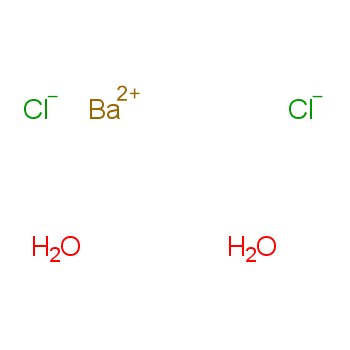
Barium chloride is an inorganic compound with the formula BaCl2. It is one of the most common water-soluble salts of barium. Like most other water-soluble barium salts, it is a white powder, highly toxic, and imparts a yellow-green coloration to a flame. It is also hygroscopic, converting to the dihydrate BaCl2·2H2O, which are colourless crystals with a bitter salty taste. It has limited use in the laboratory and industry.
Uses
Although inexpensive, barium chloride finds limited applications in the laboratory and industry.
Its main laboratory use is as a reagent for the gravimetric determination of sulfates. The sulfate compound being analyzed is dissolved in water and hydrochloric acid is added. When barium chloride solution is added, the sulfate present precipitates as barium sulfate, which is then filtered through ashless filter paper. The paper is burned off in a muffle furnace, the resulting barium sulfate is weighed, and the purity of the sulfate compound is thus calculated.
In industry, barium chloride is mainly used in the purification of brine solution in caustic chlorine plants and also in the manufacture of heat treatment salts, case hardening of steel. It is also used to make red pigments such as Lithol red and Red Lake C. Its toxicity limits its applicability.
Toxicity
Barium chloride, along with other water-soluble barium salts, is highly toxic. It irritates eyes and skin, causing redness and pain. It damages kidneys. Fatal dose of barium chloride for a human has been reported to be about 0.8-0.9 g. Systemic effects of acute barium chloride toxicity include abdominal pain, diarrhea, nausea, vomiting, cardiac arrhythmia, muscular paralysis, and death. The Ba2+ ions compete with the K+ ions, causing the muscle fibers to be electrically unexcitable, thus causing weakness and paralysis of the body. Sodium sulfate and magnesium sulfate are potential antidotes because they form barium sulfate BaSO4, which is relatively non-toxic because of its insolubility in water.
Barium chloride is not classified as a human carcinogen.
Additional Information:
What is Barium Chloride (BaCl2)?
Barium Chloride is an inorganic salt that is made up of barium cations (Ba2+) and chloride anions (Cl–). It is also called Barium Muriate or Barium dichloride. It is a white solid which is water-soluble, hygroscopic and gives a slight yellow-green colour to a flame. The chemical formula of Barium Chloride is BaCl2.
Barium salts are extensively used in the industry. The sulfate is used in white paints, particularly for outside use. Barium chloride is poisonous in nature.
Properties of Barium Chloride – BaCl2
Barium chloride is quite soluble in water (as is the case with most ionic salts). It is known to dissociate into barium cations and chloride anions in its dissolved state. At a temperature of 20 oC, the solubility of barium chloride in water is roughly equal to 358 grams per litre. However, the solubility of this compound in water is temperature-dependent. At a temperature of 100 oC, the solubility of barium chloride in water is equal to 594 grams per litre. This compound is also soluble in methanol (however, it is not soluble in ethanol).
Under standard conditions, barium chloride exists as a white crystalline solid. Anhydrous BaCl2 crystallizes in an orthogonal crystal structure. However, the dihydrate form of barium chloride is known to have a monoclinic crystal structure.
Uses of Barium Chloride (BaCl2)
* Barium Chloride is used as a raw material to produce barium salt.
* It is used in chlorine-alkali industries.
* Used in the manufacturing of rubber.
* It is widely used in oil refining.
* It is used in the papermaking industry.
* It is used in the hardening of steel.
* Used to purify brine solution.
Effects on Health
This compound is toxic when ingested. Magnesium sulfate (MgSO4) and Sodium sulfate (Na2SO4) are probable antidotes as they form BaSO4 (barium sulfate). BaSO4 is comparatively non-toxic due to its insolubility.
Frequently Asked Questions – FAQs:
Q1: What is barium chloride used for?
The primary industrial application of BaCl2 is in the purification of the brine solutions that are used in caustic chlorine plants. This compound is also used in the case-hardening of steel and the production of heat treatment salts. This compound has limited applications due to its high toxicity.
Q2: What is the oxidation number of barium and chlorine in BaCl2?
Barium chloride molecules feature an ionic bond between barium cations and chloride anions. Barium is a metal that exhibits an oxidation state of +2 in this ionic salt whereas chlorine is a non-metal which exhibits an oxidation state of -1 in BaCl2.
Q3: Is barium chloride toxic?
Yes, like most other salts of barium, BaCl2 is highly toxic to human beings. Exposure to this compound can cause irritation of the eyes, mucous membrane, and skin. Ingestion or inhalation of barium chloride can also prove fatal. Barium chloride can also negatively impact the central nervous system, the cardiovascular system, and the kidneys.
Q4: How is barium chloride produced industrially?
The industrial production of barium chloride follows a two-step process. First, barium sulfate (usually in the form of the mineral barite) is reacted with carbon at high temperatures to form barium sulphide and carbon monoxide. Then, the barium sulphide is treated with hydrochloric acid to yield barium chloride along with hydrogen sulphide.
Q5: What are the properties of aqueous solutions of BaCl2?
Aqueous solutions of barium chloride have neutral pH values since they contain the cation of a strong base and the anion of a strong acid. When exposed to sulfates, a white precipitate of barium sulfate is obtained.
It appears to me that if one wants to make progress in mathematics, one should study the masters and not the pupils. - Niels Henrik Abel.
Nothing is better than reading and gaining more and more knowledge - Stephen William Hawking.
Offline
Pages: 1