Math Is Fun Forum
You are not logged in.
- Topics: Active | Unanswered
Pages: 1
#1 2026-03-11 17:49:16
- Jai Ganesh
- Administrator

- Registered: 2005-06-28
- Posts: 53,853
San Marino
San Marino
Gist
San Marino is one of the world's smallest countries, ranking as the fifth smallest globally by area (around 61 sq km or 24 sq miles) and the third smallest in Europe after Vatican City and Monaco, entirely surrounded by Italy. It's also recognized as the world's oldest republic, founded in 301 AD.
The Oldest Republic
Established in 301 AD, this tiny nation has maintained its independence and self-governance for over 1,700 years. Its rich history and the preservation of its ancient traditions make San Marino a captivating destination for history enthusiasts.
Summary
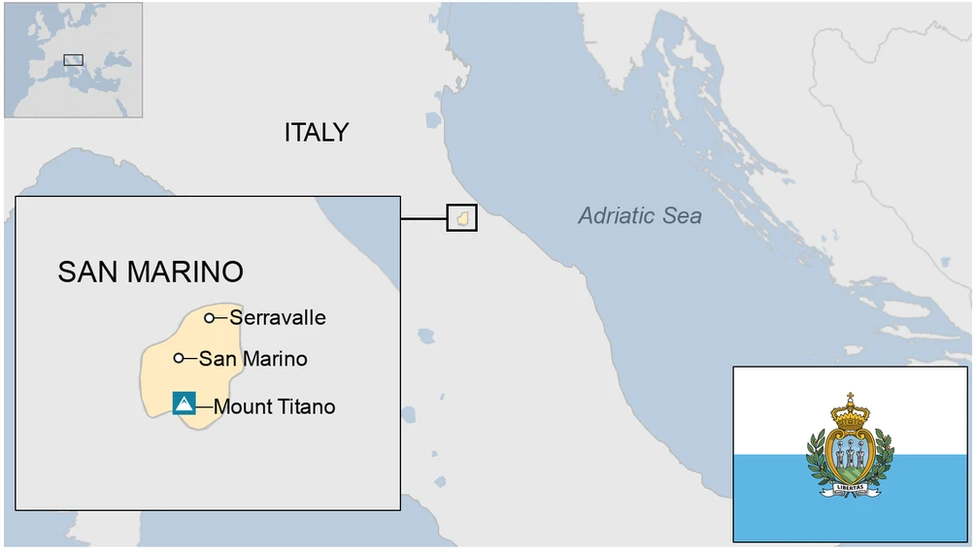
San Marino, officially the Republic of San Marino (RSM), is a landlocked country in Southern Europe, completely surrounded by Italy. Located on the northeastern slopes of the Apennine Mountains, it is the larger of two microstates within Italy, the other being Vatican City. San Marino is the fifth-smallest country in the world, with a land area of just over 61 sq km (23.5 sq mi) and a population of 34,042 as of 2025. Its capital, the City of San Marino, sits atop Monte Titano, while its largest settlement is Dogana, in the municipality of Serravalle.
San Marino claims to have been founded in AD 301 and to be the oldest extant sovereign state, and the oldest constitutional republic. It is named after Saint Marinus, a stonemason from the Roman island of Rab (in present-day Croatia), who is supposed in mythic accounts to have established a monastic community on Monte Titano. The country has a rare constitutional structure: the Grand and General Council, a democratically elected legislature, selects two heads of state, the Captains Regent, every six months. They are chosen from opposing political parties, and serve concurrently with equal powers and preside over several institutions of state, including the Grand and General Council. Only the Federal Council of Switzerland also follows that structure, except with seven heads of state, and different responsibilities and functions.
San Marino is a member of the Council of Europe and uses the euro as its official currency, but is not part of the European Union. The official language is Italian, although the traditional regiolect is Sammarinese, a dialect of Romagnol. Its economy is based on finance, industry, services, retail, and tourism, and it ranks among the wealthiest countries in the world by GDP (PPP) per capita. San Marino was also the first currently-existing state to abolish the death penalty (in 1865), and in 2025 was ranked 29th on the Human Development Index.
Details
San Marino is a small, landlocked republic situated on the slopes of Mount Titano, on the Adriatic side of central Italy between the Emilia-Romagna and Marche regions and surrounded on all sides by the republic of Italy. It is the smallest independent state in Europe after Vatican City and Monaco and, until the independence of Nauru (1968), the smallest republic in the world.
Geography
San Marino has an irregular rectangular form with a maximum length of 8 miles (13 km), northeast to southwest. It is crossed by the Marano and Ausa (Aussa) streams, which flow into the Adriatic Sea, and by the stream of San Marino, which falls into the Marecchia River. The landscape is dominated by the huge, central limestone mass of Mount Titano (2,424 feet [739 meters]); hills spread out from it on the southwest, whereas the northeastern part gently slopes down toward the Romagna plain and the Adriatic coast. The silhouette of Mount Titano, with its three summits crowned by ancient triple fortifications, may be seen from many miles away. In 2008 Mount Titano and the historic center of San Marino were designated a UNESCO World Heritage site.
The climate is mild and temperate, with maximum temperatures in the high 70s F (about 26 °C) in summer and the high teens F (about −7 °C) in winter. Annual rainfall ranges between about 22 inches (560 mm) and 32 inches (800 mm). Vegetation is typical of the Mediterranean zone, with variations due to elevation, and includes olive, pine, oak, ash, poplar, fir, and elm, as well as many kinds of grasses and flowers. Besides domestic and farmyard animals, moles, hedgehogs, foxes, badgers, martens, weasels, and hares are found. Indigenous birds and birds of passage are plentiful.
Although traces of human presence from both prehistoric and Roman times exist in the territory, Mount Titano and its slopes are known to have been populated, with certainty, only after the arrival of St. Marinus and his followers. San Marino citizens, or Sammarinesi, make up more than four-fifths of the country’s population, with Italians composing most of the remainder. Thousands of Sammarinesi reside abroad, principally in Italy, the United States, France, and Argentina. Nearly nine-tenths of San Marino’s citizens are Roman Catholics, though there is no official religion. The official language is Italian. A widely spoken dialect has been defined as Celto-Gallic, akin to the Piedmont and Lombardy dialects as well as to that of Romagna.
Because centuries-long quarrying has exhausted Mount Titano’s stone and ended the craft that depended upon it, the territory is now without mineral resources. All electrical power is transferred via electrical grid from Italy, San Marino’s main trading partner. The country’s principal resources are industry, tourism, commerce, agriculture, and crafts. Manufactures include electronics, paint, cosmetics, ceramics, jewelry, and clothing. Ceramic and wrought-iron articles, as well as modern and reproduction furniture, are among San Marino’s traditional craft products. Fine printing, particularly of postage stamps, is a consistent source of revenues. Banking is a vital industry. In 2002 San Marino replaced the Italian lira with the euro as its national currency.
Tourism is the sector of greatest expansion, and it makes a major contribution to the inhabitants’ income. Alongside traditional excursion tourism, there is convention-type tourism, based on modern hotel facilities, as well as residential tourism.
Agriculture, although no longer the principal economic resource in San Marino, remains vital. Wheat, grapes, and barley are the chief crops; dairying and livestock also are important. About three-fourths of the land is given to permanent cultivation.
The capital, San Marino city, is set high on the western side of Mount Titano, beneath the fortress crowning one of its summits, and is encircled by triple walls. Borgo Maggiore, farther down the slope, was for centuries San Marino’s commercial center, and Serravalle, beneath its castle of the Malatesta family, is agricultural and industrial. San Marino is overwhelmingly urban in character, and those three cities are home to nearly two-thirds of San Marino’s population. Most of San Marino’s landscape is agricultural in character, but industrial concerns have intruded on the centuries-old forms of agricultural life.
The San Marino constitution, originating from the Statutes of 1600, provides for a parliamentary form of government. The Great and General Council (Parliament) has 60 members, elected every five years by all adult citizens. It has legislative and administrative powers and every six months nominates the two captains regent (capitani reggenti), who hold office for that period and may not be elected again until three years have elapsed. The Great and General Council is headed by the captains regent, who are heads of state and of the administration. The Congress of State, a council of ministers, is composed of 10 members, elected by the Great and General Council from among its members, and constitutes the central organ of executive power. Each member has charge of a ministerial department.
Social programs for the citizens of San Marino are extensive. The state attempts to keep unemployment in check by seeking to provide employment for those who cannot find work with private concerns. All citizens (who make social security contributions) receive free, comprehensive, high-quality medical care and assistance in sickness, accident, and old age, as well as family allowances. The state aids home ownership through its buildings schemes. Education is free and compulsory up to age 16. The University of San Marino was founded in 1985. A public security force of about 50 persons provides national defense.
A network of roads connects San Marino with the surrounding regions of Italy. Motorcoach services connect San Marino city with Rimini, Italy, and, in summer, directly with the Adriatic coast. The main airport serving San Marino is the Federico Fellini International Airport in Rimini. There are no railroads, but the capital is reached from Borgo Maggiore by means of a cable railway.
History
The Republic of San Marino traces its origin to the early 4th century ce when, according to tradition, St. Marinus and a group of Christians settled there to escape persecution. The Castellum Sancta Marini is mentioned in the Liber Pontificalis (“The Book of the Pontiffs”) in 755; the oldest document in the republican archives mentions the abbot of San Marino in 885. By the 12th century San Marino had developed into a commune ruled by its own statutes and consuls. The commune was able to remain independent despite encroachments by neighboring bishops and lords, largely because of its isolation and its mountain fortresses. Against the attacks of the Malatesta family, who ruled the nearby seaport of Rimini, San Marino enjoyed the protection of the rival family of Montefeltro, who ruled Urbino. By the middle of the 15th century, it was a republic ruled by a Grand Council—60 men taken from the Arengo, or Assembly of Families. Warding off serious attacks in the 16th century (including an occupation by Cesare Borgia in 1503), San Marino survived the Renaissance as a relic of the self-governing Italian city-states. Rule by an oligarchy and attempts to annex it to the Papal States in the 18th century marked the decline of the republic.
When Napoleon invaded Italy, he respected the independence of the republic and even offered to extend its territory (1797). The Congress of Vienna (1815), at the end of the Napoleonic Wars, also recognized its independent status. During the 19th-century movement for Italian unification, San Marino offered asylum to revolutionaries, among them Giuseppe Garibaldi. After Italy became a national state, a series of treaties (the first in 1862) confirmed San Marino’s independence. In World War II, San Marino remained neutral, but it was the target of a British bombing raid in 1944 and was briefly occupied by both the Germans and the Allies later that year.
Additional Information
Europe attracts more international tourists than any other region of the world, according to the United Nations World Tourism Organization. The staggering 616 million people that visited the continent last year faced the tough choice of dozens of destinations, each offering stimulating history, diverse classes of creatives, and epic landscapes. France seduced the most travelers by far, but what about last place?
Hovering on a cliff encircled by Italy, the tiny landlocked country of San Marino holds the title of the least visited country in Europe, just a dot on the map of only 23.6 square miles. Here’s why travelers of all types should visit the under the radar microstate.
For History Buffs
Founded in the fourth century and one of the world’s oldest republics, San Marino survived from the time when city-states proliferated across Europe—a critical stage for developing democratic models across the globe. Ramble around the car-free capital also named San Marino, a UNESCO World Heritage site with a medievalized layout punctuated by three imposing fortresses standing testimony to a turbulent past.
Fer Epic Landscapes
The Mount Titano, part of the Apennine range, dominates San Marino's landscape surrounded by Italy with clear views all the way to the Adriatic Sea. Old stone benches pepper the slopes offering places to bask in the greenery stretching to the outlying villages. Ride the funicular from one such town, Borgo Maggiore, to the historic center for sweeping views of Italy in every direction.
For Foodies
All the rules of northern Italian food apply here too, with a strong tradition in cheesemaking. Sammarinese cuisine, heavy on pasta and meat dishes, balances the rich and fresh with locally-sourced ingredients. The area holds particular fondness for the filled flatbread called piada, similar to a piadina from the encompassing Emilia-Romagna region. Don’t forget the wine: San Marino produced wine for almost two thousand years, aging the bottles in the area caves for optimal temperatures.
For Architecture Fans
Visitors weave through time in the living history museum of the historic capital, home to 14th and 16th century convents, 18th century Titano Theatre, and a neoclassical basilica built in the 19th century. The centerpiece Palazzo Pubblico echos Florence’s Palazzo Vecchio on a much smaller scale.
For Savvy Shoppers
The tax-free policy of San Marino makes shopping cheaper than nearby Italy. Mid-century modern ceramics captivate collectors, along with postage stamps created in the late 19th century for use only within the state's borders.
For Day-Trippers
San Marino may not be a member of the European Union but enjoys open borders with Italy for tourists staying less than 10 days. The ideal location makes for easy day trips from cities like Florence or Bologna, both located less than three hours away.
It appears to me that if one wants to make progress in mathematics, one should study the masters and not the pupils. - Niels Henrik Abel.
Nothing is better than reading and gaining more and more knowledge - Stephen William Hawking.
Offline
Pages: 1