Math Is Fun Forum
You are not logged in.
- Topics: Active | Unanswered
Pages: 1
#1 2025-12-11 19:15:37
- Jai Ganesh
- Administrator

- Registered: 2005-06-28
- Posts: 52,704
Blood Plasma
Blood Plasma
Gist
Blood plasma is the pale yellow, liquid component of blood, making up about 55% of its volume, primarily water (92%) carrying vital proteins (like albumin, globulins, clotting factors), nutrients, hormones, electrolytes, and waste products, serving to transport blood cells, maintain fluid balance, regulate pH, and support immunity and clotting. It's essential for transporting substances throughout the body and is a key source for life-saving medicines.
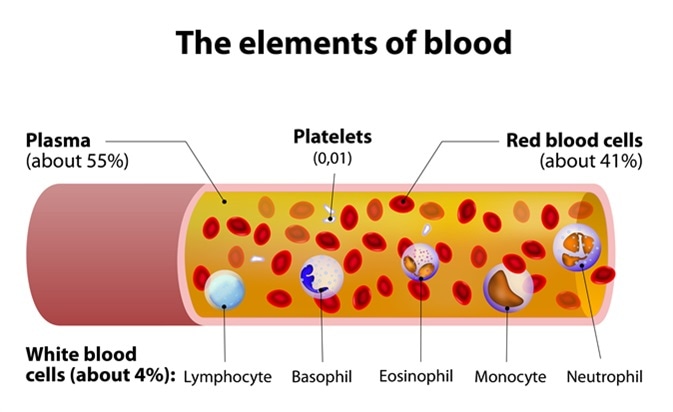
Blood is a specialized body fluid. It has four main components: plasma, red blood cells, white blood cells, and platelets. The blood that runs through the veins, arteries, and capillaries is known as whole blood—a mixture of about 55% plasma and 45% blood cells.
Summary
Blood plasma is a light amber-colored liquid component of blood in which blood cells are absent, but which contains proteins and other constituents of whole blood in suspension. It makes up about 55% of the body's total blood volume. It is the intravascular part of extracellular fluid (all body fluid outside cells). It is mostly water (up to 95% by volume), and contains important dissolved proteins (6–8%; e.g., serum albumins, globulins, and fibrinogen), glucose, clotting factors, electrolytes (Na+ Ca2+ Mg2+, HCO3−, Cl− , etc.), hormones, carbon dioxide (plasma being the main medium for excretory product transportation), and oxygen. It plays a vital role in an intravascular osmotic effect that keeps electrolyte concentration balanced and protects the body from infection and other blood-related disorders.
Blood plasma can be separated from whole blood through blood fractionation, by adding an anticoagulant to a tube filled with blood, which is spun in a centrifuge until the blood cells fall to the bottom of the tube. The blood plasma is then poured or drawn off. For point-of-care testing applications, plasma can be extracted from whole blood via filtration or via agglutination to allow for rapid testing of specific biomarkers. Blood plasma has a density of approximately 1,025 kg/{m}^{3} (1.025 g/ml). Blood serum is blood plasma without clotting factors. Plasmapheresis is a medical therapy that involves blood plasma extraction, treatment, and reintegration.
Fresh frozen plasma is on the WHO Model List of Essential Medicines, the most important medications needed in a basic health system. It is of critical importance in the treatment of many types of trauma which result in blood loss, and is therefore kept stocked universally in all medical facilities capable of treating trauma (e.g., trauma centers, hospitals, and ambulances) or that pose a risk of patient blood loss such as surgical suite facilities.
Details
Blood flows like a liquid because of plasma. And that isn’t the only thing that makes it important. Plasma also carries proteins and chemical compounds that keep you alive and your body working properly. You can also donate plasma, and it can be used to help others in a variety of ways.
Plasma is the liquid part of your blood. This fluid makes up a little over half of your blood’s total volume. Other blood cells — like red blood cells, white blood cells and platelets — mix in with the plasma, which carries them to every corner of your body.
Plasma is about 92% water. Proteins (antibodies, coagulation factors, albumin and fibrinogen) make up another 7% of it. The other 1% is hormones, vitamins, water, salt, enzymes and other important compounds.
Function:
What does plasma do?
Plasma has several jobs that make it vital to your survival:
* Carrying red blood cells to your lungs so they can pick up oxygen and release carbon dioxide
* Maintaining blood pressure so blood vessels stay open, making circulation possible
* Delivering water, hormones, nutrients, electrolytes and proteins to parts of your body that need them
* Helping regulate your body temperature
* Carrying immune cells “on patrol” and delivering them to deal with threats like infections
* Carrying proteins that your body uses for inflammation, to clot blood and to repair damage
* Removing waste products to your liver or kidneys so your body can get rid of them
Think of plasma like a river, and everything it carries like boats. Without enough plasma, it’s like a river with a water level that’s too low. It can’t flow or carry those boats — and their vital cargo —where they need to go.
Anatomy:
Where does plasma come from?
Plasma doesn’t really come from a specific place. Instead, it forms when water in your body combines with electrolytes you absorb through your digestive tract. Some of the important proteins that go into plasma come from specific organs or places, though. They include your:
* Bone marrow
* Degenerating, older blood cells
* Liver
* Spleen
Once those proteins combine with the electrolyte-rich liquid, you have plasma.
What does plasma look like?
Plasma is a pale, yellowish or straw-colored liquid when you separate it from red blood cells, white blood cells and platelets.
Your plasma can be different colors if you have a condition that affects what’s in the plasma. For example, if you have red blood cells breaking down (hemolysis), your plasma might look pinkish. If you have high bilirubin levels and jaundice from a liver condition, your plasma may look greenish or brownish.
What percentage of blood is plasma?
In general, your blood is about 55% plasma. That number can vary a little, depending on your sex or medical conditions you have.
How do you separate plasma from the other components of blood?
You can separate blood components, including plasma, using a tool called a centrifuge. This machine spins a tube full of blood very fast. That creates a gravity-like effect that pulls heavier red blood cells to the bottom of the tube. Atop the red blood cells is a whitish layer of platelets and white blood cells. And above that whitish layer is the plasma.
Additional Information
The liquid portion of the blood, the plasma, is a complex solution containing more than 90 percent water. The water of the plasma is freely exchangeable with that of body cells and other extracellular fluids and is available to maintain the normal state of hydration of all tissues. Water, the single largest constituent of the body, is essential to the existence of every living cell.
The major solute of plasma is a heterogeneous group of proteins constituting about 7 percent of the plasma by weight. The principal difference between the plasma and the extracellular fluid of the tissues is the high protein content of the plasma. Plasma protein exerts an osmotic effect by which water tends to move from other extracellular fluid to the plasma. When dietary protein is digested in the gastrointestinal tract, individual amino acids are released from the polypeptide chains and are absorbed. The amino acids are transported through the plasma to all parts of the body, where they are taken up by cells and are assembled in specific ways to form proteins of many types. These plasma proteins are released into the blood from the cells in which they were synthesized. Much of the protein of plasma is produced in the liver.
The major plasma protein is serum albumin, a relatively small molecule, the principal function of which is to retain water in the bloodstream by its osmotic effect. The amount of serum albumin in the blood is a determinant of the total volume of plasma. Depletion of serum albumin permits fluid to leave the circulation and to accumulate and cause swelling of soft tissues (edema). Serum albumin binds certain other substances that are transported in plasma and thus serves as a nonspecific carrier protein. Bilirubin, for example, is bound to serum albumin during its passage through the blood. Serum albumin has physical properties that permit its separation from other plasma proteins, which as a group are called globulins. In fact, the globulins are a heterogeneous array of proteins of widely varying structure and function, only a few of which will be mentioned here. The immunoglobulins, or antibodies, are produced in response to a specific foreign substance, or antigen. For example, administration of polio vaccine, which is made from killed or attenuated (weakened) poliovirus, is followed by the appearance in the plasma of antibodies that react with poliovirus and effectively prevent the onset of disease. Antibodies may be induced by many foreign substances in addition to microorganisms; immunoglobulins are involved in some hypersensitivity and allergic reactions. Other plasma proteins are concerned with the coagulation of the blood.
Many proteins are involved in highly specific ways with the transport function of the blood. Blood lipids are incorporated into protein molecules as lipoproteins, substances important in lipid transport. Iron and copper are transported in plasma by unique metal-binding proteins (transferrin and ceruloplasmin, respectively). Vitamin B12, an essential nutrient, is bound to a specific carrier protein. Although hemoglobin is not normally released into the plasma, a hemoglobin-binding protein (haptoglobin) is available to transport hemoglobin to the reticuloendothelial system should hemolysis (breakdown) of red cells occur. The serum haptoglobin level is raised during inflammation and certain other conditions; it is lowered in hemolytic disease and some types of liver disease.
Lipids are present in plasma in suspension and in solution. The concentration of lipids in plasma varies, particularly in relation to meals, but ordinarily does not exceed 1 gram per 100 ml. The largest fraction consists of phospholipids, complex molecules containing phosphoric acid and a nitrogen base in addition to fatty acids and glycerol. Triglycerides, or simple fats, are molecules composed only of fatty acids and glycerol. Free fatty acids, lower in concentration than triglycerides, are responsible for a much larger transport of fat. Other lipids include cholesterol, a major fraction of the total plasma lipids. These substances exist in plasma combined with proteins of several types as lipoproteins. The largest lipid particles in the blood are known as chylomicrons and consist largely of triglycerides; after absorption from the intestine, they pass through lymphatic channels and enter the bloodstream through the thoracic lymph duct. The other plasma lipids are derived from food or enter the plasma from tissue sites.
Some plasma constituents occur in plasma in low concentration but have a high turnover rate and great physiological importance. Among these is glucose, or blood sugar. Glucose is absorbed from the gastrointestinal tract or may be released into the circulation from the liver. It provides a source of energy for tissue cells and is the only source for some, including the red cells. Glucose is conserved and used and is not excreted. Amino acids also are so rapidly transported that the plasma level remains low, although they are required for all protein synthesis throughout the body. Urea, an end product of protein metabolism, is rapidly excreted by the kidneys. Other nitrogenous waste products—uric acid and creatinine—are similarly removed.
Several inorganic materials are essential constituents of plasma, and each has special functional attributes. The predominant cation (positively charged ion) of the plasma is sodium, an ion that occurs within cells at a much lower concentration. Because of the effect of sodium on osmotic pressure and fluid movements, the amount of sodium in the body is an influential determinant of the total volume of extracellular fluid. The amount of sodium in plasma is controlled by the kidneys under the influence of the hormone aldosterone, which is secreted by the adrenal gland. If dietary sodium exceeds requirements, the excess is excreted by the kidneys. Potassium, the principal intracellular cation, occurs in plasma at a much lower concentration than sodium. The renal excretion of potassium is influenced by aldosterone, which causes retention of sodium and loss of potassium. Calcium in plasma is in part bound to protein and in part ionized. Its concentration is under the control of two hormones: parathyroid hormone, which causes the level to rise, and calcitonin, which causes it to fall. Magnesium, like potassium, is a predominantly intracellular cation and occurs in plasma in low concentration. Variations in the concentrations of these cations may have profound effects on the nervous system, the muscles, and the heart, effects normally prevented by precise regulatory mechanisms. Iron, copper, and zinc are required in trace amounts for synthesis of essential enzymes; much more iron is needed in addition for production of hemoglobin and myoglobin, the oxygen-binding pigment of muscles. These metals occur in plasma in low concentrations. The principal anion (negatively charged ion) of plasma is chloride; sodium chloride is its major salt. Bicarbonate participates in the transport of carbon dioxide and in the regulation of pH. Phosphate also has a buffering effect on the pH of the blood and is vital for chemical reactions of cells and for the metabolism of calcium. Iodide is transported through plasma in trace amounts; it is avidly taken up by the thyroid gland, which incorporates it into thyroid hormone.
The hormones of all the endocrine glands are secreted into the plasma and transported to their target organs, the organs on which they exert their effects. The plasma levels of these agents often reflect the functional activity of the glands that secrete them; in some instances, measurements are possible though concentrations are extremely low. Among the many other constituents of plasma are numerous enzymes. Some of these appear simply to have escaped from tissue cells and have no functional significance in the blood.
It appears to me that if one wants to make progress in mathematics, one should study the masters and not the pupils. - Niels Henrik Abel.
Nothing is better than reading and gaining more and more knowledge - Stephen William Hawking.
Offline
Pages: 1