Math Is Fun Forum
You are not logged in.
- Topics: Active | Unanswered
Pages: 1
#1 2026-01-18 22:07:46
- Jai Ganesh
- Administrator

- Registered: 2005-06-28
- Posts: 53,853
Earthquake
Earthquake
Gist
What is an earthquake? An earthquake is the sudden release of strain energy in the Earth's crust, resulting in waves of shaking that radiate outwards from the earthquake source. When stresses in the crust exceed the strength of the rock, it breaks along lines of weakness, either a pre-existing or new fault plane.
Earthquakes are primarily caused by geological faults, but also by volcanism, landslides, and other seismic events. Significant historical earthquakes include the 1976 Tangshan earthquake in China, with over 300,000 fatalities, and the 1960 Valdivia earthquake in Chile, the largest ever recorded at 9.5 magnitude.
Summary
An earthquake is any sudden shaking of the ground caused by the passage of seismic waves through Earth’s rocks. Seismic waves are produced when some form of energy stored in Earth’s crust is suddenly released, usually when masses of rock straining against one another suddenly fracture and “slip.” Earthquakes occur most often along geologic faults, narrow zones where rock masses move in relation to one another. The major fault lines of the world are located at the fringes of the huge tectonic plates that make up Earth’s crust.
Little was understood about earthquakes until the emergence of seismology at the beginning of the 20th century. Seismology, which involves the scientific study of all aspects of earthquakes, has yielded answers to such long-standing questions as why and how earthquakes occur.
About 50,000 earthquakes large enough to be noticed without the aid of instruments occur annually over the entire Earth. Of these, approximately 100 are of sufficient size to produce substantial damage if their centres are near areas of habitation. Very great earthquakes occur on average about once per year. Over the centuries they have been responsible for millions of deaths and an incalculable amount of damage to property.
The nature of earthquakes:
Causes of earthquakes
Earth’s major earthquakes occur mainly in belts coinciding with the margins of tectonic plates. This has long been apparent from early catalogs of felt earthquakes and is even more readily discernible in modern seismicity maps, which show instrumentally determined epicentres. The most important earthquake belt is the Circum-Pacific Belt, which affects many populated coastal regions around the Pacific Ocean—for example, those of New Zealand, New Guinea, Japan, the Aleutian Islands, Alaska, and the western coasts of North and South America. It is estimated that 80 percent of the energy presently released in earthquakes comes from those whose epicentres are in this belt. The seismic activity is by no means uniform throughout the belt, and there are a number of branches at various points. Because at many places the Circum-Pacific Belt is associated with volcanic activity, it has been popularly dubbed the “Pacific Ring of Fire.”
A second belt, known as the Alpide Belt, passes through the Mediterranean region eastward through Asia and joins the Circum-Pacific Belt in the East Indies. The energy released in earthquakes from this belt is about 15 percent of the world total. There also are striking connected belts of seismic activity, mainly along oceanic ridges—including those in the Arctic Ocean, the Atlantic Ocean, and the western Indian Ocean—and along the rift valleys of East Africa. This global seismicity distribution is best understood in terms of its plate tectonic setting.
Natural forces
Earthquakes are caused by the sudden release of energy within some limited region of the rocks of the Earth. The energy can be released by elastic strain, gravity, chemical reactions, or even the motion of massive bodies. Of all these the release of elastic strain is the most important cause, because this form of energy is the only kind that can be stored in sufficient quantity in the Earth to produce major disturbances. Earthquakes associated with this type of energy release are called tectonic earthquakes.
Details
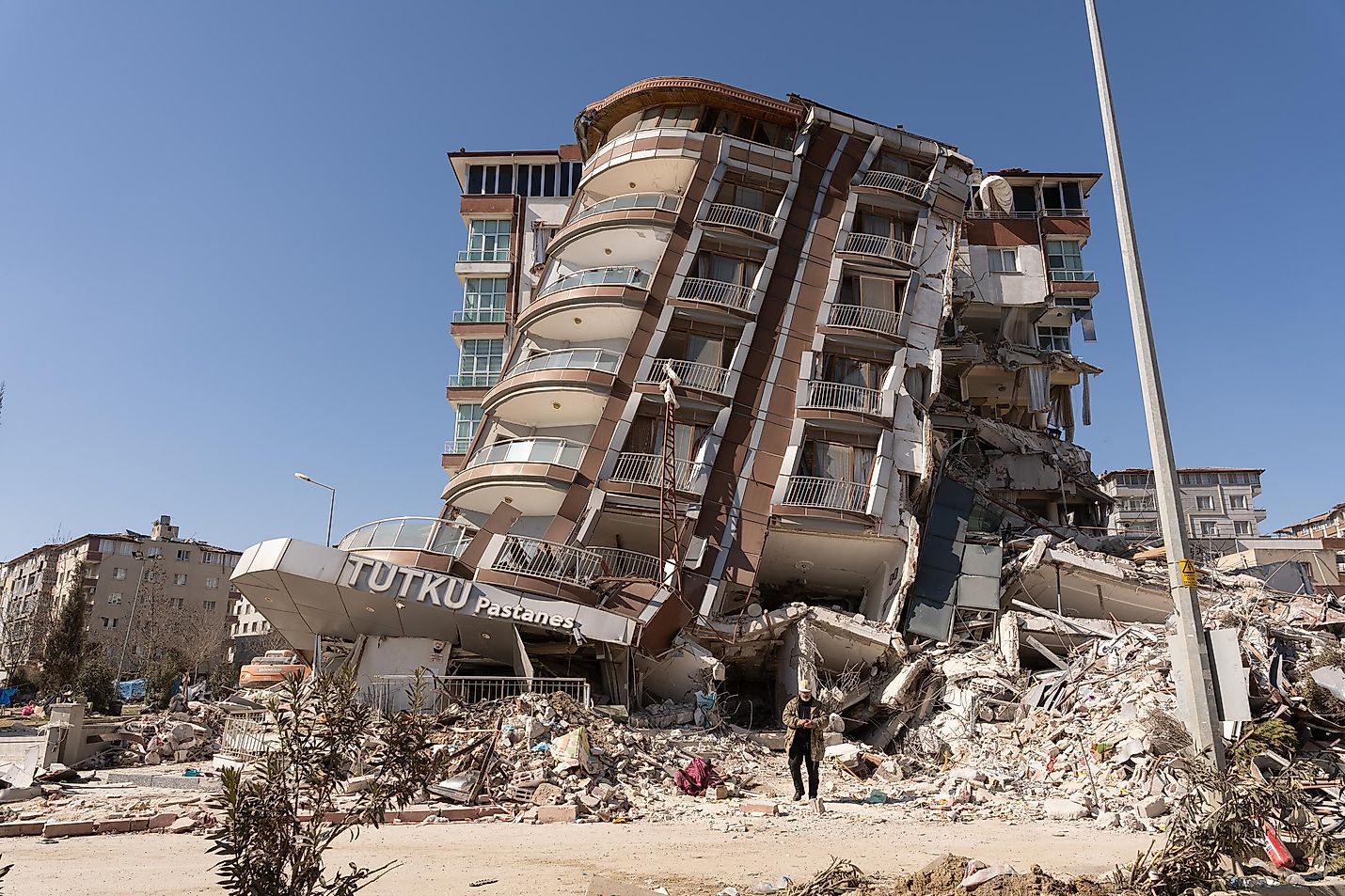
An earthquake, also called a quake, tremor, or temblor, is the shaking of the Earth's surface resulting from a sudden release of energy in the lithosphere that creates seismic waves. Earthquakes can range in intensity, from those so weak they cannot be felt, to those violent enough to propel objects and people into the air, damage critical infrastructure, and wreak destruction across entire cities. The seismic activity of an area is the frequency, type, and size of earthquakes experienced over a particular time. The seismicity at a particular location in the Earth is the average rate of seismic energy release per unit volume.
In its most general sense, the word earthquake is used to describe any seismic event that generates seismic waves. Earthquakes can occur naturally or be induced by human activities, such as mining, fracking, and nuclear weapons testing. The initial point of rupture is called the hypocenter or focus, while the ground level directly above it is the epicenter. Earthquakes are primarily caused by geological faults, but also by volcanism, landslides, and other seismic events.
Significant historical earthquakes include the 1976 Tangshan earthquake in China, with over 300,000 fatalities, and the 1960 Valdivia earthquake in Chile, the largest ever recorded at 9.5 magnitude. Earthquakes result in various effects, such as ground shaking and soil liquefaction, leading to significant damage and loss of life. When the epicenter of a large earthquake is located offshore, the seabed may be displaced sufficiently to cause a tsunami. Earthquakes can trigger landslides. Earthquakes' occurrence is influenced by tectonic movements along faults, including normal, reverse (thrust), and strike-slip faults, with energy release and rupture dynamics governed by the elastic-rebound theory.
Efforts to manage earthquake risks involve prediction, forecasting, and preparedness, including seismic retrofitting and earthquake engineering to design structures that withstand shaking. The cultural impact of earthquakes spans myths, religious beliefs, and modern media, reflecting their profound influence on human societies. Similar seismic phenomena, known as marsquakes and moonquakes, have been observed on other celestial bodies, indicating the universality of such events beyond Earth.
Additional Information:
What is an Earthquake?
An earthquake is an intense shaking of Earth’s surface. The shaking is caused by movements in Earth’s outermost layer.
Why Do Earthquakes Happen?
Although the Earth looks like a pretty solid place from the surface, it’s actually extremely active just below the surface. The Earth is made of four basic layers: a solid crust, a hot, nearly solid mantle, a liquid outer core and a solid inner core.
The solid crust and top, stiff layer of the mantle make up a region called the lithosphere. The lithosphere isn’t a continuous piece that wraps around the whole Earth like an eggshell. It’s actually made up of giant puzzle pieces called tectonic plates. Tectonic plates are constantly shifting as they drift around on the viscous, or slowly flowing, mantle layer below.
This non-stop movement causes stress on Earth’s crust. When the stresses get too large, it leads to cracks called faults. When tectonic plates move, it also causes movements at the faults. An earthquake is the sudden movement of Earth’s crust at a fault line.
The location where an earthquake begins is called the epicenter. An earthquake’s most intense shaking is often felt near the epicenter. However, the vibrations from an earthquake can still be felt and detected hundreds, or even thousands of miles away from the epicenter.
How Do We Measure Earthquakes?
The energy from an earthquake travels through Earth in vibrations called seismic waves. Scientists can measure these seismic waves on instruments called seismometer. A seismometer detects seismic waves below the instrument and records them as a series of zig-zags.
Scientists can determine the time, location and intensity of an earthquake from the information recorded by a seismometer. This record also provides information about the rocks the seismic waves traveled through.
Do Earthquakes Only Happen on Earth?
Earthquake is a name for seismic activity on Earth, but Earth isn’t the only place with seismic activity. Scientists have measured quakes on Earth's Moon, and see evidence for seismic activity on Mars, Venus and several moons of Jupiter, too!
NASA’s InSight mission took a seismometer to Mars to study seismic activity there, known as marsquakes. On Earth, we know that different materials vibrate in different ways. By studying the vibrations from marsquakes, scientists hope to figure out what materials are found on the inside of Mars.
InSight is collecting tons of information about what Mars is like under the surface. These new discoveries will help us understand more about how planets like Mars—and our home, Earth—came to be.
It appears to me that if one wants to make progress in mathematics, one should study the masters and not the pupils. - Niels Henrik Abel.
Nothing is better than reading and gaining more and more knowledge - Stephen William Hawking.
Offline
Pages: 1