Math Is Fun Forum
You are not logged in.
- Topics: Active | Unanswered
- Index
- » This is Cool
- » Swift
Pages: 1
#1 2026-02-19 17:50:08
- Jai Ganesh
- Administrator

- Registered: 2005-06-28
- Posts: 53,853
Swift
Swift
Gist
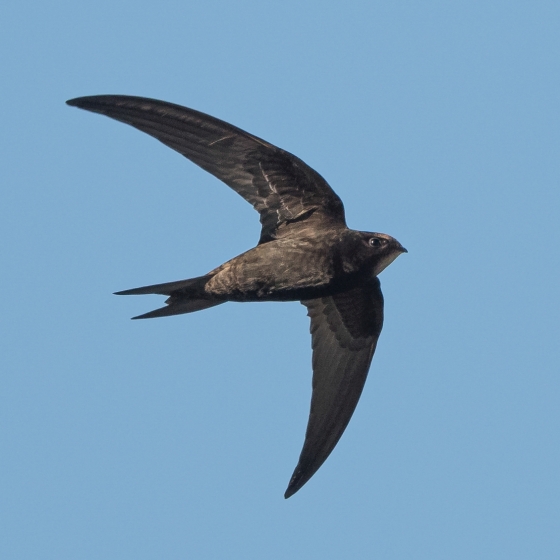
Swifts are masters of the air and spend almost their entire lives in flight – eating, drinking, sleeping and even mating on the wing. They usually only land when it's time to nest, so you'll never see them perched on overhead wires like Swallows. Groups of Swifts can often be seen flying around rooftops at high speed.
What is the lifespan of a swift?
There are around 113 Swift species worldwide, eight of which may appear in the UK. But our familiar summer visitors are the Common Swift, Apus apus. The average lifespan of a Swift is nine years, reaching breeding maturity at around four years old. Estimates of the oldest recorded Swift range from 18 – 21 years old.
Summary
According to Britannica, swifts are small, fast-flying aerial birds (family Apodidae, ~75 species) known for long, curved wings, dull plumage, and weak feet suited only for clinging, not perching. They are considered the fastest small birds, capable of reaching speeds of 70 mph (110 kph), and primarily nest in chimneys, caves, or tree hollows using saliva.
Swift is any of about 75 species of agile, fast-flying birds of the family Apodidae (sometimes Micropodidae), in the order Apodiformes, which also includes the hummingbirds. The family is divided into the subfamilies Apodinae, or soft-tailed swifts, and Chaeturinae, or spine-tailed swifts. Almost worldwide in distribution, swifts are absent only from polar regions, southern Chile and Argentina, New Zealand, and most of Australia.
Closely resembling swallows, swifts range in length from about 9 to 23 cm (3.5 to 9 inches). They have exceptionally long wings and chunky, powerful bodies. Their compact plumage is a dull or glossy gray, brown, or black, sometimes with pale or white markings on the throat, neck, belly, or rump. The head is broad, with a short, wide, slightly curved bill. The tail, although often short, may be long and deeply forked. The feet are tiny and weak; with the aid of sharp claws they are used only to cling to vertical surfaces. A swift that lands on flat ground may be unable to regain the air. In soft-tailed forms, the hind toe is rotated forward as an aid in gripping vertical surfaces; in spine-tailed swifts, support is gained from the short needle-tipped tail feathers, and the feet are less modified.
In feeding, swifts course tirelessly back and forth, capturing insects with their large mouths open. They also drink, bathe, and sometimes mate on the wing. They fly with relatively stiff, slow wingbeats (four to eight per second), but the scimitar-like design of the wing makes it the most efficient among birds for high-speed flight. The fastest of small birds, swifts are believed to reach 110 km (70 miles) per hour regularly; reports of speeds three times that figure are not confirmed. The only avian predators known to take swifts with regularity are some of the larger falcons.
The nest of a swift is made of twigs, buds, moss, or feathers and is glued with its sticky saliva to the wall of a cave or the inside of a chimney, rock crack, or hollow tree. A few species attach the nest to a palm frond, an extreme example being the tropical Asian palm swift (Cypsiurus parvus), which glues its eggs to a tiny, flat feather nest on the surface of a palm leaf, which may be hanging vertically or even upside down. Swifts lay from one to six white eggs (usually two or three). Both eggs and young may be allowed to cool toward the environmental temperature in times of food scarcity, slowing development and conserving resources. The young stay in the nest or cling near it for 6 to 10 weeks, the length of time depending largely on the food supply. Upon fledging, they resemble the adults and immediately fly adeptly.
Among the best-known swifts is the chimney swift (Chaetura pelagica), a spine-tailed, uniformly dark gray bird that breeds in eastern North America and winters in South America, nesting in such recesses as chimneys and hollow trees; about 17 other Chaetura species are known worldwide. The common swift (Apus apus), called simply “swift” in Great Britain, is a soft-tailed, black bird that breeds across Eurasia and winters in southern Africa, nesting in buildings and hollow trees; nine other Apus swifts are found throughout temperate regions of the Old World, and some Apus species inhabit South America. The white-collared swift (Streptoprocne zonaris), soft-tailed and brownish black with a narrow white collar, is found from Mexico to Argentina and on larger Caribbean islands, nesting in caves and behind waterfalls. The white-rumped swift (Apus caffer), soft-tailed and black with white markings, is resident throughout Africa south of the Sahara. The white-throated swift (Aeronautes saxatalis), soft-tailed and black with white markings, breeds in western North America and winters in southern Central America, nesting on vertical rock cliffs.
Details
The Apodidae, or swifts, form a family of highly aerial birds. They are superficially similar to swallows, but are not closely related to any passerine species. Swifts are placed in the order Apodiformes along with hummingbirds. The treeswifts are closely related to the true swifts, but form a separate family, the Hemiprocnidae.
Resemblances between swifts and swallows are due to convergent evolution, reflecting similar life styles based on catching insects in flight.
The family name, Apodidae, is derived from the Greek (ápous), meaning "footless", a reference to the small, weak legs of these most aerial of birds. The tradition of depicting swifts without feet continued into the Middle Ages, as seen in the heraldic martlet.
Taxonomy
Taxonomists have long classified swifts and treeswifts as relatives of the hummingbirds, a judgment corroborated by the discovery of the Jungornithidae (apparently swift-like hummingbird-relatives) and of primitive hummingbirds such as Eurotrochilus. Traditional taxonomies place the hummingbird family (Trochilidae) in the same order as the swifts and treeswifts (and no other birds); the Sibley-Ahlquist taxonomy treated this group as a superorder in which the swift order was called Trochiliformes.
The taxonomy of the swifts is complicated, with genus and species boundaries widely disputed, especially amongst the swiftlets. Analysis of behavior and vocalizations is complicated by common parallel evolution, while analyses of different morphological traits and of various DNA sequences have yielded equivocal and partly contradictory results.
The Apodiformes diversified during the Eocene, at the end of which the extant families were present; fossil genera are known from all over temperate Europe, between today's Denmark and France, such as the primitive swift-like Scaniacypselus[5] (Early–Middle Eocene) and the more modern Procypseloides (Late Eocene/Early Oligocene – Early Miocene). A prehistoric genus sometimes assigned to the swifts, Primapus (Early Eocene of England), might also be a more distant ancestor.
Description
Swifts are among the fastest of birds in level flight, and larger species like the white-throated needletail have been reported travelling at up to 169 km/h (105 mph). Even the common swift can cruise at a maximum speed of 31 metres per second (112 km/h; 70 mph). In a single year the common swift can cover at least 200,000 km, and in a lifetime, about two million kilometers.
The wingtip bones of swiftlets are of proportionately greater length than those of most other birds. Changing the angle between the bones of the wingtips and forelimbs allows swifts to alter the shape and area of their wings to increase their efficiency and maneuverability at various speeds. They share with their relatives the hummingbirds a special ability to rotate their wings from the base, allowing the wing to remain rigid and fully extended and derive power on both the upstroke and downstroke. The downstroke produces both lift and thrust, while the upstroke produces a negative thrust (drag) that is 60% of the thrust generated during the downstrokes, but simultaneously it contributes lift that is also 60% of what is produced during the downstroke. This flight arrangement might benefit the bird's control and maneuverability in the air.
The swiftlets or cave swiftlets have developed a form of echolocation for navigating through dark cave systems where they roost. One species, the three-toed swiftlet, has recently been found to use this navigation at night outside its cave roost too.
Distribution and habitat
Swifts occur on all the continents except Antarctica, but not in the far north, in large deserts, or on many oceanic islands. The swifts of temperate regions are strongly migratory and winter in the tropics. Some species can survive short periods of cold weather by entering torpor, a state similar to hibernation.
Many have a characteristic shape, with a short forked tail and very long swept-back wings that resemble a crescent or a boomerang. The flight of some species is characterised by a distinctive "flicking" action quite different from swallows. Swifts range in size from the pygmy swiftlet (Collocalia troglodytes), which weighs 5.4 g and measures 9 cm (3.5 in) long, to the purple needletail (Hirundapus celebensis), which weighs 184 g (6.5 oz) and measures 25 cm (9.8 in) long.
Exploitation by humans
The hardened saliva nests of the edible-nest swiftlet and the black-nest swiftlet have been used in Chinese cooking for over 400 years, most often as bird's nest soup. Over-harvesting of this expensive delicacy has led to a decline in the numbers of these swiftlets, especially as the nests are also thought to have health benefits and aphrodisiac properties. Most nests are built during the breeding season by the male swiftlet over a period of 35 days. They take the shape of a shallow cup stuck to the cave wall. The nests are composed of interwoven strands of salivary cement and contain high levels of calcium, iron, potassium, and magnesium.
Additional Information
Swift is the long-distance migrant most associated with people, as it chooses to nest amongst our urban dwellings.
We await the return of Swifts to Britain and Ireland in early May and they are given the accolade of bringing the summer with them. Written about in poetry and prose, the dark scythe-winged silhouettes of Swifts wheeling about in a blue sky are often accompanied by their screaming calls.
Although widespread across much of Britain & Ireland, Breeding Bird Survey data have documented a significant decline in their populations. The reasons for these losses are likely to include poor summer weather, a decline in their insect food and continued loss of suitable nesting sites.
It appears to me that if one wants to make progress in mathematics, one should study the masters and not the pupils. - Niels Henrik Abel.
Nothing is better than reading and gaining more and more knowledge - Stephen William Hawking.
Offline
Pages: 1
- Index
- » This is Cool
- » Swift