Math Is Fun Forum
You are not logged in.
- Topics: Active | Unanswered
- Index
- » This is Cool
- » Octopus
Pages: 1
#1 2025-12-06 18:34:40
- Jai Ganesh
- Administrator

- Registered: 2005-06-28
- Posts: 53,931
Octopus
Octopus
Gist
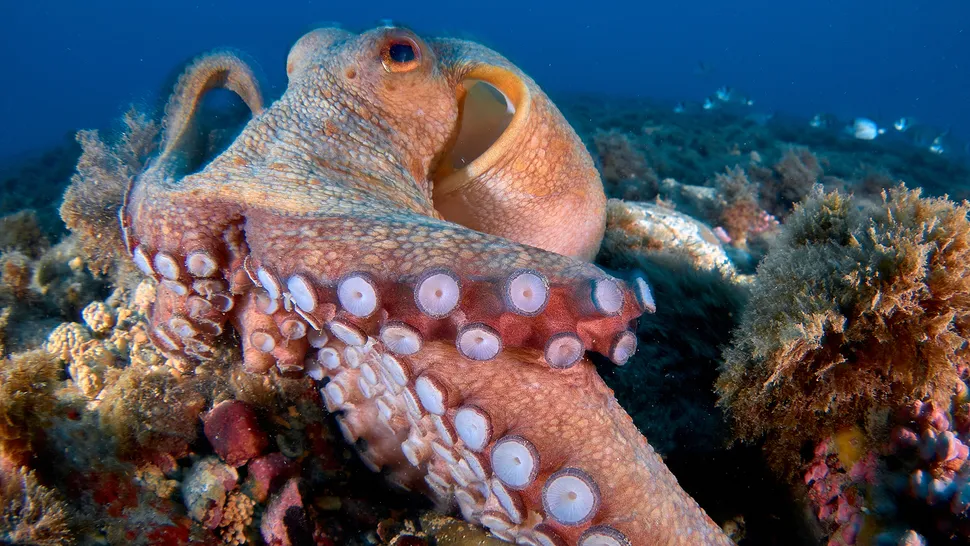
An octopus is a highly intelligent, soft-bodied marine mollusk with eight arms, known for its incredible camouflage, problem-solving skills, and unique physiology (three hearts, blue copper-based blood). Belonging to the order Octopoda, they use suction cups on their arms for movement and sensing, possess complex eyes, and can squeeze through tiny spaces due to their boneless bodies, thriving in diverse ocean environments as carnivores.
Summary
Octopuses are sea animals famous for their rounded bodies, bulging eyes, and eight long arms. They live in all the world’s oceans but are especially abundant in warm, tropical waters. Octopuses, like their cousin, the squid, are often considered “monsters of the deep,” though some species, or types, occupy relatively shallow waters.
Most octopuses stay along the ocean’s floor, although some species are pelagic, which means they live near the water’s surface. Other octopus species live in deep, dark waters, rising from below at dawn and dusk to search for food. Crabs, shrimps, and lobsters rank among their favorite foods, though some can attack larger prey, like sharks. Octopuses typically drop down on their prey from above and, using powerful suctions that line their arms, pull the animal into their mouth. The octopus performs its famous backward swim by blasting water through a muscular tube on the body called a siphon. Octopuses also crawl along the ocean’s floor, tucking their arms into small openings to search for food. Seals, whales, and large fish prey on octopuses.
If threatened, octopuses shoot an inky fluid that darkens the water, confusing the aggressor. The octopus can also change to gray, brown, pink, blue, or green to blend in with its surroundings. Octopuses may also change color as a way to communicate with other octopuses. Octopuses are solitary creatures that live alone in dens built from rocks, which the octopus moves into place using its powerful arms. Octopuses sometimes even fashion a rock “door” for their den that pulls closed when the octopus is safely inside.
Details
An octopus (pl.: octopuses or octopodes) is a soft-bodied, eight-limbed mollusc of the order Octopoda. The order consists of some 300 species and is grouped within the class Cephalopoda with squids, cuttlefish, and nautiloids. Like other cephalopods, an octopus is bilaterally symmetric with two eyes and a beaked mouth at the centre point of the eight limbs. An octopus can radically deform its shape, enabling it to squeeze through small gaps. They trail their appendages behind them as they swim. The siphon is used for respiration and locomotion (by water jet propulsion). Octopuses have a complex nervous system and excellent sight, and are among the most intelligent and behaviourally diverse invertebrates.
Octopuses inhabit various ocean habitats, including coral reefs, pelagic waters, and the seabed; some live in the intertidal zone and others at abyssal depths. Most species grow quickly, mature early, and are short-lived. In most species, the male uses a specially-adapted arm to deliver sperm directly into the female's mantle cavity, after which he becomes senescent and dies, while the female deposits fertilised eggs in a den and cares for them until they hatch, after which she also dies. They are predators and hunt crustaceans, bivalves, gastropods and fish. Strategies to defend themselves against their own predators include expelling ink, camouflage, and threat displays, the ability to jet quickly through the water and hide, and deceit. All octopuses are venomous, but only the blue-ringed octopuses are known to be deadly to humans.
Octopuses appear in mythology as sea monsters such as the kraken of Norway and the Akkorokamui of the Ainu, and possibly the Gorgon of ancient Greece. A battle with an octopus appears in Victor Hugo's book Toilers of the Sea. Octopuses appear in Japanese shunga erotic art. They are eaten and considered a delicacy by humans in many parts of the world, especially the Mediterranean and Asia.
The giant Pacific octopus (Enteroctopus dofleini) is often cited as the largest octopus species. Adults usually weigh 10–50 kg (22–110 lb), with an arm span of up to 4.8 m (16 ft). The largest specimen of this species to be scientifically documented reached a live mass of 71 kg (157 lb). Much larger sizes have been claimed: one specimen was recorded as 272 kg (600 lb) with an arm span of 9 m (30 ft). A carcass of the seven-arm octopus, Haliphron atlanticus, weighed 61 kg (134 lb) and was estimated to have had a live mass of 75 kg (165 lb). The smallest species is Octopus wolfi, which is around 2.5 cm (1 in) and weighs less than 1 g (0.035 oz).
Additional Information
An octopus, in general, is any eight-armed cephalopod (octopod) mollusk of the order Octopoda. The true octopuses are members of the genus Octopus, a large group of widely distributed shallow-water cephalopods.
Description
Octopuses vary greatly in size: the smallest (O. arborescens) is about 5 cm (2 inches) long, while the largest species, the reddish pink giant Pacific octopus (Enteroctopus dofleini), may grow to 5.4 metres (18 feet) in length and have an arm span of almost 9 metres (30 feet). The typical octopus has a saccular body: the head is only slightly demarcated from the body and has large complex eyes and eight contractile arms. Each arm bears two rows of fleshy suckers that are capable of great holding power. The arms are joined at their bases by a web of tissue known as the skirt, at the centre of which lies the mouth. The latter organ has a pair of sharp horny beaks and a filelike organ, the radula, for drilling shells and rasping away flesh.
The octopus takes water into its mantle and expels the water after respiration through a short funnel or siphon. Most octopuses move by crawling along the bottom with their arms and suckers, though when alarmed they may shoot swiftly backward by ejecting a jet of water from the siphon. When endangered, they eject an inky substance—a type of melanin-based ink (produced by a gland in the hindgut) mixed with mucus (produced by the octopus’s funnel gland)—through a duct near the math. The ink is used as a screen that helps to cover the octopus’s escape; the substance produced by some species paralyzes the sensory organs of the attacker.
Examples of species and behaviours
The best-known octopus is the common octopus, O. vulgaris, a medium-sized animal that is widely distributed in tropical and temperate seas throughout the world. It lives in holes or crevices along the rocky bottom and is secretive and retiring by nature. It feeds mainly on crabs and other crustaceans. This species is thought to be the most intelligent of all invertebrate animals. O. vulgaris has highly developed pigment-bearing cells and can change its skin colours to an astonishing degree with great rapidity. (The giant Pacific octopus can reportedly change color in one-tenth of a second, quickly blending in with rocky and coral surroundings.) Each pigment-bearing cell (chromatophore) is individually innervated from the brain.
The veined octopus (Amphioctopus marginatus) is also known for its intelligence. In 2009 biologists reported having observed the animals excavating coconut half shells from the ocean floor and carrying them for use as portable shelters. Such behaviour is regarded by biologists as the first documented example of tool use by an invertebrate.
Several species of octopuses appear to rely heavily on certain pairs of arms. In 2025 scientists examined the behaviors of octopuses in the Caribbean Sea and near Spain. They reported that while each octopus they observed could raise, lower, extend, curl, and tuck each of its arms, anterior pairs of arms were used more often than posterior pairs to perform complex activities—such as moving and grasping objects, searching the substrate, walking along the bottom, standing, and attacking prey.
Reproduction
Octopuses have separate sexes, and the male has a specially modified arm, called a hectocotylus, by means of which it inserts spermatophores, or packets of sperm, directly into the female’s mantle cavity. O. vulgaris mates during the winter, and the eggs, about 0.3 cm (1/8 inch) long, are laid under rocks or in holes, the total number of eggs amounting to more than 100,000. During the four to eight weeks required for the larvae to hatch, the female guards the eggs, cleaning them with her suckers and agitating them with water. Upon hatching, the tiny octopods, which closely resemble their parents, spend several weeks drifting in the plankton before taking refuge on the bottom.
Diet and predators
Octopuses feed mainly upon crabs and lobsters, although some are plankton feeders.
Octopuses are fed upon by a number of marine fishes, and they have long been considered a culinary delicacy by humans.
It appears to me that if one wants to make progress in mathematics, one should study the masters and not the pupils. - Niels Henrik Abel.
Nothing is better than reading and gaining more and more knowledge - Stephen William Hawking.
Offline
Pages: 1
- Index
- » This is Cool
- » Octopus