Math Is Fun Forum
You are not logged in.
- Topics: Active | Unanswered
- Index
- » Science HQ
- » Myopia
Pages: 1
#1 2026-02-15 15:54:32
- Jai Ganesh
- Administrator

- Registered: 2005-06-28
- Posts: 53,931
Myopia
Myopia
Gist
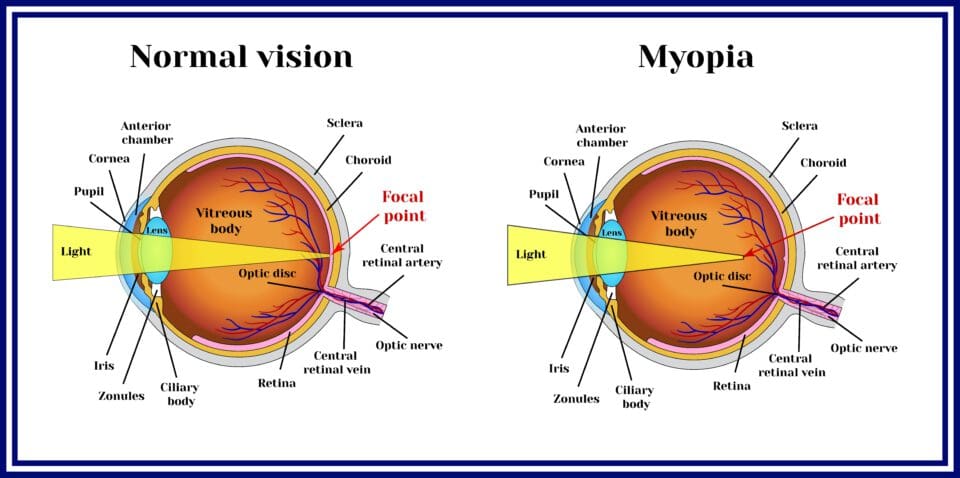
Myopia, or nearsightedness, is a common, often progressive refractive error where the eyeball grows too long or the cornea is too curved, causing light to focus in front of the retina rather than on it. It results in blurred distant vision, with symptoms like eye strain, headaches, and squinting. Affecting roughly 30% of the global population, it is commonly treated with glasses, contacts, or refractive surgery (e.g., LASIK).
Myopia, or nearsightedness, is a common vision condition where distant objects appear blurry because the eye focuses light in front of the retina instead of directly on it, often due to an elongated eyeball or a cornea that is too curved. It allows clear vision for close-up tasks but makes seeing far away difficult, leading to squinting, eye strain, and headaches. It's typically managed with glasses, contacts, or surgery, and its development is linked to genetics and increased near work like screen time.
Summary
Myopia, also known as near-sightedness and short-sightedness, is an eye condition where light from distant objects focuses in front of, instead of on, the retina. As a result, distant objects appear blurry, while close objects appear normal. Other symptoms may include headaches and eye strain. Severe myopia is associated with an increased risk of macular degeneration, retinal detachment, cataracts, and glaucoma.
Myopia results from the length of the eyeball growing too long or less commonly the lens being too strong. It is a type of refractive error. Diagnosis is by the use of cycloplegics during eye examination.
Myopia is less common in people who spent more time outside during childhood. This lower risk may be due to greater exposure to sunlight. Myopia can be corrected with eyeglasses, contact lenses, or by refractive surgery. Eyeglasses are the simplest and safest method of correction. Contact lenses can provide a relatively wider corrected field of vision, but are associated with an increased risk of infection. Refractive surgeries such as LASIK and PRK permanently change the shape of the cornea. Other procedures include implantable collamer lens (ICL) placement inside the anterior chamber in front of the natural eye lens. ICL does not affect the cornea.
Myopia is the most common eye disorder and is estimated to affect 1.5 billion people (22% of the world population). Rates vary significantly in different areas of the world. Rates among adults are between 15% and 49%. Among children, it affects 1% of rural Nepalese, 4% of South Africans, 12% of people in the US, and 37% in some large Chinese cities. In China the proportion of girls is slightly higher than boys. Rates have increased since the 1950s. Uncorrected myopia is one of the most common causes of vision impairment globally along with cataracts, macular degeneration, and vitamin A deficiency.
Details
Myopia (nearsightedness) is a common condition that’s usually diagnosed before age 20. It affects your distance vision — you can see objects that are near, but you have trouble viewing objects that are farther away like grocery store aisle markers or road signs. Myopia treatments include glasses, contact lenses or surgery.
Overview:
What is myopia?
Myopia is the medical name for nearsightedness, which means that you can see objects that are near clearly but have difficulty seeing objects that are farther away. For example, if you have nearsightedness, you may not be able to make out highway signs until they’re just a few feet away.
Myopia affects a significant percentage of people. It’s an eye focus disorder that’s normally corrected with eyeglasses, contact lenses or surgery.
How common is myopia?
Myopia is common. According to one estimate, more than 40% of people in the U.S. have nearsightedness. This number is rapidly rising, especially among school-aged children. Eye experts expect this trend to continue in the coming decades.
One in four parents has a child with some degree of nearsightedness. Some eye experts believe that if your child spends a great deal of time engaged in “near” activities, such as reading or using smartphones and computers, it may raise their risk of developing myopia.
Are there types of myopia?
Eye specialists divide myopia broadly into simple myopia and pathologic myopia. Pathologic myopia is a newer name for degenerative myopia.
People with simple myopia have contact lenses or eyeglasses that help provide clear vision, while those with pathologic myopia may not be able to have clear vision even with corrective lenses.
Symptoms and Causes:
What are the symptoms of myopia?
If you have nearsightedness, you may notice:
* Faraway objects look blurred or fuzzy.
* Close items appear clear.
* Headaches.
* Eye strain.
* Squinting.
* Tiredness when driving, playing sports or looking more than a few feet away.
Some additional symptoms of myopia to watch for in your children include:
* Poor performance in school.
* Shortened attention span.
* Holding objects close to their face.
Most cases of myopia are mild and easily managed with eyeglasses, contact lenses or refractive surgery.
What causes myopia?
If you have myopia, more than likely, at least one or both of your biological parents do, too. Eye experts are still unsure of the exact cause of myopia, but believe it to be a mix of hereditary and environmental factors.
It’s possible that you can inherit the ability to be myopic. If your lifestyle produces just the right conditions, you’ll develop it. For example, if you use your eyes for a lot of close-up work, like reading or working on a computer, you may develop myopia.
Myopia usually appears in childhood. Typically, the condition can worsen in early childhood but tends to level off by the end of teen years.
Because the light coming into your eyes doesn’t focus correctly, images are unclear. Think of it as being a little like a misdirected spotlight. If you shine a spotlight on the incorrect place in the distance, you won’t be able to see the correct object clearly.
What are the risk factors for myopia?
Risk factors for nearsightedness may include:
* A family history of myopia.
* Spending a lot of time doing “close-up” work, like reading or using screens like those on smartphones or computers.
* Not spending a lot of time outdoors. Certain studies indicate that this may be a factor in developing myopia.
* Ethnicity. Some groups of people have higher rates of myopia than others.
What are the complications of myopia?
In most cases, providers can treat nearsightedness with glasses, contact lenses or corrective surgery, like LASIK. However, some cases of pathologic myopia can lead to more serious eye conditions, including:
* Cataracts.
* Glaucoma.
* Optic neuropathy.
* Neovascularization.
* Retinal detachment.
Pathologic myopia may make you more vulnerable to other more serious eye conditions. These include:
* Developing unwanted blood vessels in your eye (neovascularization).
* Glaucoma.
* Myopic optic neuropathy.
* Retinal detachment.
* Cataracts.
* High myopia happens when your child’s eyeballs are too long, or their corneas are too steep.
Diagnosis and Tests:
How is myopia diagnosed?
An eye care provider can diagnose myopia using standard eye exams. Providers usually diagnose myopia in childhood, but it can also develop in adults because of visual stress or diabetes.
Testing an adult for myopia
Your provider will evaluate how your eyes focus light and measure the power of any corrective lenses you may need. First, they’ll test your visual acuity (sharpness) by asking you to read letters on an eye chart. Then, they’ll use a lighted retinoscope to measure how your retina reflects light.
Your provider may also use a phoropter. A phoropter is an instrument that measures the amount of your refractive error by placing a series of lenses in front of your eyes. This is how your provider measures the lens strength you need.
Testing your child for myopia
Your pediatrician will check your child’s eyes at each well-child visit. A first eye exam should be before age 1, if possible. If your child has no evident eye problems, then schedule a repeat eye exam before kindergarten.
As myopia runs in families, if your child has family members with vision issues, it’s even more important to test their eyes early. If you or your pediatrician notice any vision issues, your child may be referred to an optometrist or pediatric ophthalmologist.
During a children’s eye exam, your eye care provider will do a physical examination of your child’s eyes and check for a regular light reflex. For children between the ages of 3 and 5 years, your provider will also conduct vision screenings using eye chart tests, pictures, letters or the “tumbling E game,” also called the “Random E’s Visual Acuity Test.”
As your child’s vision continues to change as they grow, continue to make sure they get vision screenings by their pediatrician or eye care provider before first grade and every two years thereafter. While most schools conduct eye screenings, they’re usually not complete enough to diagnose myopia. Providers diagnose most children when they’re between the ages of 3 and 12.
Your provider may mention categories — mild, moderate or high myopia. These terms refer to the degree of nearsightedness as measured by refractive error. Refractive errors are issues with the natural shape of your eyes that make your vision blurry. It’s possible to have myopia and another refractive error, like astigmatism.
Management and Treatment:
How is myopia treated?
Glasses or contact lenses can correct myopia in children and adults. For adults only (with rare exceptions for children), there are several types of refractive surgeries that can also correct myopia.
With myopia, your prescription for glasses or contact lenses is a negative number, such as -3.00. The higher the number, the stronger your lenses will be. The prescription helps your eye focus light on your retina, clearing up your distance vision.
* Eyeglasses: The most popular way for most people to correct myopia is with eyeglasses. Depending on the degree of vision correction needed, you’ll wear eyeglasses either daily or only when you need distance vision. You may only need glasses for driving. Some kids with myopia may only need glasses to play ball, watch a movie or view the chalkboard. Some people may need to wear glasses constantly to see clearly. A single-vision lens will make distance vision clearer. But people over 40 who have myopia may require a bifocal or progressive lens to see clearly both near and far.
* Contact lenses: Some people find that their distance vision is sharper and wider with contact lenses. A potential downside is they require more care to keep clean. Ask your provider which type might be right for your myopia level and other refractive errors.
* Ortho-k or CRT: Some people with mild myopia may be candidates for temporary corneal refractive contact lenses that you wear to bed to reshape your cornea temporarily, long enough to see for your daily activities.
* LASIK is a laser-assisted in situ keratomileus procedure, the most common surgery to correct nearsightedness. In a LASIK procedure, your ophthalmologist uses a laser to cut a flap through the top of your cornea, reshape the inner corneal tissue and then drop the flap back into place.
* LASEK is a laser-assisted subepithelial keratectomy procedure. In a LASEK procedure, your ophthalmologist uses a laser to cut a flap through only the top layer (epithelium) of your cornea, reshape the outer layers, and then close the flap.
* PRK is short for “photorefractive keratectomy,” which is a type of laser eye surgery used to correct mild or moderate nearsightedness. It may also correct farsightedness and/or astigmatism. In a PRK procedure, your ophthalmologist cuts off the front surface of your cornea and uses a laser to reshape the surface, which flattens it and allows light rays to focus on your retina. Unlike LASIK, the ophthalmologist doesn’t cut a flap, and your cornea will regrow its top layer in one to two weeks. PRK is better for people with corneas that are thinner or have a rough surface because it disrupts less corneal tissue than a comparable LASIK surgery.
* Phakic intraocular lenses: These are an option for people who have high myopia or whose corneas are too thin for PRK or LASIK. Your provider places phakic intraocular lenses inside of your eye just in front of your natural lens.
* Intraocular lens implant: This allows your ophthalmologist to surgically insert a new lens in your eye, replacing your natural one. This procedure happens before a cataract develops.
* Vision therapy: This is an option if spasms of your focusing muscles cause myopia. You can strengthen the muscles through eye exercises and improve your focus. This treatment isn’t appropriate for everyone with myopia. After an eye exam, your ophthalmologist will let you know if it’s an option for you.
Outlook / Prognosis:
What can I expect if I have myopia?
Myopia is a condition that doesn’t go away. Treatments include using glasses or contact lenses. You may be able to get surgery to correct your vision.
What is the outlook for myopia?
The outlook for being nearsighted may differ depending on the type of myopia.
Usually, providers can treat simple myopia easily. In rare cases of high myopia or pathologic myopia, your outlook may be different.
High myopia usually stops getting worse between the ages of 20 and 30. You’ll still be able to get glasses or contact lenses or you may be able to have surgery.
High myopia may lead to pathologic myopia and the possibility of more serious sight conditions later in life. These complications can lead to loss of sight.
Regular eye exams are important for everyone but are especially if you have high myopia or pathologic myopia. You should follow the schedule set out by your eye care provider.
Prevention:
Can myopia be prevented?
You can’t prevent myopia as it’s a condition that tends to run in families, but you may be able to lower your risk of nearsightedness in some ways.
How can I lower my risk of developing myopia?
Some eye experts believe that you may be able to decrease your or your child’s risk of developing myopia by getting enough time outside and limiting the amount of time spent in front of screens. You may also want to be mindful of the amount of time doing close work like reading or sewing.
Additional Information
Myopia occurs if the eyeball is too long or the cornea (the clear front cover of the eye) is too curved. As a result, the light entering the eye isn't focused correctly, and distant objects look blurred. Myopia affects nearly 30% of the U.S. population. While the exact cause of myopia is unknown, there is significant evidence that many people inherit myopia, or at least the tendency to develop myopia. If one or both parents are nearsighted, there is an increased chance their children will be nearsighted. Even though the tendency to develop myopia may be inherited, its actual development may be affected by how a person uses his or her eyes. Individuals who spend considerable time reading, working at a computer, playing video games or doing other intense close visual work may be more likely to develop myopia. In fact, high levels of screen time on smart devices (i.e. looking at a smart phone) is associated with around a 30% higher risk of myopia and, when combined with excessive computer use, that risk rose to around 80%.
Causes & risk factors
Myopia may also occur due to environmental factors or other health problems:
* Some people may experience blurred distance vision only at night. With "night myopia," low light makes it difficult for the eyes to focus properly. Or the increased pupil size during dark conditions allows more peripheral, unfocused light rays to enter the eye.
* People who do an excessive amount of near-vision work may experience a false or "pseudo" myopia. Their blurred distance vision is caused by overuse of the eyes' focusing mechanism. After long periods of near work, their eyes are unable to refocus to see clearly in the distance. Clear distance vision usually returns after resting the eyes. However, constant visual stress may lead to a permanent reduction in distance vision over time.
* Symptoms of myopia may also be a sign of variations in blood sugar levels in people with diabetes or maybe an early indication of a developing cataract.
Symptoms
People with myopia can have difficulty clearly seeing a movie or TV screen, a whiteboard in school or while driving. Generally, myopia first occurs in school-age children. Because the eye continues to grow during childhood, it typically progresses until about age 20. However, myopia may also develop in adults due to visual stress or health conditions such as diabetes.
Diagnosis
Testing for myopia may use several procedures to measure how the eyes focus light and to determine the power of any optical lenses needed to correct the reduced vision. As part of the testing, you will identify letters on a distance chart. This test measures visual acuity, which is written as a fraction, such as 20/40. The top number of the fraction is the standard distance at which testing is performed (20 feet). The bottom number is the smallest letter size read. A person with 20/40 visual acuity would have to get within 20 feet to identify a letter that could be seen clearly at 40 feet in a "normal" eye. Normal distance visual acuity is 20/20, although many people have 20/15 (better) vision.
Using an instrument called a phoropter, a doctor of optometry places a series of lenses in front of your eyes and measures how they focus light using a handheld lighted instrument called a retinoscope. Or the doctor may choose to use an automated instrument that evaluates the focusing power of the eye. The power is then refined based on your responses to determine the lenses that allow the clearest vision. Your doctor can conduct this testing without using eye drops to determine how the eyes respond under normal seeing conditions.
In some cases, such as for patients who can't respond verbally or when some of the eye's focusing power may be hidden, a doctor may use eye drops. The eye drops temporarily keep the eyes from changing focus during testing. Using the information from these tests, along with the results of other tests of eye focusing and eye teaming, your doctor can determine if you have myopia. He or she will also determine the power of any lens correction needed to provide a clearer vision. Once testing is complete, your doctor can discuss treatment options.
Treatment
People with myopia have several options available to regain clear distance vision. They include:
* Eyeglasses. For most people with myopia, eyeglasses are the primary choice for correction. Depending on the amount of myopia, you may only need to wear glasses for certain activities, like watching a movie or driving a car. Or, if you are very nearsighted, you may need to wear them all the time. Generally, a single-vision lens is prescribed to provide clear vision at all distances. However, patients over age 40, or children and adults whose myopia is due to the stress of near vision work, may need a bifocal or progressive addition lens. These multifocal lenses provide different powers or strengths throughout the lens to allow for clear vision in the distance and up close.
* Contact lenses. For some individuals, contact lenses offer clearer vision and a wider field of view than eyeglasses. However, since contact lenses are worn directly on the eyes, they require proper evaluation and care to safeguard eye health.
* Ortho-k or CRT. Another option for treating myopia is orthokeratology (ortho-k), also known as corneal refractive therapy (CRT). In this nonsurgical procedure, you wear a series of specially designed rigid contact lenses to gradually reshape the curvature of your cornea, the front outer surface of the eye. The lenses place pressure on the cornea to flatten it. This changes how light entering the eye is focused. You wear the contact lenses for limited periods, such as overnight, and then remove them. People with mild myopia may be able to temporarily obtain clear vision for most of their daily activities.
* Laser procedures. Laser procedures such as LASIK (laser in situ keratomileusis) or PRK (photorefractive keratectomy) are also possible treatment options for myopia in adults. A laser beam of light reshapes the cornea by removing a small amount of corneal tissue. The amount of myopia that PRK or LASIK can correct is limited by the amount of corneal tissue that can be safely removed. In PRK, a laser removes a thin layer of tissue from the surface of the cornea in order to change its shape and refocus light entering the eye. LASIK removes tissue from the inner layers, but not from the surface, of the cornea. To do this, a section of the outer corneal surface is lifted and folded back to expose the inner tissue. A laser then removes the precise amount of corneal tissue needed to reshape the eye. Then, the flap of outer tissue is placed back in position to heal.
* Other refractive surgery procedures. People who are highly nearsighted or whose corneas are too thin for laser procedures may be able to have their myopia surgically corrected. A doctor may be able to implant small lenses with the desired optical correction in their eyes. The implant can be placed just in front of the natural lens (phakic intraocular lens implant), or the implant can replace the natural lens (clear lens extraction with intraocular lens implantation). This clear lens extraction procedure is similar to cataract surgery but occurs before a cataract is present.
* Vision therapy for people with stress-related myopia. Vision therapy is an option for people whose blurred distance vision is caused by a spasm of the muscles that control eye focusing. Various eye exercises can improve poor eye focusing ability and regain clear distance vision.
People with myopia have a variety of options to correct vision problems. A doctor of optometry will help select the treatment that best meets the visual and lifestyle needs of the patient.
Prevention
Children who are at high risk of progressive myopia (family history, early age of onset, and extended periods of near work) may benefit from treatment options that have been shown to reduce the progression of myopia. These treatments include the prescription of bifocal spectacle or contact lenses, orthokeratology, eye drops, or a combination of these. Because persons with high myopia are at a greater risk of developing cataracts, glaucoma and myopic macular degeneration, myopia management may help preserve eye health.
It appears to me that if one wants to make progress in mathematics, one should study the masters and not the pupils. - Niels Henrik Abel.
Nothing is better than reading and gaining more and more knowledge - Stephen William Hawking.
Offline
Pages: 1
- Index
- » Science HQ
- » Myopia