Math Is Fun Forum
You are not logged in.
- Topics: Active | Unanswered
- Index
- » Science HQ
- » Endoscopy
Pages: 1
#1 2026-03-15 16:57:49
- Jai Ganesh
- Administrator

- Registered: 2005-06-28
- Posts: 53,931
Endoscopy
Endoscopy
Gist
Endoscopy is a minimally invasive, non-surgical procedure using a flexible tube with a camera (endoscope) to examine internal organs, primarily the digestive tract, in real-time. It is used to diagnose issues like inflammation, ulcers, or tumors and can treat conditions via biopsy or polyp removal.
The main purpose of endoscopy is to visually examine the inside of the body, diagnose problems, monitor conditions, and perform minimally invasive treatments, using a flexible tube with a camera (endoscope) inserted through a natural opening or small incision. It helps doctors investigate symptoms like pain or bleeding, detect diseases such as cancer, inflammation, or ulcers, take tissue samples (biopsies), and even remove polyps or stop bleeding, all without major surgery.
Summary
An endoscopy is a procedure used in medicine to look inside the body. The endoscopy procedure uses an endoscope to examine the interior of a hollow organ or cavity of the body. Unlike many other medical imaging techniques, endoscopes are inserted directly into the organ.
There are many types of endoscopies. Depending on the site in the body and type of procedure, an endoscopy may be performed by a doctor or a surgeon. During the procedure, a patient may be fully conscious or anaesthetised. Most often, the term endoscopy is used to refer to an examination of the upper part of the gastrointestinal tract, known as an esophagogastroduodenoscopy.
Similar instruments are called borescopes for nonmedical use.
Details
An endoscopy uses a scope that goes inside your body to take pictures or videos of organs and other structures. Healthcare providers use them to screen, diagnose and treat conditions. There are many types of endoscopy that view different organs. The most common types of endoscopy include colonoscopy, upper endoscopy and laparoscopy.
Overview:
What is an endoscopy?
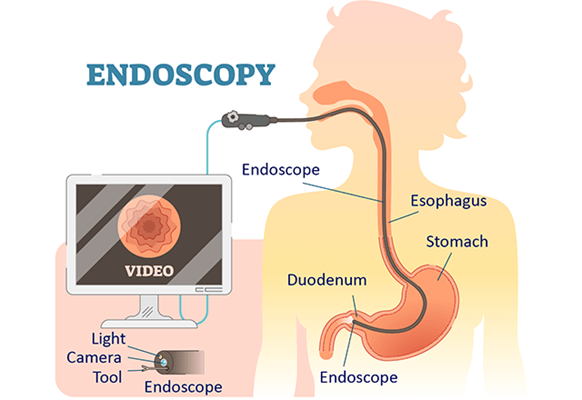
An endoscopy is a procedure done to examine structures inside your body up close. During an endoscopy, a healthcare provider places a long, thin tube (endoscope) inside your body until it reaches the organ or area they need to check. Most endoscopes have a light and special camera at the end. The scope captures images or videos of organs or other body parts. It displays them on a screen your provider sees.
Many endoscopes have special channels inside. Providers can insert operating instruments to remove tissue or perform surgery during an endoscopy.
What are the types of endoscopy?
There are many types of endoscopy procedures. But they all work in the same basic way. A healthcare provider gently inserts a scope into a body opening or small incision. The scope allows them direct access to parts of your body they need to examine or treat.
Key differences include:
* The procedure name. The name usually reflects the organ your provider is checking. For example, a “colonoscopy” is an endoscopy that examines your colon.
* The type of scope. The name usually reflects the organ, too. So the endoscope used for a colonoscopy is called a colonoscope. Endoscopes differ depending on the tasks they help your provider complete. Some are flexible, while others are rigid. Some have channels inside that hold tools that can remove tissue, seal wounds or perform other treatments.
The procedure specifics, including the body parts your provider is examining and where the scope goes in, are different, too.
* Arthroscopy: Scope goes through an incision above your joint to look for damage or conditions like arthritis.
* Bronchoscopy: Scope goes through your mouth or nostril to look at your trachea (windpipe) and lungs.
* Colonoscopy: Scope goes through your math to look at your entire large intestine (colon).
* Cystoscopy: Scope goes through your urethra (the tube that allows pee out of your body) to look at it and your bladder.
* Enteroscopy: Scope goes through your mouth (for upper enteroscopy) or your anal (for lower enteroscopy) to look at your small intestine.
* Esophagogastroduodenoscopy (EGD) or upper endoscopy: Scope goes through your mouth to look at your esophagus, stomach and the upper part of your small intestine.
* Laparoscopy: Scope goes through an incision in your abdomen to look at your abdominal and reproductive organs.
* Laryngoscopy: Scope goes through your mouth or nostril to look at your voice box (larynx).
* Mediastinoscopy: Scope goes through an incision above your breast bone to look at the area between your lungs that includes your heart, esophagus and windpipe (mediastinum).
* Neuroendoscopy: Scope goes through an incision in your skull to look at your brain.
* Proctoscopy (rigid sigmoidoscopy): Scope goes through your anal to look at your anal and rectum.
* Sigmoidoscopy (flexible sigmoidoscopy): Scope goes through your math to look at the* lower part of your colon (called the sigmoid) and your rectum.
* Thoracoscopy (also called a pleuroscopy): Scope goes through an incision in your chest to look at your lungs and the area around your lungs, including your diaphragm, esophagus and chest walls.
* Ureteroscopy: Scope goes through your urethra to look at the tubes that connect your kidneys to your bladder (ureters).
Advanced endoscopy techniques
Researchers and scientists continually develop new technologies to make endoscopies even less invasive. For example, a capsule endoscopy shows your organs up close without a scope. Instead, you swallow a vitamin-sized capsule with a camera inside. As the capsule travels through your esophagus, stomach and small intestine, it takes pictures that can help diagnose bleeding and tumors in your digestive system.
What does an endoscopy test for?
Healthcare providers use endoscopies to screen for conditions and diagnose diseases. A colonoscopy is probably the most well-known endoscopy used to screen for diseases. It’s used to detect colon cancer. One of the most well-known diagnostic uses of endoscopy is that it allows providers to remove abnormal tissue for lab testing. This is called a biopsy. Biopsies can show if growths are cancerous or noncancerous.
When providers first used endoscopy, they primarily used it to examine organs. Now, they can use endoscopy for many different treatments, such as fixing a bleeding stomach ulcer. In the past, a problem like this could’ve required surgery.
Diseases an endoscopy can detect
An endoscopy can detect diseases that affect your:
* Digestive system, including gastrointestinal diseases, colon polyps and colon cancer.
* Head and neck, including swallowing disorders and laryngitis.
* Joints, including arthritis, tears and dislocations.
* Nervous system, including brain tumors.
* Respiratory system, including lung disease and infections.
* Urinary system, including urinary tract infections (UTIs) and kidney stones.
* Reproductive system, including abnormal uterine bleeding, endometriosis and fertility issues.
Endoscopy treatments
Some endoscopes can be used with instruments that allow providers to:
* Seal wounds.
* Inject medicine.
* Drain fluid.
* Stop internal bleeding.
* Remove damaged tissue or tumors.
* Fix blockages or widen organs that are too narrow.
* Place stents (tiny tubes that open a blocked or damaged organ).
* Perform surgeries.
During a laparoscopy, providers operate on organs through tiny incisions instead of a large opening. This is sometimes called keyhole surgery. It’s much less invasive than traditional surgery. It’s the preferred technique for treating many conditions.
Test Details:
How do I prepare for an endoscopy?
You’ll receive instructions based on the type of endoscopy. You may be asked to:
* Complete required pre-tests and procedures. You may need a urine test (urinalysis) to check for a UTI before procedures involving your urinary tract. You may need a pregnancy test before a hysteroscopy.
* Provide a medical history. Alert your healthcare provider of any conditions and medications or supplements you’re taking.
* Fast. You may need to stop eating or drinking for a certain amount of time before your endoscopy. Or, you may need to limit yourself to only certain types of food and drink.
* Cleanse your bowels. You may be asked to complete a bowel prep, which involves flushing the feces (poop) out of your intestines. Colonoscopies, enteroscopies and other procedures involving your lower digestive tract involve bowel prep.
* Stop taking certain medicines. You may need to stop taking blood thinners like warfarin (Coumadin® or Jantoven®) and aspirin. You may need to switch prescription medicines briefly before the procedure. Follow your provider’s guidance.
* Stop smoking. You may need to stop smoking and using tobacco products before your procedure.
* Arrange for someone to drive you home. You won’t be able to drive yourself if you receive sedation or anesthesia for your procedure and go home the same day. Most people need to arrange for a driver.
What should I expect during an endoscopy?
An endoscopy typically takes 30 minutes to two hours, depending on the procedure type. Most people go home on the day of their endoscopy, but some endoscopies require an overnight hospital stay.
Providers use moderate sedation for most endoscopies so that you’re asleep and pain-free during the procedure. General anesthesia (which involves intubation, or placement of a breathing tube) is necessary in a small percentage of cases. Some people may instead get local anesthesia and a sedative. Local anesthesia numbs a particular area instead of putting you to sleep completely. Sedatives help you relax.
Once you’re completely relaxed or asleep, the provider gently inserts the scope until it reaches the area they want to examine. They’ll adjust the scope to display the correct organs or structures on the screen. They’ll note irregular areas and remove tissue or provide treatment if needed.
They’ll close any incisions.
How painful is an endoscopy?
The anesthesia and sedatives prevent you from experiencing pain during the procedure. With some procedures, like a colonoscopy, you may feel pressure when the scope goes in, but the feeling passes quickly.
Additional Information
Endoscopy is a procedure that lets your doctor look inside your body. It uses an instrument called an endoscope, or scope for short. Scopes have a tiny camera attached to a long, thin tube. The doctor moves it through a body passageway or opening to see inside an organ. Sometimes scopes are used for surgery, such as for removing polyps from the colon.
There are many different kinds of endoscopy. Here are the names of some of them and where they look.:
Arthroscopy: joints
Bronchoscopy: lungs
Colonoscopy and sigmoidoscopy: large intestine
Cystoscopy and ureteroscopy: urinary system
Laparoscopy: abdomen or pelvis
Upper gastrointestinal endoscopy: esophagus and stomach
What is an endoscopy?
A doctor or specialist nurse, called an endoscopist does the test. The endoscopist uses these to look inside different parts of the body.
The endoscopist can use the camera to take photographs or videos of the areas they are looking at. They can also pass fine surgical instruments through the endoscopes.
The name of the test you have will depend on which part of the body the endoscopist is looking at.
Why do I need an endoscopy?
You might have an endoscopy to help find out what is causing your symptoms. During this test the endoscopist can also take a sample () of any abnormal looking tissue through the endoscope.
Sometimes you might have an endoscopy for treatment. For example, to control bleeding or to put in a .
You are most likely to have an endoscopy to look at the inside of your:
* food pipe (oesophagus)
* stomach
* duodenum, which is the first part of the small bowel that attaches to the stomach
This test is called a gastroscopy or oesophago gastric duodenoscopy (OGD).
You may have this test if you have symptoms such as:
* abnormal bleeding
* indigestion
* low levels of iron (iron deficiency anaemia)
* difficulty swallowing
If you have you'll have regular gastroscopies to check for any changes to cells in the lining of your food pipe. The endoscopist looks down the endoscope to see if there are any abnormal looking areas. If any are found they can take biopsies through the endoscope.
It appears to me that if one wants to make progress in mathematics, one should study the masters and not the pupils. - Niels Henrik Abel.
Nothing is better than reading and gaining more and more knowledge - Stephen William Hawking.
Offline
Pages: 1
- Index
- » Science HQ
- » Endoscopy