Math Is Fun Forum
You are not logged in.
- Topics: Active | Unanswered
Pages: 1
#1 2025-12-04 20:52:37
- Jai Ganesh
- Administrator

- Registered: 2005-06-28
- Posts: 53,931
Suspension
Suspension (chemistry)
Gist:
Examples of Suspensions
* Slurry of sand in seawater
* Orange juice
* Wheat beer
* Blood
* Concrete or mortar
* Drilling mud
What Characterizes a Suspension?
Suspensions separate over time due to gravity. The solid settles on the ground or forms a sediment, for example, in tanks or containers.
Stable suspensions can form with very small solid particles (particle size below 1 µm). The fine particles are held in suspension by molecular movement. The particles separate very slowly from the liquid or not at all. These solids are called colloids.
To accelerate the process of sedimentation in a suspension (for example, in chemistry), centrifuges can be used. Centrifugal force separates the solid particles from the liquid.
Summary
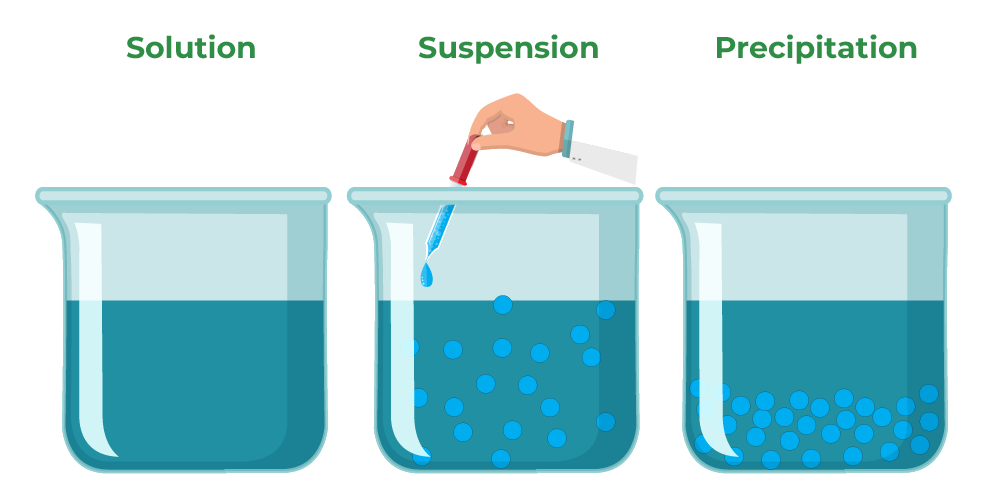
Suspension is a heterogeneous mixture of a fluid that contains solute particles that are considerably large for the process of sedimentation. Suspensions are considered to be heterogeneous in nature because they contain at least two different substances. The particles in a suspension are easily visible to the naked eye. The particles are pulled down to the bottom of the container containing the dispersion medium (water). Some of the particles in the suspension sediment to the bottom when the mixture is left. However, suspensions are mixtures where the particles do not settle.
Suspension Definition
The size of the particles is generally larger than the particles forming the solution, usually ranging up to one micrometre. The typical diameter in the case of dispersed particles in a suspension is generally 1000 times greater than that of a solution. Since the dissolved particles are larger in size, therefore, they don't pass through the filter paper. Hence, the physical separation technique of filtration can be used to separate the suspended particles.
Characteristics and Properties of Suspension
Various properties and characteristics of the suspension are,
* A heterogeneous mixture is composed of two or more substances.
* Shows the Tyndall effect due to the large size of the particles.
* Suspensions are not stable. This is because the particles sediment to the bottom of the solution is left untouched for a while.
* The particles in the suspension can be separated through physical methods, like the process of filtration.
* Particles of the solute, in the case of suspension, do not dissolve in the solvent. They remain suspended in bulk throughout the suspension.
* Suspensions are opaque in nature.
* Dispersed particles are easily visible to the naked eye. The particle size is greater than 1 nanometer.
* When the particles settle, it doesn't scatter light on them.
Details
In chemistry, a suspension is a heterogeneous mixture of a fluid that contains solid particles sufficiently large for sedimentation. The particles may be visible to the naked eye, usually must be larger than one micrometer, and will eventually settle, although the mixture is only classified as a suspension when and while the particles have not settled out.
Properties
A suspension is a heterogeneous mixture in which the solid particles do not dissolve, but get suspended throughout the bulk of the solvent, left floating around freely in the medium. The internal phase (solid) is dispersed throughout the external phase ,fluid, through mechanical (action), with the use of certain or suspending agents.
An example of a suspension would be sand in water. The suspended particles are visible under a microscope and will settle over time if left undisturbed. This distinguishes a suspension from a colloid, in which the colloid particles are smaller and do not settle. Colloids and suspensions are different from solution, in which the dissolved substance (solute) does not exist as a solid, and solvent and solute are homogeneously mixed.
A suspension of liquid droplets or fine solid particles in a gas is called an [aerosol]. In the [Earth's Atmosphere/Atmosphere], the suspended particles are called [particulates] and consist of fine dust and [soot] particles, [sea salt], [biogenic] and [volcano] genic [sulfates, [nitrate, and cloud droplets.
Suspensions are classified on the basis of the [dispersed phase] and the dispersion medium, where the former is essentially solid while the latter may either be a solid, a liquid, or a gas.
In modern chemical process industries, high-shear mixing technology has been used to create many novel suspensions.
Suspensions are unstable from a thermodynamic point of view but can be kinetically stable over a longer period of time, which in turn can determine a suspension's shelf life. This time span needs to be measured in order to provide accurate information to the consumer and ensure the best product quality.
"Dispersion stability refers to the ability of a dispersion to resist change in its properties over time."
Technique monitoring physical stability
Multiple light scattering coupled with vertical scanning is the most widely used technique to monitor the dispersion state of a product, hence identifying and quantifying destabilization phenomena. It works on concentrated dispersions without dilution. When light is sent through the sample, it is back scattered by the particles. The backscattering intensity is directly proportional to the size and volume fraction of the dispersed phase. Therefore, local changes in concentration (sedimentation) and global changes in size (flocculation, aggregation) are detected and monitored. Of primary importance in the analysis of stability in particle suspensions is the value of the zeta potential exhibited by suspended solids. This parameter indicates the magnitude of interparticle electrostatic repulsion and is commonly analyzed to determine how the use of adsorbates and pH modification affect particle repulsion and suspension stabilization or destabilization.
Accelerating methods for shelf life prediction
The kinetic process of destabilisation can be rather long (up to several months or even years for some products) and it is often required for the formulator to use further accelerating methods in order to reach reasonable development time for new product design. Thermal methods are the most commonly used and consists in increasing temperature to accelerate destabilisation (below critical temperatures of phase and degradation). Temperature affects not only the viscosity, but also interfacial tension in the case of non-ionic surfactants or more generally interactions forces inside the system. Storing a dispersion at high temperatures enables simulation of real life conditions for a product (e.g. tube of sunscreen cream in a car in the summer), but also to accelerate destabilisation processes up to 200 times including vibration, centrifugation and agitation are sometimes used. They subject the product to different forces that pushes the particles / film drainage. However, some emulsions would never coalesce in normal gravity, while they do under artificial gravity. Moreover, segregation of different populations of particles have been highlighted when using centrifugation and vibration.
Examples
Common examples of suspensions include:
* Mud or muddy water: where soil, clay, or silt particles are suspended in water
* Flour suspended in water
* Chalk suspended in water
* Sand suspended in water
* Oil incorporated in water
* Pulp suspended in lemonade
* Blood suspended in plasma.
It appears to me that if one wants to make progress in mathematics, one should study the masters and not the pupils. - Niels Henrik Abel.
Nothing is better than reading and gaining more and more knowledge - Stephen William Hawking.
Offline
Pages: 1