Math Is Fun Forum
You are not logged in.
- Topics: Active | Unanswered
Pages: 1
#1 2025-12-07 17:15:50
- Jai Ganesh
- Administrator

- Registered: 2005-06-28
- Posts: 53,931
Polar Bear
Polar Bear
Gist
Polar bears live in the Arctic regions, including the North Pole, and are found in the five "range states": the U.S. (Alaska), Canada, Russia, Greenland, and Norway (Svalbard). They primarily live on sea ice, where they hunt, rest, and raise their young.
Polar bears live in the Arctic where temperatures can reach as low as minus 50-60 °C in the winter months. The Arctic is covered in snow and ice and very few animals are able to survive there. Polar bears spend much of their time on the Arctic sea ice where they hunt live and breed.
Summary
Polar bears live along shores and on sea ice in the icy cold Arctic. When sea ice forms over the ocean in cold weather, many polar bears, except pregnant females, head out onto the ice to hunt seals.
Polar bears primarily eat seals. Polar bears often rest silently at a seal's breathing hole in the ice, waiting for a seal in the water to surface. A polar bear may also hunt by swimming beneath the ice. But climate change is making it harder for polar bears to hunt. Ice melts earlier and re-forms later than it has in the past. Without the sea ice, the polar bear must scavenge for other, less nutritious food.
Polar bears roam the Arctic ice sheets and swim in that region's coastal waters. They are very strong swimmers, and their large front paws, which they use to paddle, are slightly webbed. Some polar bears have been seen swimming hundreds of miles from land—though they probably cover most of that distance by floating on sheets of ice.
In fall pregnant polar bears make dens in earth and snowbanks, where they'll stay through the winter and give birth to one to three cubs. In spring the mother emerges from her den followed by her cubs. During that time she will protect them and teach them how to hunt. The U.S., Canada, Denmark, Norway, and Russia signed an agreement in 1973 to protect polar bears.
Details
Polar bear, (Ursus maritimus), great white northern bear (family Ursidae) is found throughout the Arctic region. The polar bear travels long distances over vast desolate expanses, generally on drifting oceanic ice floes, searching for seals, its primary prey. The polar bear is the largest and most powerful carnivore on land, a title it shares with a subspecies of brown bear called the Kodiak bear. It has no natural predators and knows no fear of humans, making it an extremely dangerous animal.
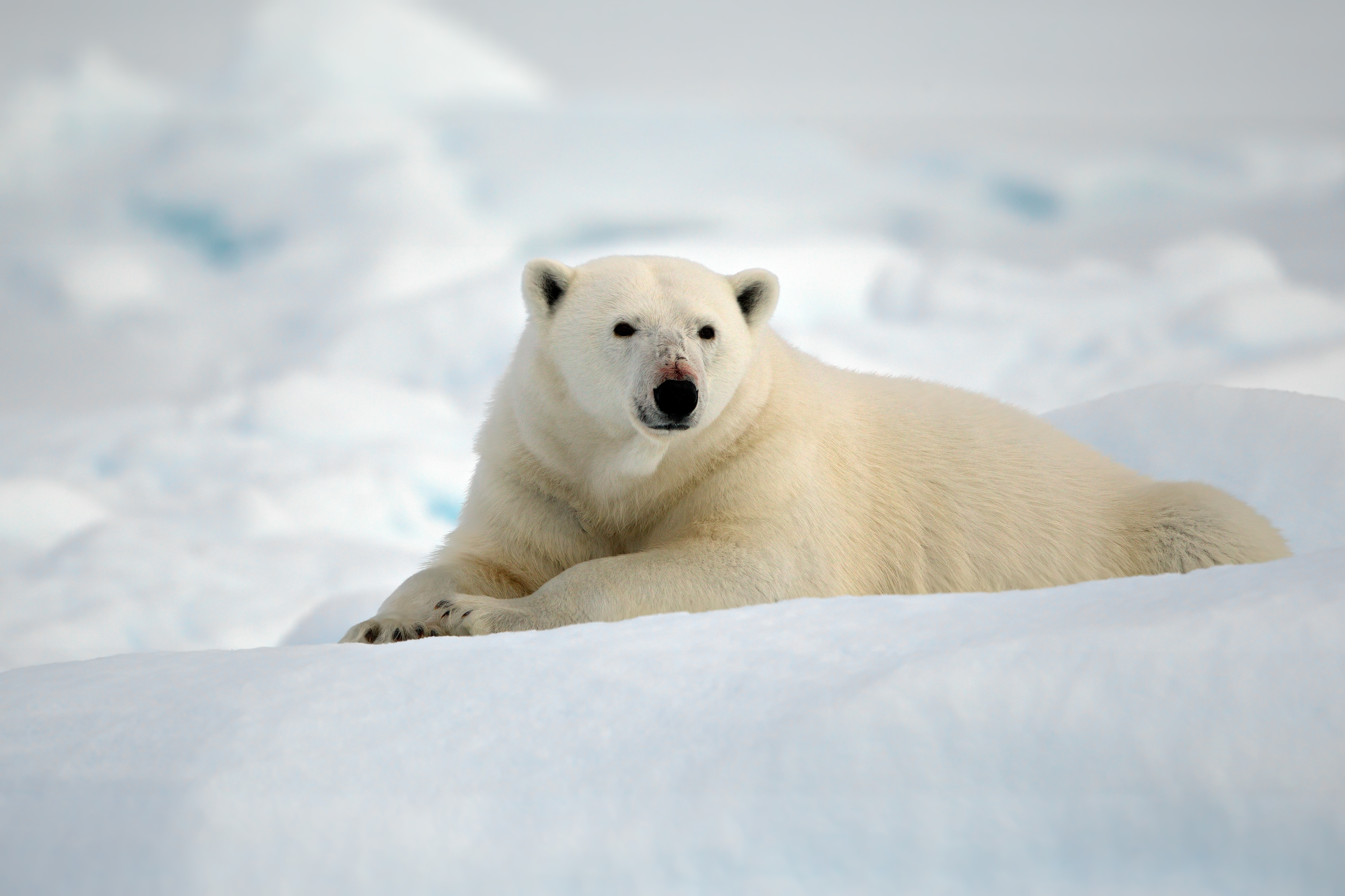
Polar bears are stocky, with a long neck, relatively small head, short, rounded ears, and a short tail. The male, which is much larger than the female, weighs 410 to 720 kg (900 to 1,600 pounds). It grows to about 1.6 metres (5.3 feet) tall at the shoulder and 2.2–2.5 metres in length. The tail is 7–12 cm (3–5 inches) long. Sunlight can pass through the thick fur, its heat being absorbed by the bear’s black skin. Under the skin is a layer of insulating fat. The broad feet have hairy soles to protect and insulate as well as to facilitate movement across ice, as does the uneven skin on the soles of the feet, which helps to prevent slipping. Strong, sharp claws are also important for gaining traction, for digging through ice, and for killing prey.
Polar bears are solitary and overwhelmingly carnivorous, feeding especially on the ringed seal but also on the bearded seal and other pinnipeds. The bear stalks seals resting on the ice, ambushes them near breathing holes, and digs young seals from snow shelters where they are born. Polar bears prefer ice that is subject to periodic fracturing by wind and sea currents, because these fractures offer seals access to both air and water. As their prey is aquatic, polar bears are excellent swimmers, and they are even known to kill beluga whales. In swimming, the polar bear uses only its front limbs, an aquatic adaptation found in no other four-legged mammal. Polar bears are opportunistic as well as predatory: they will consume dead fish and carcasses of stranded whales and eat garbage near human settlements.
Mating occurs in spring, and implantation of the fertilized ovum is delayed. Including the delay, gestation may last 195–265 days, and one to four cubs, usually two, are born during the winter in a den of ice or snow. Cubs weigh less than 1 kg at birth and are not weaned until after they are two years old. Young polar bears may die of starvation or may be killed by adult males, and for this reason female polar bears are extremely defensive of their young when adult males are present. Young remain with their mothers until they reach sexual maturity. Females first reproduce at four to eight years of age and breed every two to four years thereafter. Males mature at about the same age as females but do not breed until a few years later. Adult polar bears have no natural predators, though walruses and wolves can kill them. Longevity in the wild is 25 to 30 years, but in captivity several polar bears have lived to more than 35 years old.
Humans probably cause most polar bear deaths, by hunting and by destroying problem animals near settlements. Polar bears have been known to kill people. The bears are hunted especially by Inuit people for their hides, tendons, fat, and flesh. Although polar bear meat is consumed by indigenous people, the liver is inedible and often poisonous because of its high vitamin A content.
An estimated 22,000 to 31,000 polar bears were living in the wild by 2020. The International Union for Conservation of Nature (IUCN) has classified the polar bear as a vulnerable species since 2006, and the U.S. government has listed the polar bear as a threatened species since 2008, in large part because of the influence of global warming, which continues to reduce Arctic sea ice coverage. Sea ice is prime habitat for polar bears. Population models have predicted increased rates of starvation as a result of longer ice-free seasons and a decline in mating success, since sea ice fragmentation could reduce encounter rates between males and females. Ecological studies show evidence that declines in sea ice coverage have forced polar bears to spend more time foraging for berries and seabird eggs, which are lower-quality foods that require greater effort to obtain. Given the compounding threats to the species, model forecasts suggest that polar bear populations will have declined by one-third by the year 2050.
Additional Information
The polar bear (Ursus maritimus) is a large bear native to the Arctic and nearby areas. It is closely related to the brown bear, and the two species can interbreed. The polar bear is the largest extant species of bear and land carnivore by body mass, with adult males weighing 300–800 kg (660–1,760 lb). The species is sexually dimorphic, as adult females are much smaller. The polar bear is white- or yellowish-furred with black skin and a thick layer of fat. It is more slender than the brown bear, with a narrower skull, longer neck and lower shoulder hump. Its teeth are sharper and more adapted to cutting meat. The paws are large and allow the bear to walk on ice and paddle in the water.
Polar bears are both terrestrial and pagophilic (ice-living) and are considered marine mammals because of their dependence on marine ecosystems. They prefer the annual sea ice but live on land when the ice melts in the summer. They are mostly carnivorous and specialized for preying on seals, particularly ringed seals. Such prey is typically taken by ambush; the bear may stalk its prey on the ice or in the water, but also will stay at a breathing hole or ice edge to wait for prey to swim by. The bear primarily feeds on the seal's energy-rich blubber. Other prey include walruses, beluga whales and some terrestrial animals. Polar bears are usually solitary but can be found in groups when on land. During the breeding season, male bears guard females and defend them from rivals. Mothers give birth to cubs in maternity dens during the winter. Young stay with their mother for up to two and a half years.
The polar bear is considered a vulnerable species by the International Union for Conservation of Nature (IUCN) with an estimated total population of 22,000 to 31,000 individuals. Its biggest threats are climate change, pollution and energy development. Climate change has caused a decline in sea ice, giving the polar bear less access to its favoured prey and increasing the risk of malnutrition and starvation. Less sea ice also means that the bears must spend more time on land, increasing conflicts with humans. Polar bears have been hunted, both by native and non-native peoples, for their coats, meat and other items. They have been kept in captivity in zoos and circuses and are prevalent in art, folklore, religion and modern culture.
It appears to me that if one wants to make progress in mathematics, one should study the masters and not the pupils. - Niels Henrik Abel.
Nothing is better than reading and gaining more and more knowledge - Stephen William Hawking.
Offline
Pages: 1