Math Is Fun Forum
You are not logged in.
- Topics: Active | Unanswered
Pages: 1
#1 2026-01-15 22:20:20
- Jai Ganesh
- Administrator

- Registered: 2005-06-28
- Posts: 53,931
Accelerator
Accelerator
Gist
An accelerator, also known as the gas pedal, is the rightmost pedal in a car that controls the vehicle's speed by regulating the fuel and air supply to the engine; pressing it makes the car go faster, while releasing it slows the car down. It's a fundamental control in both manual and automatic cars, allowing drivers to increase engine power for acceleration and maintain momentum.
How to control the accelerator in a car for beginners?
The best way to accomplish this is by keeping your heel planted on the floor and then pressing the gas pedal GENTLY with the ball of the foot. Apply gradual pressure until you feel the car moving at a nice, comfortable pace based on the speed limit for your situation.
Summary
The throttle, which controls fuel and air supply to the engine and is also known as the "accelerator" or "gas pedal", is normally the right-most floor pedal. It has a fail-safe design – a spring, which returns it to the idle position when not depressed by the driver.
Normally the throttle and brake are operated by the right foot, while the clutch is operated by the left foot. However, some drivers sometimes mistake the accelerator for the brake, leading to sudden unintended acceleration and causing 16,000 accidents per year in the US. There are also drivers who intentionally practice left-foot braking.
Early cars had a hand lever to control the throttle, either directly, or by controlling an engine speed governor which in turn controlled both the throttle and timing. In 1900, the Wilson-Pilcher car was introduced in Britain which had a hand controlled speed governor, and a foot throttle which could override the action of the governor. Unlike modern throttle pedals, this could be raised to accelerate the car or depressed to slow it, "and thus quick accelerations or retardations can be effected" without interfering with the governed speed set using the hand control. The combination of governed engine speed with foot throttle override is in many ways similar to a modern cruise control. In spite of this development, steering column mounted hand throttles remained common, especially in mass-produced cars such as the Ford Model T. Later cars used both a foot pedal and a hand lever to set the minimum throttle. The 1918 Stutz Bearcat had a central throttle pedal with the clutch and brake to the right and left. Modern cruise control was invented in 1948.
Details
"Accelerator mechanical" refers to traditional, cable-driven systems in vehicles where pressing the pedal physically pulls a cable to open the engine's throttle, contrasting with modern electronic systems, or it can describe specialized roles like Accelerator Mechanical Technicians who maintain complex scientific particle accelerator machinery using mechanical engineering principles for high-precision equipment. In both contexts, it involves physical mechanisms (cables, linkages, sensors, pumps, vacuum systems) that directly control or monitor motion and energy transfer, ensuring performance, reliability, and safety.
In Vehicles (Traditional Systems)
* Function: A cable directly connects the gas pedal to the throttle body, controlling airflow into the engine.
* Mechanism: Pushing the pedal pulls the cable, which physically opens the throttle valve, increasing engine power and speed.
* Contrast: This differs from "drive-by-wire" systems where sensors (like APP sensors) convert pedal movement to electronic signals for the Engine Control Unit (ECU).
Key Mechanical Components & Concepts
* Throttle Linkage: The physical connection between the cable and the throttle valve.
* Accelerator Pedal Module (APM): Includes the pedal and sensors (potentiometer/Hall-effect) that might still use mechanical input but send electronic signals.
* Physical Systems: In research, this involves large-scale vacuum chambers, cooling loops, support structures, and precision positioning systems.
In essence, "accelerator mechanical" describes the physical, tangible parts and processes that either control vehicle speed or enable scientific particle acceleration, focusing on engineering and maintenance.
Additional Information
With the Otto engine, the air-and-fuel system produces an air-fuel mixture which helps the engine to produce the required torque while also fulfilling additional requirements, e.g. as regards the exhaust system. The electronic control adjusts the optimal mixing ratio between air and fuel as well as the optimal time of injection.
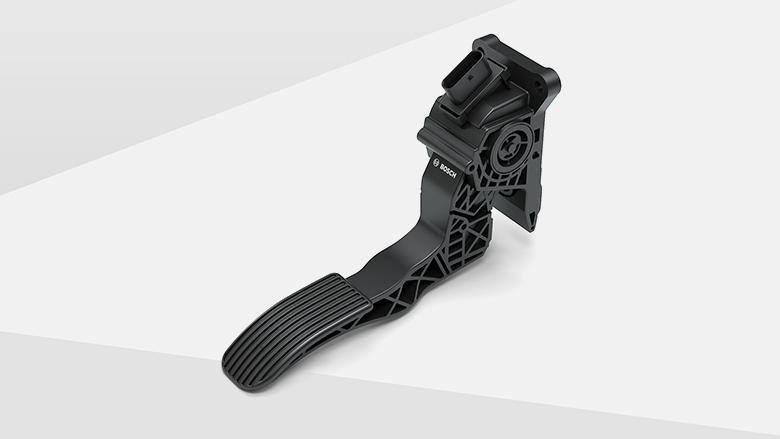
The driver's requirement for more or less torque is a key input variable for controlling the air charge electronically. The accelerator-pedal module provides this information as a sensor signal.
The accelerator-pedal module (APM) consists of the accelerator pedal and an angular-position sensor as potentiometer or touchless hall-effect sensor. This sensor registers the movement and position of the accelerator pedal. From this information, the engine management calculates the required torque. The signal can be output in analog or digital form. The accelerator pedal is made out of plastic. A new, topology-optimized design helps saving up to 25% of weight at the same stability and compared with former designs.
It appears to me that if one wants to make progress in mathematics, one should study the masters and not the pupils. - Niels Henrik Abel.
Nothing is better than reading and gaining more and more knowledge - Stephen William Hawking.
Offline
Pages: 1