Math Is Fun Forum
You are not logged in.
- Topics: Active | Unanswered
Pages: 1
#1 2026-01-17 15:52:19
- Jai Ganesh
- Administrator

- Registered: 2005-06-28
- Posts: 53,931
Convex Lens
Convex Lens
Gist
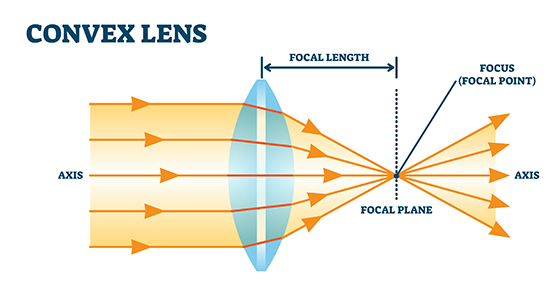
A convex lens is a transparent, curved optical device, thicker in the middle and thinner at the edges, that converges (bends inward) parallel light rays to a focal point, hence it's also called a converging lens, used in cameras, eyeglasses (for farsightedness), microscopes, and telescopes to focus light and magnify images.
A convex lens is a transparent, curved lens that bulges outwards, making it thicker in the middle and thinner at the edges, causing parallel light rays to converge (come together) at a single focal point, which is why it's also called a "converging lens". These lenses are used in magnifying glasses, eyeglasses for farsightedness, cameras, and telescopes to focus light and form real or magnified images.
Summary
A lens is a piece of transparent material which concentrates or disperses light rays when passes through them by refraction. According to the shape and purpose of the lens, they are classified into two types convex lens and concave lens.
Definition of Convex Lens
This type of lens is thicker at the centre and thinner at the edges.
An optical lens is generally made up of two spherical surfaces. If those surfaces are bent outwards, the lens is called a biconvex lens or simply a convex lens. These types of lenses can converge a beam of light coming from outside and focus it to a point on the other side. This point is known as the focus and the distance between the centre of the lens to the focus is called the focal length of the convex lens. However if one of the surfaces is flat and the other convex, then it is called a plano-convex lens.
Uses of Convex Lens
These are used for a variety of purposes in our day-to-day lives. For example,
* The lens in the human eyes is the prime example. So the most common use of the lens is that it helps us to see.
* Another common example of the use of this type of lens is a magnifying glass. When an object is placed in front of it at a distance shorter than the focal length of the lens, it produces a magnified and erect image of the object on the same side as the object itself.
* It is used to correct Hypermetropia or long-sightedness.
* It is used in cameras because it focuses light and produces a clear and crisp image.
* More generally these are often used in compound lenses used in various instruments such as magnifying devices like microscopes, telescopes and camera lenses.
* A simple kind of these lenses can focus light into an image, but that image won’t be of high quality. For correcting the distortions and aberrations, it is better to combine both types of lenses.
Details
A convex lens is used in cameras, telescopes, microscopes, and other essential gadgets, but you might not know what it is or how it works. This article will explain what a convex lens is, how it works, the different types, and what fields it is applied in.
What Is a Convex Lens?
A convex (converging) lens is a lens that combines light beams that are parallel to the lens’s principal axis. They are easily recognized by their distinctive shape, which is thick in the center and tapered at the top and bottom. Instead of being rounded inward, the edges are rounded outward. When light passes through a lens, it is refracted at a particular spot based on the incidence angle.
Depending on their distance from the surface, light beams will be bent at varying angles due to the curvature of the surface. This is in contrast to what happens when using a concave (divergent lens) in which light is scattered in a direction perpendicular to the axis.
Why a Convex Lens Is Called a Converging Lens
A convex lens is classified as a converging lens because it allows all light rays to converge on a single point along the lens’s primary axis. It is the opposite of a concave (diverging) lens that separates light rays into several points.
Types of Convex Lenses:
Plano-Convex Lenses
Plano-convex lenses have one flat surface and one spherical surface. These simple lenses function best with infinite parallel light, should be used in non-critical settings, and are typically used in robots, focusing optics, and other fields.
Double Convex Lenses
A double convex (bi-convex) lens has both sides bent outward. This is the opposite of a bi-concave lens with two sides bent inward. Compared to a plano-convex lens of the same diameter and surface radius, a bi-convex lens has a shorter focal length. However, today’s optical tools require longer focal lengths. Therefore, most people prefer double convex lenses. You can find these lenses being used in projectors, cameras, etc.
Concave-Convex Lenses
A concave-convex lens (meniscus) has one side curved inward and the other curved outward. Essentially, the lens possesses one convex lens and one concave lens. You can use this lens to correct spherical aberrations of different lenses.
Uses of Convex Lenses:
Cameras
Some cameras use convex lenses to focus and magnify images. You can change the camera’s magnification by repositioning these lenses. By doing so, you can fine-tune the magnification by shifting the focal point. You can also find convex lenses being used in webcams, video cameras, and others.
Eyeglasses
When your eye’s lens can’t concentrate light where it needs to be, it will be hard to see clearly. For example, people with hyperopia (far-sightedness) find it hard to see nearby objects well but have no trouble seeing distant objects.
This is usually caused by the ciliary muscles’ failure to change the eye lens’s focal length properly. In a case like this, the objects’ rays are converged on a spot behind the retina. Hence, the rays of light need to be focused in a way that they converge on the retina, and this is where convex lenses come in. You can fix far-sightedness by placing convex lenses in front of your eyes (wearing glasses).
Peepholes
Doors with peepholes allow anyone to view what is going on on the other side without opening the door. For additional safety, these holes can be tucked away in undisclosed locations.
Although the hole is relatively tiny, the image on the opposite side is enlarged because of the convex lens put inside. With this lens, the viewer can easily see who or what is on the other side of the door by looking through the peephole.
Microscopes
An optical microscope allows you to study microscopic features such as those found on microfibers, bacteria, and others. The microscope uses a convex lens to enlarge the image. It works by using a set of three lenses. You can also find compound microscopes (with more lenses) that magnify microbes even more dramatically.
Magnifying Glass
A magnifying glass works by focusing all the light entering the lens on one spot, which is known as the focal point. When the space between the lens and the object is smaller than the focal length, the item is magnified.
Projectors
A projector is an optical device with the capability of displaying images or films on massive displays. An essential principle of a projector’s operation is the enlargement of a moving image or video onto film.
In this case, the lens produces an enlarged and flipped image. So, in order to fix the flipped image, the film is always uploaded upside down.
Refracting Telescopes
Telescopes work best for seeing objects that are incredibly far away, such as planets. You can find two types of telescopes – one made with mirrors (reflecting telescope) and the other with convex lenses (refracting telescope).
A refracting telescope contains two convex lenses. One lens combines all the light rays while the second zooms in on the image.
Conclusion
A convex lens is a lens that connects light beams that are entering its principal axis. It has an oval shape, with the thickest part being the middle and the upper and lower portions being thinner, and that’s why light converges when it goes through this lens. There are three different types of convex lenses that work in distinct ways depending on the purposes and applications.
Additional Information:
Key Takeways:
* Convex lenses, known for converging light rays towards a focal point, have diverse applications. Types like plano convex, double convex lens, and concave-convex serve specific purposes.
* They’re crucial in eyeglasses for vision correction, microscopy for magnification, and cameras for focusing images.
* They also power magnifying glasses for detailed inspection. Their versatility makes them indispensable across optics, ensuring clear vision and precise imaging.
* Convex lenses play an essential role when it comes to optics. They have various applications, and people use them in their daily lives. However, most do not know how these items work or what they do.
What is a Convex Lens?
A convex lens, also called a converging lens, joins parallel light rays. This lens is thick in the center and much thinner at the upper and lower ends, allowing the light to converge at the principal axis. Due to the shape of this lens, the rays of light passing through the upper and lower ends are curved inwardly and not outwardly. It is placed in front of the eye to sharply curve incoming light, thereby shortening the focal point and guaranteeing optimal retinal illumination.
Typically, it may concentrate a beam of parallel rays onto a point on the other side. This distance from the optical center of the beam is used to determine the focal length of the lens.
Types of Convex Lenses
Various types of lenses reflect light in different ways depending on the shape of the lens. These lenses can be used to create a real or virtual image based on the type and use. Here are the types of convex lenses.
Plano-Convex Lens
It’s shape is rounded on both the left and right sides. Plano-Convex Lens possesses positive focal length components with one spherical and one flat face. Plano-Convex Lenses function best in non-critical settings where unlimited parallel light can be used. They are intended to be used as general-purpose focusing optics. You can also find them being used in pharmaceuticals, robotics, etc.
Double Convex Lens
The sides in a double Convex lens are curved outwards, creating an outward curve. This convex shape is what gives rise to its multiple names, and its focal length is less than that of a similarlysized and shaped plano-convex lens. In order to function, many optical tools need longer focal lengths. Due to this, double convex lenses are the better options.
Double Convex Lens has many applications, including projectors, monoculars, telescopes, cameras, and more. In addition, it is used for an optical illusion for the human eye, glass-cutting, real imaging for photography, and an optical sensor.
Convex Lenses, Plano Convex Lens, Double Convex Lens, Concave Convex Lens
Concave-Convex Lens
It curves outwards on one side and inwards on the other. It corrects for spherical aberrations, which occur because of other lens types. Also, it directs the laser beam. To put it simply, a concave-convex lens, or meniscus, consists of two lenses, one of which is the convex lens and the other of which is a concave lens.
A similar lens is a biconcave lens, which increases focal length or expands laser beams. Biconcave lenses can be applied in optical character readers, projection systems, etc.
Why Is a Convex Lens Called a Simple Microscope?
A simple microscope is an optical equipment used to increase the apparent size of a tiny object to examine it better. But which lens is used in the microscope: convex or concave? Well, all microscopes use convex lenses, but why do we use a convex lens in a microscope? These lenses are used in microscopes because they magnify images, whereas concave lenses do not.
Some might call a convex lens a simple microscope because that is the only type of lens that can be used on this device. Keep in mind that there is a difference between a simple and a compound microscope. A simple microscope uses just one lens to magnify a distant object, while a compound microscope uses several lenses to increase magnification.
General Applications:
Eyeglasses
Incorrect focusing of light onto the retina causes vision impairments such as farsightedness and nearsightedness. If you suffer from farsightedness, your lens concentrates on an image that is behind your retina.
Since your lens cannot properly focus the image on the retina, it becomes difficult for you to see near objects. Using a convex lens on your eye will correct the problem. This works because the convex lenses curve the ray of right correctly onto your retina, allowing the focal point to be shorter.
Microscopes
A convex lens is always used in a microscope because of its ability to magnify images. Convex lenses are ideal for use in microscopes because they enable the creation of highly magnified visuals of tiny objects. A simple microscope typically uses three lenses. However, only the lens at the end of the microscope creates a magnified image size; the other two do not.
Magnifying Glasses
The magnifying glass, which utilizes a convex lens, is the most common application of a convex lens. When light enters the magnifying glass’ convex lens, it is concentrated on a point directly in front of the lens’ optical center, thereby increasing magnification. In addition, to get the best magnification results, you need to position the magnifying glass at the optimum distance from the object.
Cameras
A convex lens is generally used in cameras because it can both focus and enlarge the captured image. The camera’s lens is a combination of two convex lenses, one concave and one convex. The distance between the object and the first lens determines the degree of magnification.
Conclusion
A convex lens is a tool that converges parallel light rays into a focal point (principal axis). It can do this due to its oval shape, with the upper and low ends thinner than the middle. Although a simple item, a convex lens ensures that several apparatus work efficiently to produce results. Some of this equipment includes eyeglasses, cameras, and microscopes. Without a convex lens, using these tools would be challenging.
It appears to me that if one wants to make progress in mathematics, one should study the masters and not the pupils. - Niels Henrik Abel.
Nothing is better than reading and gaining more and more knowledge - Stephen William Hawking.
Offline
Pages: 1