Math Is Fun Forum
You are not logged in.
- Topics: Active | Unanswered
Pages: 1
#1 2026-01-18 22:53:30
- Jai Ganesh
- Administrator

- Registered: 2005-06-28
- Posts: 53,931
Concave Lens
Concave Lens
Gist
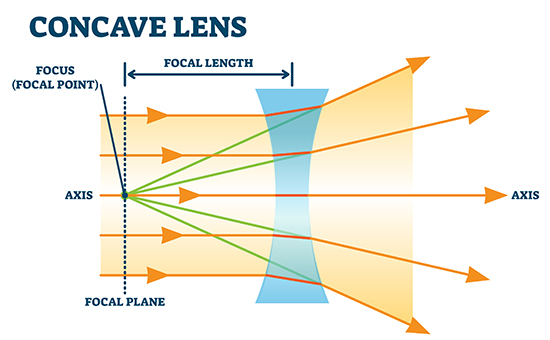
A concave lens is a diverging lens, thinner in the middle and thicker at the edges, that curves inward, causing parallel light rays to spread out (diverge) after passing through it, forming virtual, upright, and diminished (smaller) images, commonly used in eyeglasses for nearsightedness and optical instruments.
A concave lens is also known as a diverging lens because it is shaped round inwards at the centre and bulges outwards through the edges, making the light diverge. They are used to treat myopia as they make faraway objects look smaller than they are.
A concave lens corrects myopia by being thinner at the center and thicker at the edge. It diverges light rays entering the eye so they focus a little further back, landing directly on the retina instead of in front of it.
Summary
A concave lens is a lens that diverges a straight light beam from the source to a diminished, upright, virtual image. It can form both real and virtual images. Concave lenses have at least one surface curved inside. A concave lens is also known as a diverging lens because it is shaped round inwards at the centre and bulges outwards through the edges, making the light diverge. They are used to treat myopia as they make faraway objects look smaller than they are.
Uses of Concave Lens
Some uses of the concave lens are listed below:
Used in Telescope
Concave lenses are used in telescopes and binoculars to magnify objects. As a convex lens creates blurs and distortion, telescope and binocular manufacturers install concave lenses before or in the eyepiece so that a person can focus more clearly.
Used in Eye Glasses
Concave lenses are most commonly used to correct myopia which is also called nearsightedness. The eyeball of a person suffering from myopia is too long, and the images of faraway objects fall short of the retina. Therefore, concave lenses are used in glasses which correct the shortfall by spreading out the light rays before it reaches the eyeball. This enables the person to see far away objects more clearly.
Used in Peepholes
Peepholes or door viewers are security devices that give a panoramic view if objects outside walls or doors. A concave lens is used to minimize the proportions of the objects and gives a wider view of the object or area.
Details
Concave lenses are one of the many lenses used in optics. They help create some of the most important equipment you use in your everyday life. These lenses come in various types and have plenty of applications. This article contains all you need to know about concave lenses, such as the different types and how they are applied.
What Is a Concave Lens?
A concave lens bends light inward so that the resulting image is smaller and more vertical than the original. Furthermore, it can create an actual or virtual image. Concave lenses contain at least one face that is curved inward. Another name for these lenses is diverging lenses, and this is because they bulge outward at their borders and are spherical in their centers, causing light to spread out rather than focus.
Types of Concave Lenses:
Bi-Concave Lenses
These types of lenses are also called double-concave lenses. Both sides of a bi-concave lens have equal radius curvature and, similar to plano-concave lenses, can deviate from incident light.
Plano-Concave Lenses
A plano-concave lens works like a bi-concave lens. However, these lenses have one flat face and one concave. Furthermore, plano-concave lenses have a negative focal length.
Convexo-Concave Lenses
A convexo-concave lens has one convex surface and one concave surface. That said, the convex surface has a higher curvature than the concave surface, which leads to the lens being thickest in the center.
Applications of Concave Lenses:
Corrective Lenses
Correction of myopia (short-sightedness) typically involves the use of concave lenses. Myopic eyes have longer than average eyeballs, which causes images of a distant object to be projected onto the fovea instead of the retina.
Glasses with concave lenses can fix this by spreading the incoming light out before reaching the eye. In doing so, the patient can perceive further away objects with more clarity.
Binoculars and Telescopes
Binoculars allow users to see distant objects, making them appear closer. They are constructed from convex and concave lenses. The convex lens zooms in on the object, while the concave lens is used to focus the image properly.
Telescopes function similarly in that they have convex and concave lenses. They are used to observe extremely distant objects, such as planets. The convex lens serves as the magnification lens, while the concave lens serves as the eyepiece.
Lasers
Laser beams are used in a variety of devices, including scanners, DVD players, and medical instruments. Even though lasers are incredibly concentrated sources of light, they must be spread out for usage in practical applications. As a result, the laser beam is widened by a series of tiny concave lenses, allowing for pinpoint targeting of a specific location.
Flashlights
Flashlights also make use of concave lenses to increase the output of the light they use. Light converges on the lens’ hollowed side and spreads out on the other. This broadens the light’s beam by expanding the source’s diameter.
Cameras
Camera manufacturers frequently utilize lenses that possess concave and convex surfaces to enhance image quality. Convex lenses are the most used lenses in cameras, and chromatic aberrations can occur when they are used. Fortunately, this issue can be solved by combining concave and convex lenses.
Peepholes
Peepholes, often called door viewers, are safety features that allow a full view of what’s on the other side of a wall or door. While looking at an object or area, a concave lens will make it appear smaller and provide a wider perspective.
Conclusion
Well, there you have it. All there is to know about concave lenses. They are lenses with at least one surface curved inward. These lenses are able to bend light inward and make images appear upright and smaller. You can find them used in several contraptions, such as cameras, flashlights, telescopes, and others.
Additional Information
The word "lens" owes its origin to the Latin word for lentils, the tiny beans that have from ancient times been an important ingredient in the cuisine of the Mediterranean region. The convex shape of lentils resulted in their Latin name being coined for glass possessing the same shape.
Because of the way in which lenses refract light that strikes them, they are used to concentrate or disperse light. Light entering a lens can be altered in many different ways according, for example, to the composition, size, thickness, curvature and combination of the lens used. Many different kinds of lenses are manufactured for use in such devices as cameras, telescopes, microscopes and eyeglasses. Copying machines, image scanners, optical fiber transponders and cutting-edge semiconductor production equipment are other more recent devices in which the ability of lenses to diffuse or condense light is put to use.
Convex and Concave Lenses Used in Eyeglasses
Lenses may be divided broadly into two main types: convex and concave. Lenses that are thicker at their centers than at their edges are convex, while those that are thicker around their edges are concave. A light beam passing through a convex lens is focused by the lens on a point on the other side of the lens. This point is called the focal point. In the case of concave lenses, which diverge rather than condense light beams, the focal point lies in front of the lens, and is the point on the axis of the incoming light from which the spread light beam through the lens appears to originate.
Concave Lenses Are for the Nearsighted, Convex for the Farsighted
Concave lenses are used in eyeglasses that correct nearsightedness. Because the distance between the eye's lens and retina in nearsighted people is longer than it should be, such people are unable to make out distant objects clearly. Placing concave lenses in front of a nearsighted eye reduces the refraction of light and lengthens the focal length so that the image is formed on the retina.
Convex lenses are used in eyeglasses for correcting farsightedness, where the distance between the eye's lens and retina is too short, as a result of which the focal point lies behind the retina. Eyeglasses with convex lenses increase refraction, and accordingly reduce the focal length.
Telephoto Lenses Are Combinations of Convex and Concave Lenses
Most optical devices make use of not just one lens, but of a combination of convex and concave lenses. For example, combining a single convex lens with a single concave lens enables distant objects to be seen in more detail. This is because the light condensed by the convex lens is once more refracted into parallel light by the concave lens. This arrangement made possible the
Galilean telescope, named after its 17th century inventor, Galileo.
Adding a second convex lens to this combination produces a simple telephoto lens, with the front convex and concave lens serving to magnify the image, while the rear convex lens condenses it.
Adding a further two pairs of convex/concave lenses and a mechanism for adjusting the distance between the single convex and concave lenses enables the modification of magnification over a continuous range. This is how zoom lenses work.
Lenses that Correct the Blurring of Colors
The focused image through a single convex lens is actually very slightly distorted or blurred in a phenomenon known as lens aberration. The reason why camera and microscope lenses combine so many lens elements is to correct this aberration to obtain sharp and faithful images.
One common lens aberration is chromatic aberration. Ordinary light is a mixture of light of many different colors, i.e. wavelengths. Because the refractive index of glass to light differs according to its color or wavelength, the position in which the image is formed differs according to color, creating a blurring of colors. This chromatic aberration can be canceled out by combining convex and concave lenses of different refractive indices.
Low-chromatic-aberration Glass
Special lenses, known as fluorite lenses, and boasting very low dispersion of light, have been developed to resolve the issue of chromatic aberration. Fluorite is actually calcium fluoride (CaF2), crystals of which exist naturally. Towards the end of the 1960s, Canon developed the technology for artificially creating fluorite crystals, and in the latter half of the 1970s we achieved the first UD (Ultra Low Dispersion) lenses incorporating low-dispersion optical glass. In the 1990s, we further improved this technology to create Super UD lenses. A mixture of fluorite, UD and Super UD elements are used in today's EF series telephoto lenses.
Aspherical Lenses for Correcting Spherical Aberration
There are four other key types of aberration: spherical and coma aberration, astigmatism, curvature of field, and distortion. Together with chromatic aberration, these phenomena make up what are known as Seidel's five aberrations. Spherical aberration refers to the blurring that occurs as a result of light passing through the periphery of the lens converging at a point closer to the lens than light passing through the center. Spherical aberration is unavoidable in a single spherical lens, and so aspherical lenses, whose curvature is slightly modified towards the periphery, were developed to reduce it.
In the past, correcting spherical aberration required the combination of many different lens elements, and so the invention of aspherical lenses enabled a substantial reduction in the overall number of elements required for optical instruments.
Lenses that Make Use of the Diffraction of Light
Because light is a wave, when it passes through a small hole, it is diffracted outwards towards shadow areas. This phenomenon can be used to advantage to control the direction of light by making concentric sawtooth-shaped grooves in the surface of a lens. Such lenses are known as diffractive optical elements. These elements are ideal for the small and light lenses that focus the laser beams used in CD and DVD players. Because the lasers used in electronic devices produce light of a single wavelength, a single-layer diffractive optical element is sufficient to achieve accurate light condensation.
Chromatic aberration caused by diffraction on the one hand, and refraction on the other arise in completely opposite ways. Skillful exploitation of this fact enables the creation of small and light telephoto lenses.
Unlike pickup lenses for CD and DVD players, incorporating simple diffractive optical elements into SLR camera lenses results in the generation of stray light. However this problem can be resolved by using laminated diffractive optical elements, in which two diffractive optical elements are aligned within a precision of a few micrometers.
If this arrangement is then combined with a refractive convex lens, chromatic aberration can be corrected. Smaller and lighter than the purely refractive lenses that have been commonly used until now, these diffractive lenses are now being increasingly used by sports and news photographers.
The larger the mirror of an astronomical telescope, the greater will be the telescope's ability to collect light. The primary mirror of the Subaru telescope, built by Japan's National Astronomical Observatory, has a diameter of 8.2 m, making Subaru the world's largest optical telescope, and one that boasts very high resolution, with a diffraction limit of only 0.23 arc seconds. This is good enough resolution to be able to make out a small coin placed on the tip of Mt. Fuji from as far away as Tokyo. Moreover, the Subaru telescope is about 600 million times more sensitive to light than the human eye. Even the largest telescopes until Subaru were unable to observe stars more than about one billion light years away, but Subaru can pick up light from galaxies lying 15 billion light years away. Light from 15 billion light years away and beyond is, in fact, thought to be light produced by the "big bang" that supposedly gave birth to the universe.
With a diameter of 52 cm and total weight of 170 kg, this high-precision lens unit is the fruit of Canon's lens design and manufacturing technologies. Stellar light picked up by the world's largest mirror and passed through this unit is focused on a giant CCD unit consisting of ten 4,096 x 2,048 pixel CCDs, producing images of 80 megapixels.
It appears to me that if one wants to make progress in mathematics, one should study the masters and not the pupils. - Niels Henrik Abel.
Nothing is better than reading and gaining more and more knowledge - Stephen William Hawking.
Offline
Pages: 1