Math Is Fun Forum
You are not logged in.
- Topics: Active | Unanswered
Pages: 1
#1 2026-02-07 17:06:57
- Jai Ganesh
- Administrator

- Registered: 2005-06-28
- Posts: 53,931
Dispersion
Dispersion
Gist
Dispersion of light is the phenomenon where white light splits into its seven constituent colors (VIBGYOR: Violet, Indigo, Blue, Green, Yellow, Orange, Red) as it passes through a transparent medium, like a glass prism or water droplets. This occurs because different colors (wavelengths) of light travel at different speeds in the medium, causing them to bend, or refract, at slightly different angles, creating a spectrum.
In physics, dispersion is the phenomenon where a wave (like light, sound, or water waves) splits into its constituent frequencies or wavelengths, causing them to travel at different speeds, most famously seen as white light separating into a rainbow spectrum (VIBGYOR) when passing through a prism or water droplet. This happens because the refractive index or phase velocity of the medium changes with the wave's frequency, meaning different colors bend or travel at different rates, separating from the original beam.
Summary
Dispersion, in wave motion, is any phenomenon associated with the propagation of individual waves at velocities that depend on their wavelengths.
Ocean waves in deep water, for example, move at speeds proportional to the square root of their wavelengths; these speeds vary from a few meters per second for ripples to hundreds of kilometers per hour for tsunamis. (When ocean waves come closer to land in shallow water, the waves are nondispersive and move at a constant speed equal to the square root of the acceleration due to gravity times the depth of the water.)
In a vacuum, a wave of light has a defined speed, but in a transparent medium that speed varies inversely with the index of refraction (a measure of the angle by which the direction of a wave is changed as it moves from one medium into another). Any transparent medium—e.g., a glass prism—will cause an incident parallel beam of light to fan out according to the refractive index of the glass for each of the component wavelengths, or colors. This effect also causes rainbows, in which sunlight entering raindrops is spread out into its different wavelengths before it is reflected. This separation of light into colors is called angular dispersion or sometimes chromatic dispersion.
Chromatic dispersion is the change of index of refraction with wavelength. Generally the index decreases as wavelength increases, blue light traveling more slowly in the material than red light. Dispersion is the phenomenon which gives you the separation of colors in a prism. It also gives the generally undesirable chromatic aberration in lenses. Usually the dispersion of a material is characterized by measuring the index at the blue F line of hydrogen (486.1 nm), the yellow sodium D lines (589.3 nm), and the red hydrogen C line (656.3 nm).
Details
Dispersion is the phenomenon in which the phase velocity of a wave depends on its frequency. Sometimes the term chromatic dispersion is used to refer to optics specifically, as opposed to wave propagation in general. A medium having this common property may be termed a dispersive medium.
Although the term is used in the field of optics to describe light and other electromagnetic waves, dispersion in the same sense can apply to any sort of wave motion such as acoustic dispersion in the case of sound and seismic waves, and in gravity waves (ocean waves). Within optics, dispersion is a property of telecommunication signals along transmission lines (such as microwaves in coaxial cable) or the pulses of light in optical fiber.
In optics, one important and familiar consequence of dispersion is the change in the angle of refraction of different colors of light, as seen in the spectrum produced by a dispersive prism and in chromatic aberration of lenses. Design of compound achromatic lenses, in which chromatic aberration is largely cancelled, uses a quantification of a glass's dispersion given by its Abbe number V, where lower Abbe numbers correspond to greater dispersion over the visible spectrum. In some applications such as telecommunications, the absolute phase of a wave is often not important but only the propagation of wave packets or "pulses"; in that case one is interested only in variations of group velocity with frequency, so-called group-velocity dispersion.
All common transmission media also vary in attenuation (normalized to transmission length) as a function of frequency, leading to attenuation distortion; this is not dispersion, although sometimes reflections at closely spaced impedance boundaries (e.g. crimped segments in a cable) can produce signal distortion which further aggravates inconsistent transit time as observed across signal bandwidth.
Examples
Dispersion causes a rainbow's spatial separation of a white light into components of different wavelengths (different colors). However, dispersion also has an effect in many other circumstances: for example, group-velocity dispersion causes pulses to spread in optical fibers, degrading signals over long distances; also, a cancellation between group-velocity dispersion and nonlinear effects leads to soliton waves.
Material and waveguide dispersion
Most often, chromatic dispersion refers to bulk material dispersion, that is, the change in refractive index with optical frequency. However, in a waveguide there is also the phenomenon of waveguide dispersion, in which case a wave's phase velocity in a structure depends on its frequency simply due to the structure's geometry. More generally, "waveguide" dispersion can occur for waves propagating through any inhomogeneous structure (e.g., a photonic crystal), whether or not the waves are confined to some region. In a waveguide, both types of dispersion will generally be present, although they are not strictly additive. For example, in fiber optics the material and waveguide dispersion can effectively cancel each other out to produce a zero-dispersion wavelength, important for fast fiber-optic communication.
Additional Information
A rainbow shining against a gloomy stormy sky is a sight that everyone loves. How does sunshine shining through pure raindrops produce the rainbow of colors observed? A transparent glass prism or a diamond uses the same method to break white light into colors. There are about six colors in a rainbow—red, black, yellow, green, blue, and violet; indigo is often identified as well.
Specific wavelengths of light are correlated with certain colors. Depending on the wavelength, we expect to see only one of the six colors as we absorb pure-wavelength light. Our eye's response to a combination of various wavelengths produces the thousands of other colors we can detect in other conditions. White light, in fact, is a combination of all visible wavelengths that are fairly uniform.
Because of the combination of wavelengths, sunlight, which is known bright, tends to be a little yellow, but it does include all visible wavelengths. The colors in rainbows are in the same order as the colors plotted against wavelength. This means the white light in a rainbow is distributed according to wavelength. This scattering of white light is known as Dispersion. More precisely, dispersion happens if a mechanism changes the direction of light in a wavelength-dependent way. Dispersion can occur with any form of wave and is often associated with wavelength-dependent processes.
What is a White Light?
Sometimes you have noticed that when you face towards the sun and see the sky you see the white light in the sky it is not really a white light it is a mixture of several colors. We can say that white light is the mixture of several colors having different wavelengths and frequency points on the same spot. We can also say that the complete blend of all the wavelengths of the spectrum is known as White Light.
The natural sources of white light are stars and the sun. The source of white light in the solar system is the sun. The artificial white light can be created with the help of LED and fluorescent light bulbs.
What is the Visible Light Spectrum?
Visible light waves are one of the significant forms of electromagnetic waves just like X-rays, infrared radiation, UV-rays, and microwaves. These waves can be visualized as the colors of the rainbow, with each color possessing a different wavelength. The wavelength of red is the longest, while that of violet is the smallest.
White light is formed when all the waves are seen together. As white light passes through the lens, it splits into the visible light spectrum's colors. The visible light spectrum is a portion of an electromagnetic spectrum which can we can see from our naked eyes. The human eye can only see light with a specific wavelength only, and it ranges between 380 and 740 nm. If we are considering the frequency then the range of frequency varies between 405 and 790 THz.
Dispersion
The phenomenon of splitting of visible light into its component colors is called dispersion. Dispersion of light is caused by the change of speed of light ray (resulting in angle of deviation) of each wavelength by a different amount.
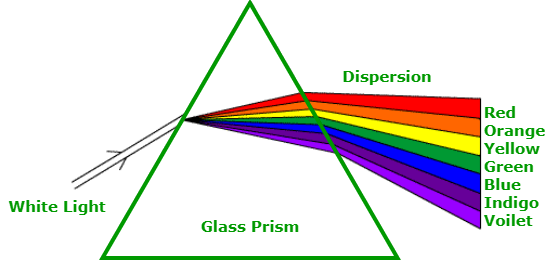
The dispersion of a light wave by a prism is shown in the diagram. As white light is incident on a glass prism, the emergent light appears to be multicolored (violet, indigo, blue, green, yellow, orange and red). The light that bends the least is red, while the light that bends the most is violet. Dispersion is the process of light breaking into its constituent colors. The continuum of light is the pattern of color components in light.
When light falls on the surface it dispersed into several colors depending on the wavelength of the color or the frequency, as we know that frequency and wavelength are inversely proportional to each other. Each color has its own wavelength and frequency, so we see different colors for the same white light.
Causes of the Dispersion of Light
* The various degrees of refraction produced by different colors of light cause dispersion. In a vacuum, various colors of light travel at the same speed, but in a refracting medium, they travel at different speeds.
* Violet light travels at a much slower speed than red light. As a result, violet light has the highest refractive index of the medium, while red light has the lowest.
* As a result, violet light has the highest refractive index, while red light has the lowest refractive index (in the visible spectrum). As a consequence, violet-colored light refracts or bends the most, while red-colored light refracts the least.
* The dispersion of white light into its constituent colors as it emerges from a prism is caused by the disparity in the degree of bending of various colors of light.
Examples of Dispersion of Light
* Dispersion of white light through a prism: As shown in the figure, when white light falls on the prism a collection of seven colors found to come out from the prism due to the dispersion.
* Dispersion due to Oil on Road: Small amounts of oil are usually present on the road surface e.g. lubricating oil from automobiles, which give rise to bands of beautiful colors when it rains.
* Formation of Rainbow: A rainbow is considered to be one of the most amazing light displays ever seen on the planet. A rainbow is a multicolored arc formed by light striking water droplets. Rainbows are formed during rain by the absorption, refraction, and dispersion of light in water droplets. All of these phenomena provide a light spectrum in the sky, which is known as a rainbow.
* Dispersion in a Diamond: Diamond dispersion is where white light enters a diamond (or any dense object), separates into all the spectral colors of the rainbow, and bounces back to the viewer’s eyes in a wonderful display of colored light, also known as diamond fire.
Rainbow Formation
A Rainbow is formed of seven colors (VIBGYOR) Violet, Indigo, Blue, Green, Yellow, Orange, Red. When rain happens the drops of rain falling on the surface works like a prism and when sunlight falls on the drops of water the rays of the sun scatter into different colors and form a rainbow, and sometimes we may also see multiple rainbows. In this concept drops of water, acts likes a prism and create a rainbow. Drops of water are nothing but the spherical ball containing the water and having the refractive index of water (1.333) which makes the white light to dispersed and forming a beam of light of several called rainbow.
Therefore, the necessary conditions for the formation of the rainbow are: the presence of water droplets or raindrops and the position of Sun must be at the back side of the observer of rainbow.
It appears to me that if one wants to make progress in mathematics, one should study the masters and not the pupils. - Niels Henrik Abel.
Nothing is better than reading and gaining more and more knowledge - Stephen William Hawking.
Offline
Pages: 1