Math Is Fun Forum
You are not logged in.
- Topics: Active | Unanswered
Pages: 1
#1 2026-02-21 18:24:25
- Jai Ganesh
- Administrator

- Registered: 2005-06-28
- Posts: 53,937
Tower Bridge, London
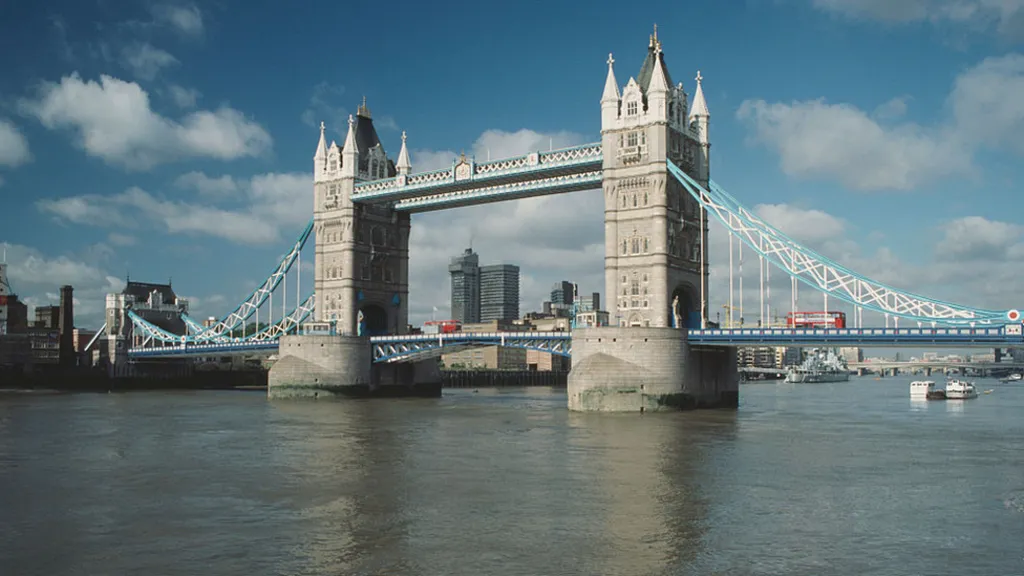
Tower Bridge
Gist
The modern concrete and steel structure we know today was opened to traffic in 1973. Tower Bridge, on the other hand, has never fallen down. It stands today as it was built in 1894. It is known as London's defining landmark - representing London as an iconic structure that is recognised the world-over.
Tower Bridge is one of the most iconic London attractions and it's also very easy to visit. You can walk across the bridge for free or for a slight fee you can walk up inside the bridge, take in the breathtaking skyline and walk across the glass bottom walkway.
Summary
Tower Bridge is a movable bridge of the double-leaf bascule (drawbridge) type that spans the River Thames between the Greater London boroughs of Tower Hamlets and Southwark. It is a distinct landmark that aesthetically complements the Tower of London, which it adjoins.
The bridge was completed in 1894. It is about 240 meters (800 feet) in length and provides an opening 76 meters (250 feet) wide. Its twin towers rise 61 meters (200 feet) above the Thames. Between the towers stretch a pair of glass-covered walkways that are popular among tourists. The walkways were originally designed to allow pedestrians to cross even while the bridge was raised, but they became hangouts for sex workers and thieves and so were closed from 1909 to 1982.
The Tower Bridge was operated by hydraulic pumps driven by steam until 1976, when electric motors were put into operation; the steam power system is still kept (in good repair) as a tourist display. Because of the reduction in shipping at the London Docklands, however, the leaves are raised less frequently. The modern bridge raises the leaves about 800 times a year, down from more than 6,000 times a year in 1894.
Details
Tower Bridge is a Grade I listed combined bascule, suspension, and, until 1960, cantilever bridge in London, built between 1886 and 1894, designed by Horace Jones and engineered by John Wolfe Barry with the help of Henry Marc Brunel. It crosses the River Thames close to the Tower of London and is one of five London bridges owned and maintained by the City Bridge Foundation, a charitable trust founded in 1282.
The bridge was constructed to connect the 39% of London's population that lived east of London Bridge, equivalent to the populations of "Manchester on the one side, and Liverpool on the other", while allowing shipping to access the Pool of London between the Tower of London and London Bridge. The bridge was opened by Edward, Prince of Wales, and Alexandra, Princess of Wales, on 30 June 1894.
The bridge is 940 feet (290 m) in length including the abutments and consists of two 213-foot (65 m) bridge towers connected at the upper level by two horizontal walkways, and a central pair of bascules that can open to allow shipping. Originally hydraulically powered, the operating mechanism was converted to an electro-hydraulic system in 1972. The bridge is part of the London Inner Ring Road and thus the boundary of the London congestion charge zone, and remains an important traffic route with 40,000 crossings every day. The bridge deck is freely accessible to both vehicles and pedestrians, whereas the bridge's twin towers, high-level walkways, and Victorian engine rooms form part of the Tower Bridge Exhibition.
Tower Bridge has become a recognisable London landmark. It is sometimes confused with London Bridge, about 0.5 miles (800 m) upstream, which has led to a persistent urban legend about an American purchasing the wrong bridge.
Touring the bridge
The Tower Bridge attraction is a display housed inside the bridge's towers, the high-level walkways, and the Victorian engine rooms. It uses films, photos, and interactive displays to explain why and how Tower Bridge was built. Visitors can access the original steam engines that once powered the bridge bascules, housed in Engine Rooms, underneath the south end of the bridge.
The attraction charges an admission fee. The entrance is from the ticket office on the west side of the North Tower, from where visitors can climb the stairs (or take a lift) to the high-level Walkways to cross to the South Tower. In the Towers and Walkways is interpretation about the history of the bridge. The Walkways also provide views over the city, the Tower of London and the Pool of London, and include two Glass Floors, where you can look down to see the road and River Thames below. From the South Tower, visitors can visit exit and follow the Blue Line to the Victorian Engine Rooms, with the original steam engines, which are situated in a separate building underneath the southern approach to the bridge.
Of the 1,114 English visitor attractions tracked by Visit England, in 2019 Tower Bridge had 889,338 visitors and was the 34th most visited attraction in England, and the 17th most visited attraction that charged an admission fee. It is one of only three bridges in England tracked as a visitor attraction alongside the Clifton Suspension Bridge in Bristol and The Iron Bridge in Shropshire.
Additional Information
Opened on 30 June 1894, Tower Bridge was built by and is owned and managed by the charity City Bridge Foundation - historically known as Bridge House Estates. It was founded around 900 years ago to maintain the old London Bridge, using income from bridge tolls, rents and bequests. Today, it owns and maintains Tower Bridge and London, Southwark, Millennium and Blackfriars bridges - at no cost to the taxpayer.
Tower Bridge was built to ease road traffic while maintaining river access to the busy Pool of London docks. Built with giant movable roadways that lift up for passing ships, it is to this day considered an engineering marvel and beyond being one of London’s favourite icons.
It appears to me that if one wants to make progress in mathematics, one should study the masters and not the pupils. - Niels Henrik Abel.
Nothing is better than reading and gaining more and more knowledge - Stephen William Hawking.
Offline
Pages: 1