Math Is Fun Forum
You are not logged in.
- Topics: Active | Unanswered
Pages: 1
#1 2026-02-23 16:52:09
- Jai Ganesh
- Administrator

- Registered: 2005-06-28
- Posts: 53,931
Intravenous Infusion
Intravenous Infusion
Gist
IV infusion is the rapid, direct delivery of fluids, medications, or nutrients into the bloodstream via a vein, ensuring 100% absorption compared to oral intake. It is used to treat severe dehydration, electrolyte imbalances, or to administer specialized medication. Common types include hydration, blood products, and medication, often administered by professionals in hospitals or clinics.
The three main types of infusion administration routes are Intravenous (IV) (directly into a vein), Intramuscular (IM) (into a muscle), and Subcutaneous (SQ) (into the fatty tissue under the skin), with Epidural (into the spine) being another important method, all used to deliver medication when oral intake isn't possible or effective. These routes differ in how quickly they deliver drugs, with IV being the fastest, followed by IM, then SQ for slower absorption.
Summary
Intravenous (IV) fluid therapy plays a vital role in modern medical practice, particularly in critical care management. This review aims to summarize the composition, indications, and contraindications of IV fluids, serving as a useful resource for healthcare professionals.
Results:
IV fluids can be administered for various reasons, including resuscitation, correction of electrolyte imbalances, or more critical cases. They can be divided into 2 categories: crystalloids and colloids. Crystalloids, in turn, can be subdivided into unbalanced solutions, such as salines (0.45%, 0.9%, 3%, and 20%) and dextrose 5%, or balanced solutions, such as Ringer lactate and polyelectrolytic solutions. Colloids can be derived from plasma, such as 5% albumin, or semisynthetic, such as 4% modified fluid gelatin. Crystalloids are generally more cost-effective, have a lower risk of allergic reactions, and are more readily available than colloids. However, the use of each solution should be individualized based on the patient's specific needs and corresponding conditions.
Conclusions:
It is essential to have a thorough understanding of available IV fluid solutions to select the best option for each patient's condition at any given time. This review summarizes the most relevant information to guide these decisions. Future research should develop IV fluids that combine the benefits of colloids and crystalloids for safer, more personalized, and cost-effective treatments.
Details
Intravenous therapy (abbreviated as IV therapy) is a medical process that administers fluids, medications and nutrients directly into a person's vein. The intravenous route of administration is commonly used for rehydration or to provide nutrients for those who cannot, or will not—due to reduced mental states or otherwise—consume food or water by mouth. It may also be used to administer medications or other medical therapy such as blood products or electrolytes to correct electrolyte imbalances. Attempts at providing intravenous therapy have been recorded as early as the 1400s, but the practice did not become widespread until the 1900s after the development of techniques for safe, effective use.
The intravenous route is the fastest way to deliver medications and fluid replacement throughout the body as they are introduced directly into the circulatory system and thus quickly distributed. For this reason, the intravenous route of administration is also used for the consumption of some recreational drugs. Many therapies are administered as a "bolus" or one-time dose, but they may also be administered as an extended infusion or drip. The act of administering a therapy intravenously, or placing an intravenous line ("IV line") for later use, is a procedure which should only be performed by a skilled professional. The most basic intravenous access consists of a needle piercing the skin and entering a vein which is connected to a syringe or to external tubing. This is used to administer the desired therapy. In cases where a patient is likely to receive many such interventions in a short period (with consequent risk of trauma to the vein), normal practice is to insert a cannula which leaves one end in the vein, and subsequent therapies can be administered easily through tubing at the other end. In some cases, multiple medications or therapies are administered through the same IV line.
IV lines are classified as "central lines" if they end in a large vein close to the heart, or as "peripheral lines" if their output is to a small vein in the periphery, such as the arm. An IV line can be threaded through a peripheral vein to end near the heart, which is termed a "peripherally inserted central catheter" or PICC line. If a person is likely to need long-term intravenous therapy, a medical port may be implanted to enable easier repeated access to the vein without having to pierce the vein repeatedly. A catheter can also be inserted into a central vein through the chest, which is known as a tunneled line. The specific type of catheter used and site of insertion are affected by the desired substance to be administered and the health of the veins in the desired site of insertion.
Placement of an IV line may cause pain, as it necessarily involves piercing the skin. Infections and inflammation (termed phlebitis) are also both common side effects of an IV line. Phlebitis may be more likely if the same vein is used repeatedly for intravenous access, and can eventually develop into a hard cord which is unsuitable for IV access. The unintentional administration of a therapy outside a vein, termed extravasation or infiltration, may cause other side effects.
Additional Information
Most children will have an intravenous (IV) infusion at some point in hospital. We think it is helpful to explain what an infusion is and what it involves, so it is less scary for your child. This page from Great Ormond Street Hospital (GOSH) describes how infusions are used at GOSH, how they are inserted and what to expect when your child has one.An intravenous (IV) infusion is a way of delivering fluid or medicine directly into your child’s bloodstream. This enables the fluid or medicine to get into your child’s system much quicker than taking it by mouth. We use an infusion when a child cannot swallow medicine by mouth or it is better to give it into the bloodstream.
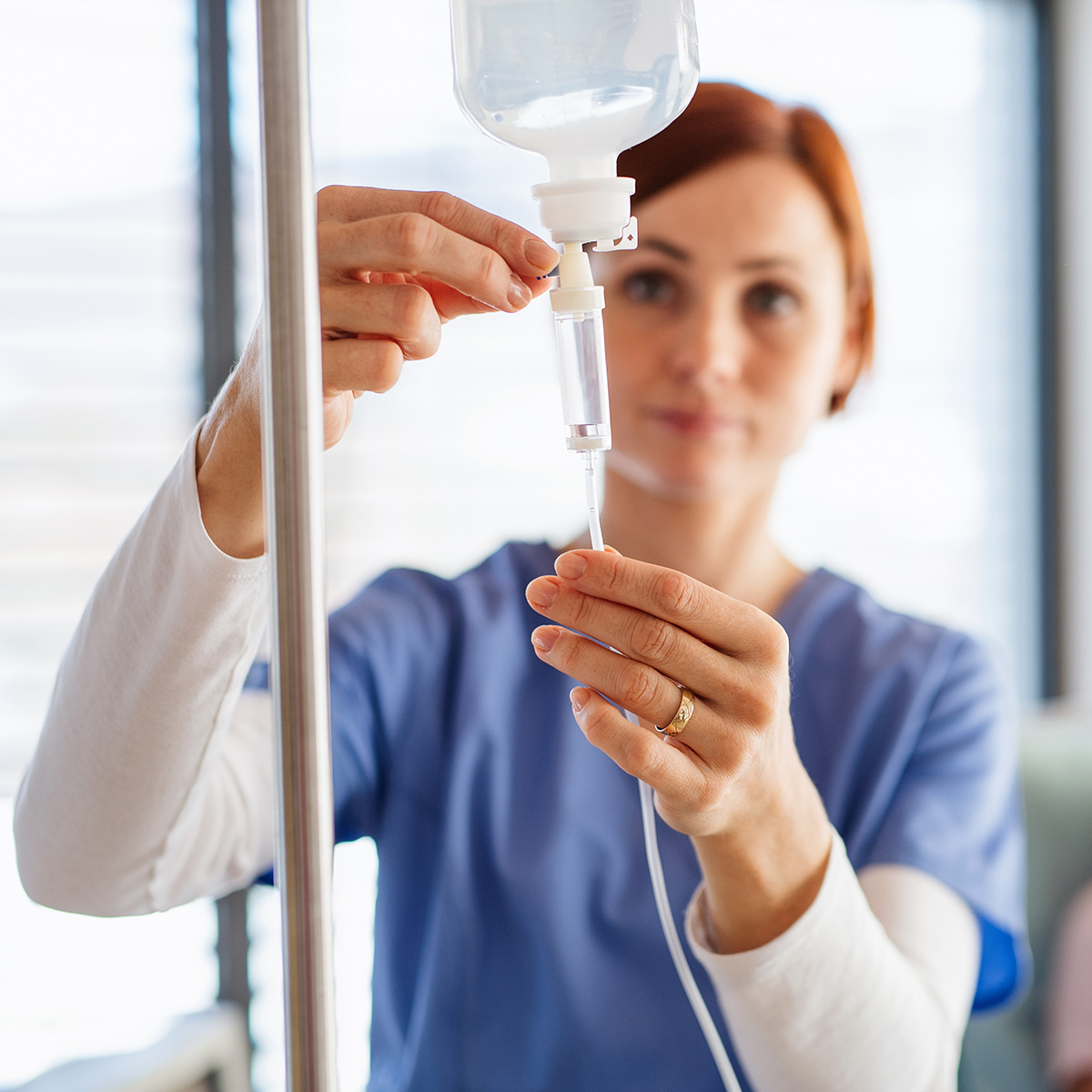
An IV infusion consists of various bits of equipment joined together. The first bit is a cannula (thin, plastic tube) which is put into a vein, usually in their hand or arm. The cannula is then connected to a longer, wider tube which, in turn, is joined to a bag containing the fluid or medicine.
This bag is attached to a machine, which helps to make sure the correct amount of fluid or medicine is given. The machine and bag are hung on a drip stand on wheels so that gravity helps the fluid or medicine.
How is an IV infusion set up?
The first stage is to insert a cannula into a vein.
Most children and young people at GOSH have local anaesthetic cream put on their skin before a cannula is inserted. This takes up to an hour to make the skin numb and is then wiped off.
Alternatively, some children prefer a cold spray, which only takes a few seconds to work but wears off quickly too.
The next stage is to find the right vein to use – usually a vein in the wrist or back of the hand. The nurse will usually put a tight band (tourniquet) around the arm so that the veins stand out better.
They will feel the back of your child’s hand or lower arm to find the best vein and clean the skin over it with an alcohol wipe. They will quickly insert a needle into the vein – this contains the cannula – and remove the needle, leaving the cannula in the vein.
The nurse will usually give the cannula a quick flush of saline (salt water) solution to check it is in the right place and prepare it for the drip. They will make the cannula secure with a see-through dressing and medical sticky tape, before connecting the cannula to a longer, wider piece of tubing called a ‘giving set’. This has a plastic spike on the end so it can be connected to an IV bag.
Finally, the nurse will secure the cannula on your child’s arm or wrist with a splint and bandage – this will stop the cannula being dislodged.
The nurse will connect the cannula to the giving set, thread the longer, wider tube through an IV pump and program the flow rate. The fluid will drip regularly into the drip chamber, through the machine and into your child’s bloodstream.
IV pumps have lots of alarms to tell your nurse about any problems or that the fluid or medicine has all been delivered. The nurse will be listening out for alarms so do not try to turn them off.
Sometimes the medicine can leak out of the vein (extravasation), which can be harmful, depending on the medicine that has leaked. If your child complains of pain or stinging near the cannula, or you notice any redness to the area and the surrounding area, tell the nurse immediately.
All infusions are connected in the same way using the spike and programmed into the IV pump.
When your child no longer needs any IV infusions and the cannula isn’t needed anymore, the nurse will disconnect the tubing from the cannula and throw away the IV bag and giving set.
They will remove the see-through dressing and medical sticky tape, then press down on the vein with gauze or cotton wool while they pull out the cannula. They will tape the gauze or cotton wool in place – you should leave this in place for 30 minutes or so.
It appears to me that if one wants to make progress in mathematics, one should study the masters and not the pupils. - Niels Henrik Abel.
Nothing is better than reading and gaining more and more knowledge - Stephen William Hawking.
Offline
Pages: 1