Math Is Fun Forum
You are not logged in.
- Topics: Active | Unanswered
Pages: 1
#1 2026-03-01 18:03:57
- Jai Ganesh
- Administrator

- Registered: 2005-06-28
- Posts: 53,937
Hydrogen Peroxide
Hydrogen Peroxide
Gist
Hydrogen peroxide (H2O2) is a powerful, versatile oxidizing agent and antiseptic, commonly used at 3% concentration for treating minor skin wounds, mouth irritation, bleaching hair, and disinfecting surfaces. It acts as an antimicrobial by releasing oxygen to break down microorganisms, though it can damage healthy tissue.
Hydrogen peroxide is used as a versatile disinfectant, antiseptic, and bleaching agent for wound cleaning, surface sanitizing, laundry whitening, and hair lightening, while industrially it bleaches paper, treats wastewater, and aids in chemical synthesis, with uses also extending to food packaging and agriculture, but it should be used cautiously on skin to avoid damage.
Summary
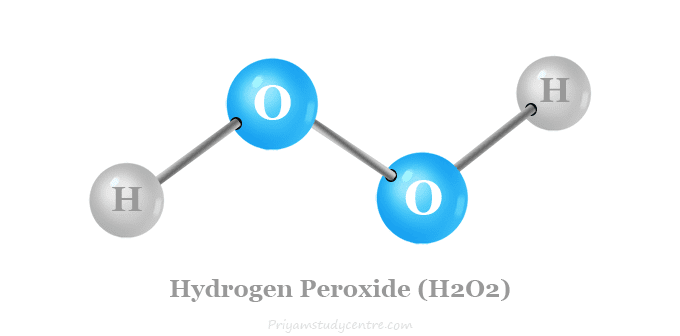
Hydrogen peroxide is a chemical compound with the formula H2O2. In its pure form, it is a very pale blue liquid; however, at lower concentrations, it appears colorless due to the faintness of the blue coloration. The molecule hydrogen peroxide is asymmetrical and highly polarized. Its strong tendency to form hydrogen bond networks results in greater viscosity compared to water. It is used as an oxidizer, bleaching agent, and antiseptic, usually as a dilute solution (3%–6% by weight) in water for consumer use and in higher concentrations for industrial use. Concentrated hydrogen peroxide, or "high-test peroxide", decomposes explosively when heated and has been used as both a monopropellant and an oxidizer in rocketry.
Hydrogen peroxide is a reactive oxygen species and the simplest peroxide, a compound having an oxygen–oxygen single bond. It decomposes slowly into water and elemental oxygen when exposed to light, and rapidly in the presence of organic or reactive compounds. It is typically stored with a stabilizer in a weakly acidic solution in an opaque bottle. Hydrogen peroxide is found in biological systems including the human body. Enzymes that use or decompose hydrogen peroxide are classified as peroxidases.
Details
Remember the days when a tumble off your bike inevitably led to a cotton ball dipped in hydrogen peroxide? If you’ve never been subjected to the sting, consider yourself lucky. And rest assured that healthcare experts no longer recommend using hydrogen peroxide for cuts and scrapes.
But it still has a lot of other uses around your home.
We asked family medicine physician Sarah Pickering Beers, MD, to explain how to use hydrogen peroxide safely — and when to leave it on the shelf.
What is hydrogen peroxide?
Hydrogen peroxide is water with an extra oxygen molecule (H2O2 instead of H2O). That extra boost of oxygen gives it serious cleaning and germ-killing power.
“The extra oxygen molecule kills bacteria,” Dr. Pickering Beers says. “It’s also what removes color from porous surfaces like fabric.” (In other words, it bleaches them.)
Is hydrogen peroxide safe?
Yes — but with limits. Hydrogen peroxide can be helpful for disinfecting and stain removal.
But don’t use it directly on your skin.
“Hydrogen peroxide has fallen out of favor as a wound cleanser,” Dr. Pickering Beers says. “It irritates the skin and can prevent the wound from healing. Essentially, it can do more harm than good.”
Instead, wash minor wounds with soap and water, pat dry and apply antibiotic ointment and a bandage.
It’s a similar story with acne. In the past, hydrogen peroxide may have been a suggested remedy for pimples, but it’s no longer recommended.
“It’s too irritating for skin and doesn’t stay active long enough to help with acne,” she explains. Opt for acne-fighters like salicylic acid or benzoyl peroxide instead. They penetrate your skin and fight acne-causing bacteria longer — and are gentler on your skin.
What is hydrogen peroxide used for?
Hydrogen peroxide can be used all over your home — from the bathroom to the fridge — as long as you use it safely.
Follow these precautions:
* Keep it out of reach of kids and pets. Hydrogen peroxide can be harmful if swallowed or spilled on skin in large amounts.
* Use gloves and ventilate the space. Peroxide can irritate your skin and eyes. And breathing it in can be harmful.
* If it stops bubbling when you use it, it’s expired. Pour it down the drain and replace it.
* Keep it in its original container or a dark spray bottle. Hydrogen peroxide breaks down over time, especially when exposed to light.
* Stick with 3% medical-grade peroxide. Stronger concentrations, like 35% food-grade peroxide, aren’t safe for home use. “Food-grade peroxide can be toxic if you inhale it or get it on your skin,” Dr. Pickering Beers warns.
With those ground rules covered, let’s clean up.
Cleaning and disinfecting
Hydrogen peroxide kills germs. Use a 50/50 mix of water and peroxide in a spray bottle to disinfect shared objects and surfaces, like:
* Counters
* Cutting boards
* Doorknobs
* Mirrors
* Garbage cans
* Refrigerators
* Sinks and bathtubs
* Toilets
* Toys
Spray, let sit for five minutes and rinse surfaces that touch food.
Washing produce
Want a cheap, chemical-free way to clean fruits and veggies?
Add 1/4 cup of peroxide to a large bowl or sink full of water. Soak your fruits and veggies, rinse them well and allow them to dry.
This method helps remove germs and pesticides — and may even help your produce last longer.
Removing household stains
Hydrogen peroxide is a natural bleach. It works great on white or off-white surfaces — but test a small area first. Like bleach, it can remove color, so avoid using it on colored fabrics.
Try it on:
* Carpet stains: Spray on white carpet and blot gently.
* Clothing stains: Soak white clothes in a mix of water and 1 cup of peroxide for 30 minutes. Or add peroxide to your washer’s bleach compartment.
* Grout: Spray on white tile grout, let it sit, then scrub.
* Cookware: Sprinkle baking soda on ceramic pots and pans, spray with peroxide, let sit 10 minutes and rinse.
Cleaning beauty tools
Hydrogen peroxide isn’t a skin care product, but you can use it to sanitize tools, like your:
* Nail clippers
* Tweezers
* Eyelash curlers
* Nails
Noticing yellow or discolored fingernails? Or did opting for midnight blue during your last mani-pedi leave your nails stained?
Soaking your nails in warm water and 3 tablespoons of peroxide for three minutes can brighten them up.
This method works best on natural nails. Don’t use it if you have cuts or broken skin around your cuticles, and stop if you notice irritation.
Teeth
Hydrogen peroxide is found in many over-the-counter teeth-whitening products. It can help lift stains, but use it with care.
“Talk to your dentist before trying whitening products,” advises Dr. Pickering Beers. “They can make your teeth more sensitive.”
You can also try gargling with diluted peroxide to kill everyday germs in your mouth. Or choose mouthwash that already contains peroxide (and probably tastes better). Just be sure not to swallow it.
You can also try using hydrogen peroxide to clean your toothbrush. Dip it in peroxide for five minutes to kill germs and rinse thoroughly with water. If you choose this method, be sure to change out the peroxide daily — and always replace your toothbrush at least every three to four months.
Bottom line
Hydrogen peroxide is a powerful cleaning solution — but it’s not for your body. So, if you haven’t already, it’s time to move your brown bottle of bubbly stuff from the medicine cabinet and find it a new home with the cleaning supplies.
Additional Information
Hydrogen peroxide is a colorless liquid at room temperature with a bitter taste. Small amounts of gaseous hydrogen peroxide occur naturally in the air. Hydrogen peroxide is unstable, decomposing readily to oxygen and water with release of heat. Although nonflammable, it is a powerful oxidizing agent that can cause spontaneous combustion when it comes in contact with organic material. Hydrogen peroxide is found in many households at low concentrations (3-9%) for medicinal applications and as a clothes and hair bleach. In industry, hydrogen peroxide in higher concentrations is used as a bleach for textiles and paper, as a component of rocket fuels, and for producing foam rubber and organic chemicals.
Hydrogen peroxide, aqueous solution, stabilized, with more than 60% hydrogen peroxide appears as a colorless liquid. Vapors may irritate the eyes and mucous membranes. Under prolonged exposure to fire or heat containers may violently rupture due to decomposition. Used to bleach textiles and wood pulp, in chemical manufacturing and food processing.
Hydrogen peroxide, aqueous solution, with not less than 20% but not more than 60% hydrogen peroxide (stabilized as necessary) appears as colorless aqueous solution. Vapors may irritate the eyes and mucous membranes. Contact with most common metals and their compounds may cause violent decomposition, especially in the higher concentrations. Contact with combustible materials may result in spontaneous ignition. Prolonged exposure to fire or heat may cause decomposition and rupturing of the container. Used to bleach textiles and wood pulp, in chemical manufacturing and food processing.
Hydrogen peroxide solution is the colorless liquid dissolved in water. Its vapors are irritating to the eyes and mucous membranes. The material, especially the higher concentrations, can violently decompose in contact with most common metals and their compounds. Contact with combustible materials can result in spontaneous ignition. Under prolonged exposure to fire or heat containers may violently rupture due to decomposition of the material. It is used to bleach textiles and wood pulp, in chemical manufacturing and food processing.
Hydrogen peroxide, stabilized appears as a crystalline solid at low temperatures. Has a slightly pungent, irritating odor. Used in the bleaching and deodorizing of textiles, wood pulp, hair, fur, etc. as a source of organic and inorganic peroxides; pulp and paper industry; plasticizers; rocket fuel; foam rubber; manufacture of glycerol; antichlor; dyeing; electroplating; antiseptic; laboratory reagent; epoxidation; hydroxylation; oxidation and reduction; viscosity control for starch and cellulose derivatives; refining and cleaning metals; bleaching and oxidizing agent in foods; neutralizing agent in wine distillation; seed disinfectant; substitute for chlorine in water and sewage treatment.
Hydrogen peroxide is the simplest peroxide with a chemical formula H2O2. Hydrogen peroxide is an unstable compound in the presence of a base or catalyst, and is typically stored with a stabilizer in a weakly acidic solution. If heated to its boiling point, it may undergo potentially explosive thermal decomposition. Hydrogen peroxide is formed in the body of mammals during reduction of oxygen either directly in a two-electron transfer reaction. As a natural product of metabolism, it readily undergoes decomposition by catalase in normal cells. Due to its potent and broad-spectrum antimicrobial actions, hydrogen peroxide is used in both liquid and gas form for preservative, disinfection and sterilization applications as an oxidative biocide. It is used in industrial and cosmetic applications as a bleaching agent. Hydrogen peroxide is also considered as a generally recognized as safe compound by the FDA; it is used as an antimicrobial agent in starch and cheese products, and as an oxidizing and reducing agent in products containing dried eggs, dried egg whites, and dried egg yolks.
Hydrogen Peroxide is a peroxide and oxidizing agent with disinfectant, antiviral and anti-bacterial activities. Upon rinsing and gargling or topical application, hydrogen peroxide exerts its oxidizing activity and produces free radicals which leads to oxidative damage to proteins and membrane lipids. This may inactivate and destroy pathogens and may prevent spreading of infection.
Uses of Hydrogen Peroxide
* Industrial peroxide is mostly used in medicine and is a bleaching agent in our everyday life. About 30% of peroxide is used as a bleaching agent for textiles, paper, pumps, lather, and oil industries.
* A large quantity of about 33% uses in the manufacture of borax, epoxides, propylene oxide, and other chemicals.
* In environmental science, peroxide is used in pollution control during the treatment of sewage cleanup and waste.
* It uses as a mild antiseptic to prevent the small cuts, and buns on the skin.
* Hydrogen peroxide is also used as a mouth rinse in medicine to the freshness or as a mouth cleaner.
It appears to me that if one wants to make progress in mathematics, one should study the masters and not the pupils. - Niels Henrik Abel.
Nothing is better than reading and gaining more and more knowledge - Stephen William Hawking.
Offline
Pages: 1