Math Is Fun Forum
You are not logged in.
- Topics: Active | Unanswered
#2726 2026-03-18 00:04:18
- Jai Ganesh
- Administrator

- Registered: 2005-06-28
- Posts: 53,931
Re: Miscellany
2525) Sulfur Dioxide
Gist
Sulfur dioxide (SO2) is a colorless, pungent, and toxic gas composed of sulfur and oxygen, primarily produced by burning fossil fuels and volcanic activity. It is a major air pollutant known to cause respiratory issues, such as difficulty breathing and asthma exacerbation. Industrially, it is crucial for manufacturing sulfuric acid and used as a preservative in food and wine.
Sulfur dioxide (SO2) is an industrial chemical used primarily as a precursor for sulfuric acid production, a preservative (especially for dried fruits and wine), a bleaching agent in paper/pulp manufacturing, and a disinfectant. It acts as a reducing agent in chemical processes and a refrigerant in industrial cooling systems.
Summary
Sulfur dioxide (SO2), is an inorganic compound, a heavy, colorless, poisonous gas. It is produced in huge quantities in intermediate steps of sulfuric acid manufacture.
Sulfur dioxide has a pungent, irritating odor, familiar as the smell of a just-struck match. Occurring in nature in volcanic gases and in solution in the waters of some warm springs, sulfur dioxide usually is prepared industrially by the burning in air or oxygen of sulfur or such compounds of sulfur as iron pyrite or copper pyrite. Large quantities of sulfur dioxide are formed in the combustion of sulfur-containing fuels.
Sulfur dioxide pollution carries serious health and environmental risks and is one of the six criteria air pollutants regulated by the U.S. Environmental Protection Agency and other regulatory agencies around the world. In the atmosphere sulfur dioxide can combine with water vapor to form sulfuric acid, a major component of acid rain; in the second half of the 20th century, measures to control acid rain were widely adopted. Most of the sulfur dioxide released into the environment comes from coal-fired power plants and petroleum refineries. Paper pulp manufacturing, cement manufacturing, and metal smelting and processing facilities are other important sources.
Sulfur dioxide is a precursor of the trioxide (SO3) used to make sulfuric acid. In the laboratory the gas may be prepared by reducing sulfuric acid (H2SO4) to sulfurous acid (H2SO3), which decomposes into water and sulfur dioxide, or by treating sulfites (salts of sulfurous acid) with strong acids, such as hydrochloric acid, again forming sulfurous acid.
Details
Sulfur dioxide (SO2) is a pungent, toxic gas that is the primary product of burning elemental sulfur. It exists widely in nature, mostly from volcanic activity and burning fossil fuels. It is found elsewhere in the solar system, as a gas in the atmospheres of Venus and Jupiter’s moon Io and as an ice on the other Galilean moons.
The major use of SO2 is in the manufacture of sulfuric acid (H2SO4), the most-produced chemical worldwide. Elemental sulfur and oxygen react to form SO2, which is catalytically oxidized with additional oxygen to make sulfur trioxide (SO3). The SO3 is mixed with existing H2SO4 to produce oleum (fuming sulfuric acid), which is added to water in a strongly exothermic process to make concentrated H2SO4. This is known as the contact process; it dates to an 1831 patent by British inventor Peregrine Phillips.
In chemical laboratories, it has multiple functions, including as a reducing agent, as a reagent in sulfonylation reactions, and as a low-temperature solvent. SO2 is also used to preserve dried fruits such as raisins and prunes and to prevent spoilage in wine.
The hazard information table shows that SO2 is pretty nasty stuff; but, in addition to its value as a chemical, it has another positive side: Volcanoes that emit the gas can have a beneficial effect on climate change. When SO2 spews into the stratosphere, it reacts photochemically with oxygen to form H2SO4 aerosols, which in turn reflect solar radiation and cool the atmosphere. But, as might be expected, even this has a downside because SO2 and H2SO4 contribute to acid rain.
Additional Information:
What Is Sulfur Dioxide?
Sulfur dioxide (SO2) is a gaseous air pollutant composed of sulfur and oxygen. SO2 forms when sulfur-containing fuel such as coal, petroleum oil, or diesel is burned. Sulfur dioxide gas can also change chemically into sulfate particles in the atmosphere, a major part of fine particle pollution, which can blow hundreds of miles away.
What Are the Health Effects of Sulfur Dioxide Pollution?
Sulfur dioxide causes a range of harmful effects on the lungs:
* Wheezing, shortness of breath and chest tightness and other problems, especially during exercise or physical activity. Rapid breathing during exercise helps SO2 reach the lower respiratory tract, as does breathing through the mouth.
* Long-term exposure at high levels increases respiratory symptoms and reduces the ability of the lungs to function.
* Short exposures to peak levels of SO2 in the air can make it difficult for people with asthma to breathe when they are active outdoors.
* Increased risk of hospital admissions or emergency room visits, especially among children, older adults and people with asthma.
What Are the Sources of Sulfur Dioxide Emissions?
As of 2020, human-made sources in the U.S. emit about 1.8 million short tons of sulfur dioxide per year (down from just over 6 million short tons per year in 2011) mainly from burning fuels. Power plants, commercial and institutional boilers, internal combustion engines, manufacturing, and industrial processes such as petroleum refining and metal processing are the largest sources of emissions, followed by diesel engines in old buses and trucks, locomotives, ships, and off-road equipment such as construction vehicles. Emissions of sulfur dioxide will decline as cleanup of many of these sources continue in future years.
Where Do High SO2 Concentrations Occur?
Coal-fired power plants remain one of the biggest sources of sulfur dioxide in the U.S. Columns of emissions (plumes) such as from chimneys of a coal-fired power plant are moved by wind over long distances before touching down at ground level at far away sites. These plumes could also get trapped at the ground level by unusual weather conditions such as a layer of warmer air occurring higher up in the atmosphere (inversion).
Ports, smelters, and other sources of sulfur dioxide also cause high concentrations of emissions nearby.
People who live and work near these large sources get the highest exposure to SO2.
What Can We Do about it?
SO2 levels have improved over time, thanks to policies requiring cleaner fuels and pollution controls on power plants. The nation achieved major reductions in this pollutant through its successful program to reduce acid rain.
However, it remains a health concern. What’s more, even with pollution controls installed, high levels can occur when a polluting source such as a power plant is starting up or shutting down its operation or if its equipment malfunctions.
Individuals can take steps to protect themselves on days with unhealthy levels of air pollutants and also ask policymakers at all levels of government to continue to require cleanup of air pollution.

It appears to me that if one wants to make progress in mathematics, one should study the masters and not the pupils. - Niels Henrik Abel.
Nothing is better than reading and gaining more and more knowledge - Stephen William Hawking.
Offline
#2727 2026-03-19 00:08:34
- Jai Ganesh
- Administrator
- Registered: 2005-06-28
- Posts: 53,931
Re: Miscellany
2526) Potassium Hydroxide
Gist
Potassium hydroxide is a disinfectant used to clean hands, skin, and surfaces. Potassium hydroxide, also known as lye is an inorganic compound with the chemical formula KOH. Also commonly referred to as caustic potash, it is a potent base that is marketed in several forms including pellets, flakes, and powders.
Potassium hydroxide is an inorganic compound with the formula KOH, and is commonly called caustic potash. Along with sodium hydroxide, KOH is a prototypical strong base. It has many industrial and niche applications, most of which utilize its caustic nature and its reactivity toward acids.
Summary
Potassium hydroxide is an inorganic compound with the formula KOH, and is commonly called caustic potash.
Along with sodium hydroxide (NaOH), KOH is a prototypical strong base. It has many industrial and niche applications, most of which utilize its caustic nature and its reactivity toward acids. About 2.5 million tonnes were produced in 2023. KOH is noteworthy as the precursor to most soft and liquid soaps, as well as numerous potassium-containing chemicals. It is a white solid that is dangerously corrosive.
Properties and structure
KOH exhibits high thermal stability. Because of this high stability and relatively low melting point, it is often melt-cast as pellets or rods, forms that have low surface area and convenient handling properties. These pellets become tacky in air because KOH is hygroscopic. Most commercial samples are ca. 90% pure, the remainder being water and carbonates. Its dissolution in water is strongly exothermic. Concentrated aqueous solutions are sometimes called potassium lyes. Even at high temperatures, solid KOH does not dehydrate readily.
Details
Potassium hydroxide is also known as caustic potash, lye, and potash lye. This alkali metal hydroxide is a very powerful base. The aqueous form of potassium hydroxide appears as a clear solution. In its solid form, KOH can exist as white to slightly yellow lumps, flakes, pellets, or rods. No characteristic odour can be attributed to this compound in its solid state.
Potassium hydroxide is soluble in water, freely soluble in ethanol, methanol, and glycerin. It is slightly soluble in ether. It is non-combustible but highly corrosive. It is widely used in chemical manufacturing, cleaning compounds, and petroleum refining.
Uses of Potassium Hydroxide
* Potassium hydroxide solution is more conductive when compared to NaOH and therefore used as an electrolyte in some alkaline batteries.
* It is used as a pH control agent in the food industry.
* It is used in the thickening of food.
* It is used in chip fabrication for semiconductors.
* It is used in the manufacturing of cuticle removers which are used in manicure treatment.
* It is used in the identification of species of fungi.
* It is used in mercerizing cotton.
* It is used in alkalimetric titrations in analytical chemistry.
* Used in the manufacturing of liquid fertilisers.
Chemical Reactions Undergone by KOH
1. Saponification of ester
The ester is saponified by heating with a known amount of potassium hydroxide in an organic solvent in a sealed tube. To be useful analytically, this reaction must be quantitative in a reasonable length of time. One condition that favours a rapid and quantitative reaction is the use of KOH as a strong base as possible.
2. KOH reacts with CO2 to produce bicarbonate
The addition of hydroxide ions by adding lime, sodium hydroxide, or potassium hydroxide, adjusts the pH because the hydroxide ion reacts with carbon dioxide to form bicarbonate alkalinity.
Health Hazards of KOH
The health hazards of potassium hydroxide are similar to those of the other strong alkalies, such as sodium hydroxide. Potash lye and its solution can severely irritate skin, mucous membranes, and eyes. When it comes in contact with water or moisture it can generate heat to instigate combustion. Potassium hydroxide is corrosive to tissues.
Frequently Asked Questions – FAQs
Q1: What is potassium hydroxide used for?
A1: Potassium hydroxide, or caustic potash, is used in a wide variety of industries. It is used in the chemical industry, mining, manufacturing of different compounds, fertilisers, in potassium soaps and in detergents.
Q2: What are the dangers of potassium hydroxide?
A2: Causes eye pain, tearing, redness and swelling. Larger exposures cause serious burns with potential subsequent blindness. Chronic exposure: repeated contact with dilute solutions of potassium hydroxide dust has a tissue-destroying effect.
Q3: Is potassium hydroxide a carcinogen?
A3: The National Toxicology Program (NTP), the International Agency for Research on Cancer (IARC), and the Occupational Safety and Health Administration (OSHA) do not recognize potassium hydroxide as a carcinogen. Potassium hydroxide is of low toxicity to marine species.
Q4: What is potassium hydroxide in chemistry?
A4: Potassium hydroxide, also called lye, is an inorganic compound containing the chemical formula KOH. Often commonly called caustic potash, it is a strong base that is sold in different forms including pellets, flakes, and powders.
Q5: What is the pH of KOH?
A5: KOH is an example of a strong base which means that it dissociates completely in an aqueous solution into its ions. Although the pH of KOH or potassium hydroxide is extremely high (typical solutions typically range from 10 to 13), the exact value depends on the concentration of this strong base in water.
Additional Information
Potassium hydroxide (KOH) is an alkali that penetrates and destroys the skin by dissolving keratin. It is used in aqueous solution at concentrations of 5% to 20%, and applied to MC lesions once or twice per day.20,26 In a prospective trial in which 35 children with MC lesions received twice-daily treatments with 10% KOH aqueous solution, complete lesion resolution was observed in 32 of the patients. Applications were discontinued in 3 patients due to severe stinging and secondary infection. The efficacy of KOH has been compared with that of other MC treatments. No significant differences were reported in a trial comparing the efficacy of cryotherapy with that of 10% KOH in solution for the treatment of MC. However, the higher cost and secondary local effects of cryotherapy would tend to favor the use of KOH. Another study found that 10% KOH and 5% imiquimod cream were equally effective, but that KOH had a faster onset of action. Finally, a third study compared 10% KOH administered once per day with salicylic acid and lactic acid in combination, finding they were equally effective in the treatment of MC. Because 10% KOH treatment is noninvasive, efficacious, and can be applied at home, many authors consider it to be the first line of therapy.
MC: Molluscum contagiosum is defined as a contagious viral infection that can manifest on the skin, commonly found on the face in children and on the inner thighs, abdomen, and in adults and athletes.

It appears to me that if one wants to make progress in mathematics, one should study the masters and not the pupils. - Niels Henrik Abel.
Nothing is better than reading and gaining more and more knowledge - Stephen William Hawking.
Offline
#2728 2026-03-20 00:06:35
- Jai Ganesh
- Administrator
- Registered: 2005-06-28
- Posts: 53,931
Re: Miscellany
2527) Ammonium Phosphate
Gist
Ammonium phosphate is a group of water-soluble inorganic salts, commonly (triammonium phosphate), formed by reacting ammonia with phosphoric acid. It is a white, crystalline solid with an ammonia odor, primarily used as a high-nutrient, readily absorbed fertilizer (N-P-K), a fire-extinguishing agent, and in food processing.
Ammonium phosphate, including Monoammonium Phosphate (MAP) and Diammonium Phosphate (DAP), is primarily used as a high-nutrient, water-soluble fertilizer, providing nitrogen and phosphorus for agricultural, forestry, and lawn applications. Key uses also include fire suppression in ABC dry chemical extinguishers, food-grade additives (leavening/yeast nutrition), and industrial applications like fire retardants for wood/paper.
Summary
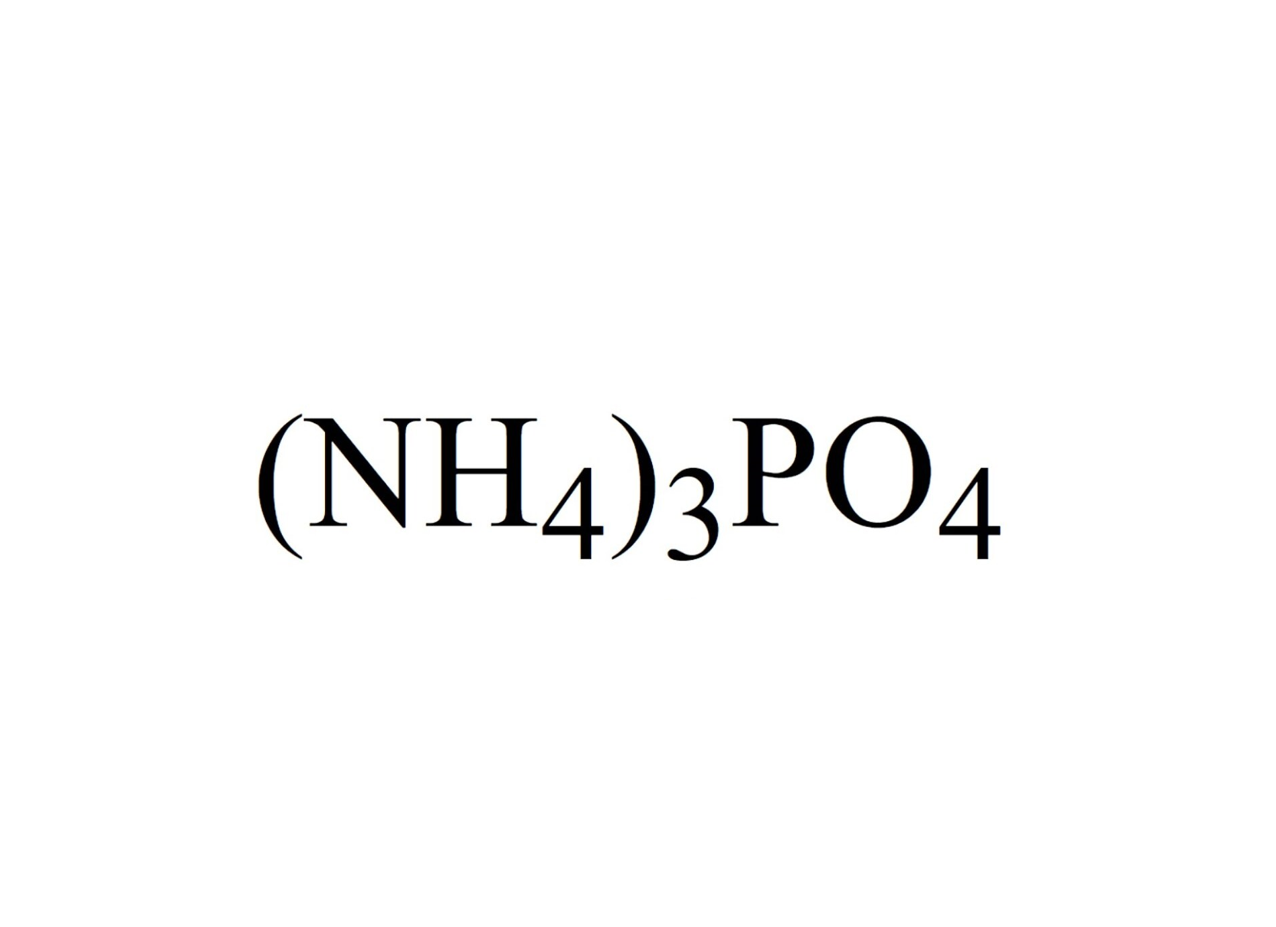
Ammonium phosphate is the inorganic compound with the formula (NH4)3PO4. It is the ammonium salt of orthophosphoric acid. A related double salt, (NH4)3PO4.(NH4)2HPO4 is also recognized but is impractical to use. Both triammonium salts evolve ammonia. In contrast to the unstable nature of the triammonium salts, the diammonium phosphate (NH4)2HPO4 and monoammonium salt (NH4)H2PO4 are stable materials that are commonly used as fertilizers to provide plants with fixed nitrogen and phosphorus.
Details
Ammonium phosphate is an unstable compound made of ammonium and phosphate salt with the chemical formula (NH4)3PO4.
Ammonium phosphate is manufactured by mixing together ammonium phosphate and urea in a molten condition. Considerable heat is generated which transform the ammonium phosphate to the molten state. It includes a group of nitrogen phosphorus materials: mono ammonium phosphates and diammonium phosphates, mixtures of the two or combinations with ammonium nitrate or ammonium sulfate.
Uses of Ammonium phosphate – (NH4)3PO4
* Ammonium phosphate is a broad generic name for a variety of fertilizer materials containing both nitrogen and phosphate.
* Ammonium phosphates are becoming increasingly important as a source of available P2O5. P2O5 is somewhat higher in ammonium phosphates than in triple superphosphate.
* Mainly used as a solid fertilizer but can also be utilized in solution.
* Used as components of intumescent paints and mastics where they function as an acid catalyst.
* Used in paints in which pentaerythritol is the carbonific component and melamine is the specific compound.
Frequently Asked Questions – FAQs
Q1: What is ammonium phosphate used for?
A1: Ammonium phosphate is a high source of elemental nitrogen used as an ingredient in certain fertilizers. This is also used in thermoplastic formulations as a flame retardant.
Q2: What is ammonium phosphate fertilizer?
AmmA2: onium phosphate adds nitrogen and phosphates to the lawns which lack the nutrients. Ammonium phosphate is a fast-release fertilizer that can be used for new grass planting, cleaning, monitoring, or lawn renovation.
Q3: What’s the difference between ammonia and ammonium?
A3: Ammonia contains one nitrogen and three hydrogens opposed to one nitrogen and four hydrogens formed by ammonium. Ammonia is a low, unionized foundation. In the other side, it is ionized to ammonium. Some major distinctions between the two is that Ammonia gives off a heavy odour while Ammonium does not smell at all.
Q4: Is ammonium phosphate an acid?
A4: Ammonium phosphate is an orthophosphoric acid ammonium salt. Formula (NH4)3PO4 is a highly unstable compound. It is elusive, and of little economic interest due to its uncertainty.
Q5: Why is ammonium phosphate soluble in water?
A5: It is soluble in water, and ammonia loses and the acid phosphate (NH4)(H2PO4) is formed as the aqueous solution on the boil. Ammonium phosphate is a high source of elemental nitrogen used as an ingredient in certain fertilizers. This is also used in thermoplastic formulations as a flame retardant.
Additional Information:
Key Properties and Everyday Uses of Ammonium Phosphate
Ammonium phosphate is a salt that is made up of ammonia and phosphorus, and its chemical formula is (NH4)3PO4. However, this is a very unstable salt and due to how unstable it is, it is not exactly a salt worth a lot of commercial value. It can be formed by combining phosphoric acid along with ammonia, or by adding a lot more ammonia with acid phosphate.
For it to be used commercially, it is mostly obtained from crystalline powders.
Major Uses of Ammonium Phosphate:
* Agriculture & Fertilizer: High-concentration, soluble fertilizers (MAP/DAP) provide quick nutrients to plants and are used in foliar feeding and irrigation.
* Fire Retardant & Extinguisher: Used as an ingredient in dry chemical powder extinguishers and in flame-retardant coatings for materials like paper and wood.
* Food Industry: Functions as a leavening agent in baking powders and as a dough conditioner, as well as a yeast nutrient for wine production.
* Industrial Applications: Acts as a fluxing agent in soldering, in the production of intumescent paints, and as a raw material for producing electronics such as piezo-electric crystals.
* Water Treatment: Sometimes used in pH regulation to assist with ammonia removal.
Key Types:
* MAP (Monoammonium Phosphate): Often used for direct soil application, it is highly soluble.
* DAP (Diammonium Phosphate): Widely used for its high nitrogen and phosphorus content.
The Formula of Ammonium Phosphate
The molecular formula for this salt is (NH4)3PO4 and it is also referred to as triammonium phosphate or diazonium hydrogen phosphate.
It appears to me that if one wants to make progress in mathematics, one should study the masters and not the pupils. - Niels Henrik Abel.
Nothing is better than reading and gaining more and more knowledge - Stephen William Hawking.
Offline
#2729 2026-03-21 00:46:01
- Jai Ganesh
- Administrator
- Registered: 2005-06-28
- Posts: 53,931
Re: Miscellany
2528) MASER
Gist
A maser (Microwave Amplification by Stimulated Emission of Radiation) is a device that produces coherent, highly focused electromagnetic waves in the microwave spectrum. Invented in the 1950s, it works by stimulating atoms to emit energy, often used for low-noise amplification in radio telescopes, atomic clocks, and satellite communications.
Masers (Microwave Amplification by Stimulated Emission of Radiation) produce coherent, low-noise microwave signals used for precise timekeeping in atomic clocks, deep-space communication, and high-sensitivity radio astronomy. They are essential for tracking spacecraft, studying interstellar molecular clouds, and providing stable frequency standards for radar.
Summary
A maser is a device that produces coherent electromagnetic waves (microwaves), through amplification by stimulated emission. The term is an acronym for microwave amplification by stimulated emission of radiation. Nikolay Basov, Alexander Prokhorov and Joseph Weber introduced the concept of the maser in 1952, and Charles H. Townes, James P. Gordon, and Herbert J. Zeiger built the first maser at Columbia University in 1953. Townes, Basov and Prokhorov won the 1964 Nobel Prize in Physics for theoretical work leading to the maser. Masers are used as timekeeping devices in atomic clocks, and as extremely low-noise microwave amplifiers in radio telescopes and deep-space spacecraft communication ground-stations.
Modern masers can be designed to generate electromagnetic waves at microwave frequencies and radio and infrared frequencies. For this reason, Townes suggested replacing "microwave" with "molecular" as the first word in the acronym "maser".
The laser works by the same principle as the maser, but produces higher-frequency coherent radiation at visible wavelengths. The maser was the precursor to the laser, inspiring theoretical work by Townes and Arthur Leonard Schawlow that led to the invention of the laser in 1960 by Theodore Maiman. When the coherent optical oscillator was first imagined in 1957, it was originally called the "optical maser". This was ultimately changed to laser, for "light amplification by stimulated emission of radiation". Gordon Gould is credited with creating this acronym in 1957.
Details
A maser is a device that produces and amplifies electromagnetic radiation in the microwave range of the spectrum. The first maser was built by the American physicist Charles H. Townes. Its name is an acronym for “microwave amplification by stimulated emission of radiation.” The wavelength produced by a maser is so constant and reproducible that it can be used to control a clock that will gain or lose no more than a second over hundreds of years. Masers have been used to amplify faint signals returned from radar and communications satellites, and have made it possible to measure faint radio waves emitted by Venus, giving an indication of the planet’s temperature. The maser was the principal precursor of the laser.
A maser oscillator requires a source of excited atoms or molecules and a resonator to store their radiation. The excitation must force more atoms or molecules into the upper energy level than in the lower, in order for amplification by stimulated emission to predominate over absorption. For wavelengths of a few millimetres or longer, the resonator can be a metal box whose dimensions are chosen so that only one of its modes of oscillation coincides with the frequency emitted by the atoms; that is, the box is resonant at the particular frequency, much as a kettle drum is resonant at some particular audio frequency. The losses of such a resonator can be made quite small, so that radiation can be stored long enough to stimulate emission from successive atoms as they are excited. Thus, all the atoms are forced to emit in such a way as to augment this stored wave. Output is obtained by allowing some radiation to escape through a small hole in the resonator.
The first maser used a beam of ammonia molecules that passed along the axis of a cylindrical cage of metal rods, with alternate rods having positive and negative electric charge. The nonuniform electric field from the rods sorted out the excited from the unexcited molecules, focusing the excited molecules through a small hole into the resonator. The output was less than one microwatt (10-6 watt) of power, but the wavelength, being determined primarily by the ammonia molecules, was so constant and reproducible that it could be used to control a clock that would gain or lose no more than a second in several hundred years. This maser can also be used as a microwave amplifier. Maser amplifiers have the advantage that they are much quieter than those that use vacuum tubes or transistors; that is, they add very little noise to the signal being amplified. Very weak signals can thus be utilized. The ammonia maser amplifies only a very narrow band of frequencies and is not tunable, however, so that it has largely been superseded by other kinds, such as solid-state ruby masers.
Solid-state and traveling-wave masers
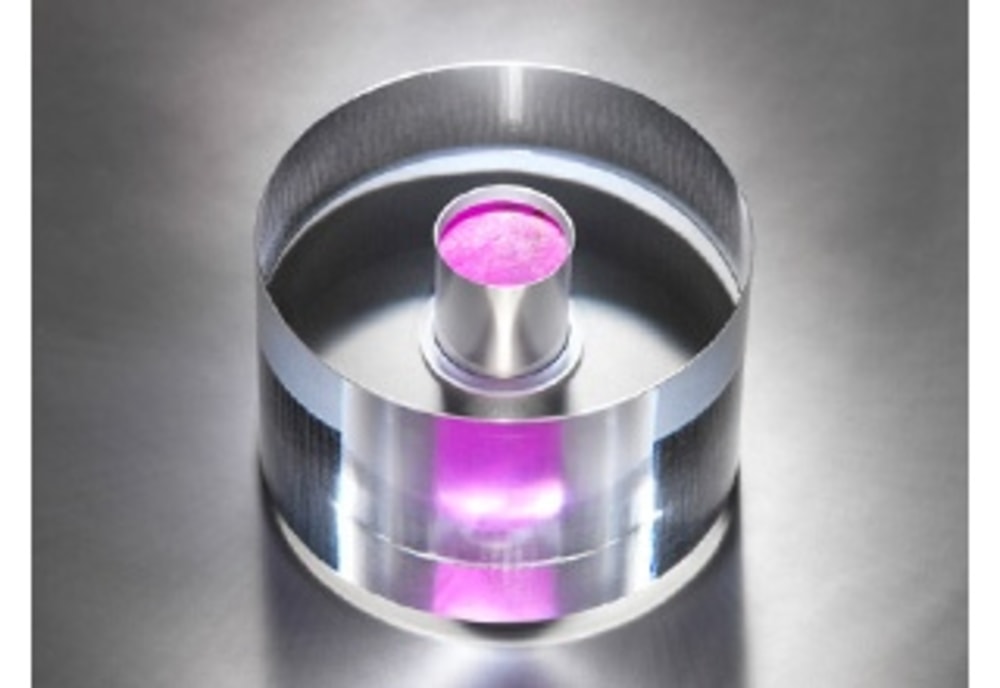
Amplification of radio waves over a wide band of frequencies can be obtained in several kinds of solid-state masers, most commonly crystals such as ruby at low temperatures. Suitable materials contain ions (atoms with an electrical charge) whose energy levels can be shifted by a magnetic field so as to tune the substance to amplify the desired frequency. If the ions have three or more energy levels suitably spaced, they can be raised to one of the higher levels by absorbing radio waves of the proper frequency.
The amplifying crystal may be operated in a resonator that, as in the ammonia maser, stores the wave and so gives it more time to interact with the amplifying medium. A large amplifying bandwidth and easier tunability are obtained with traveling-wave masers. In these, a rod of a suitable crystal, such as ruby, is positioned inside a wave-guide structure that is designed to cause the wave to travel relatively slowly through the crystal.
Solid masers have been used to amplify the faint signals returned from such distant targets as satellites in radar and communications. Their sensitivity is especially important for such applications because signals coming from space are usually very weak. Moreover, there is little interfering background noise when a directional antenna is pointed at the sky, and the highest sensitivity can be used. In radio astronomy, masers made possible the measurement of the faint radio waves emitted by the planet Venus, giving the first indication of its temperature.
Gas masers
Generation of radio waves by stimulated emission of radiation has been achieved in several gases in addition to ammonia. Hydrogen cyanide molecules have been used to produce a wavelength of 3.34 mm. Like the ammonia maser, this maser uses electric fields to select the excited molecules.
One of the best fundamental standards of frequency or time is the atomic hydrogen maser introduced by American scientists N.F. Ramsey, H.M. Goldenberg, and D. Kleppner in 1960. Its output is a radio wave whose frequency of 1,420,405,751.786 hertz (cycles per second) is reproducible with an accuracy of one part in 30 × 1012. A clock controlled by such a maser would not get out of step more than one second in 100,000 years.
In the hydrogen maser, hydrogen atoms are produced in a discharge and, like the molecules of the ammonia maser, are formed into a beam from which those in excited states are selected and admitted to a resonator. To improve the accuracy, the resonance of each atom is examined over a relatively long time. This is done by using a very large resonator containing a storage bulb. The walls of the bulb are coated so that the atoms can bounce repeatedly against the walls with little disturbance of their frequency.
Another maser standard of frequency or time uses vapour of the element rubidium at a low pressure, contained in a transparent cell. When the rubidium is illuminated by suitably filtered light from a rubidium lamp, the atoms are excited to emit a frequency of 6.835 gigahertz (6.835 × 10⁹ hertz). As the cell is enclosed in a cavity resonator with openings for the pumping light, emission of radio waves from these excited atoms is stimulated.
Additional Information
MASER stands for Microwave Amplification by Stimulation Emission of Radiation. A LASER is a MASER that works with higher frequency photons in the ultraviolet or visible light spectrum (photons are bundles of electromagnetic energy commonly thought of as "rays of light" which travel in oscillating waves of various wavelengths) .
The first papers about the MASER were published in 1954 as a result of investigations carried out simultaneously and independently by Charles Townes and co-workers at Columbia University in New York and by Dr. Basov and Dr. Prochorov at the Lebedev Institute in Moscow. All three of these gentlemen received the Nobel Prize in 1964 for their contributions to science.
[The following was paraphrased in part from Halliday & Resnick's "Fundamentals of Physics", second edition.]
The fundamental physical principle motivating the MASER is the concept of stimulated emission, first introduced by Einstein in 1917. Before defining it we look at two related but more familiar phenomena involving the interplay between matter and radiation, absorption and spontaneous emission.
* Absorption. According to quantum mechanics, absorption of photons by atoms occurs only if the wavelength of the photon is just the right size (say, of wavelength l). If it is, the atom will "absorb" it (the photon vanishes) and go to a higher energy state. In physics, this process is called "absorption."
* Spontaneous Emission. Atoms don't like to stay in high energy states (this is dictated by the laws of thermodynamics), so after absorbing a photon and going to a higher energy state, they will move of their own accord to a lower energy state, emitting a photon in the process. This is called "spontaneous emission" because no outside influence triggers the emission. Normally the average lifetime for spontaneous emissions by excited atoms is around 10-8 seconds (that is, the atom or molecule will usually take around 10-8 seconds before emitting the photon). Occasionally, however, there are states for which the lifetime is much longer, perhaps around 10-3 seconds. These states are called metastable. Metastable emission levels are essential for a working MASER and will be discussed further in a moment.
Now that we've discussed absorption and spontaneous emission, we can get to stimulated emission (a MASER beam is made up entirely of stimulated emission).
* Stimulated Emission. With stimulated emission, a photon of the absorption wavelength, l , is fired at an atom already in its high energy state from prior absorption. The atom absorbs this photon, and then quickly emits two photons to get back to its lower energy state. Thanks to quantum mechanics, both of these newly emitted photons are of wavelength l! The following figure displays this concept in detail:
* MASER. In each frame, a molecule in the upper level of the MASER transition (that is, in the high energy, excited state) is indicated by a large red circle, while one in the lower level (low energy state) is indicated by a small blue circle. (a) All of the molecules are in the upper state and a photon of wavelength l (shown in green) is incident from the left. (b) The photon l stimulates emission from the first molecule, so there are now two photons of wavelength l, in phase. (c) These photons stimulate emission from the next two molecules, resulting in four photons of wavelength l. (d) The process continues with another doubling of the number of photons.
Basically, a man-made MASER is a device that sets up a series of atoms or molecules and excites them to generate the chain reaction, or amplification, of photons. Metastable emission states make MASERs and LASERs possible. To get the proper wavelengths to generate the chain reaction, first electricity or another energy source is "pumped" into a chamber filled with particular atoms or molecules. Then this "pumping" radiation causes the transition of atoms from the ground state to a high energy excited state higher than that referred to in the above paragraphs. From this short-lived state the atoms come down through non-radiative transition to the long-lived metastable state. Once in the metastable state many atoms can be accumulated in one place and in the same state. The LASER or MASER beam, stimulated emission, arises when all these accumulated atoms simultaneously make a transition to the ground state, releasing their energy of wavelength l, creating a beam of microwave radiation (or visible light in the case of a LASER) which can be sent on to other atoms to cause the chain reaction described in the above figure. Since all the resulting photons are the same wavelength, MASER beams are extremely focussed and coherent. MASERs and their shorter-wavelength counterparts (LASERs), have many practical applications, especially in science and medicine.
Naturally occurring MASERs have been discovered in interstellar space. For more information about MASERs in space, check out this site for a discussion of astrophysical MASERs.
It appears to me that if one wants to make progress in mathematics, one should study the masters and not the pupils. - Niels Henrik Abel.
Nothing is better than reading and gaining more and more knowledge - Stephen William Hawking.
Offline
#2730 2026-03-22 00:05:24
- Jai Ganesh
- Administrator
- Registered: 2005-06-28
- Posts: 53,931
Re: Miscellany
2529) Vanadium Pentoxide
Gist
Vanadium pentoxide (V2O5) is a brownish-yellow solid inorganic compound, appearing as an orange powder when freshly precipitated. It is a crucial industrial catalyst, most notably used in the contact process to produce sulfuric acid. It serves as a strong oxidizing agent, a flux in ceramics, and a precursor to vanadium alloys and batteries.
Vanadium pentoxide (V2O5) is a crucial industrial compound primarily used as a catalyst in sulfuric acid production (contact process) and for manufacturing vanadium alloys/steel. It is also essential as a cathode material in lithium-ion and redox flow batteries, and as a coloring agent in ceramics and glass.
Summary:
Key Industrial and Technical Uses
1) Catalyst in Chemical Synthesis: V2O5 acts as a catalyst in the production of sulfuric acid, which is one of the world’s largest industrial chemicals. It is also used to produce maleic anhydride and as an oxidizer in organic chemical manufacturing.
2) Metallurgy and Alloying: Approximately 85% of total vanadium is used in special steel production, and V2O5 is the key precursor to producing vanadium aluminum master alloys for aerospace and high-stress structural applications.
3) Energy Storage (Batteries): It is a crucial component in vanadium redox flow batteries (VRFBs) for large-scale grid energy storage, as well as a cathode material in high-capacity lithium-ion batteries.
4) Ceramics and Glass Manufacturing: It is used as a pigment, yielding yellow, green, and blue colors in glazes for tiles and sanitary ware, and in specialized glass coating.
5) Other Applications: It is utilized in the manufacturing of photographic developers and as a sensing material in infrared detectors and gas sensors.
V2O5 is a highly stable metal-oxide semiconductor often used as a pigment or specialized catalytic agent in ceramic production. It is also utilized in research regarding chemical and battery applications, serving as a primary ingredient for creating higher-capacity anodes in, for instance, Sodium-Ion or Zinc-Ion battery systems.
Details
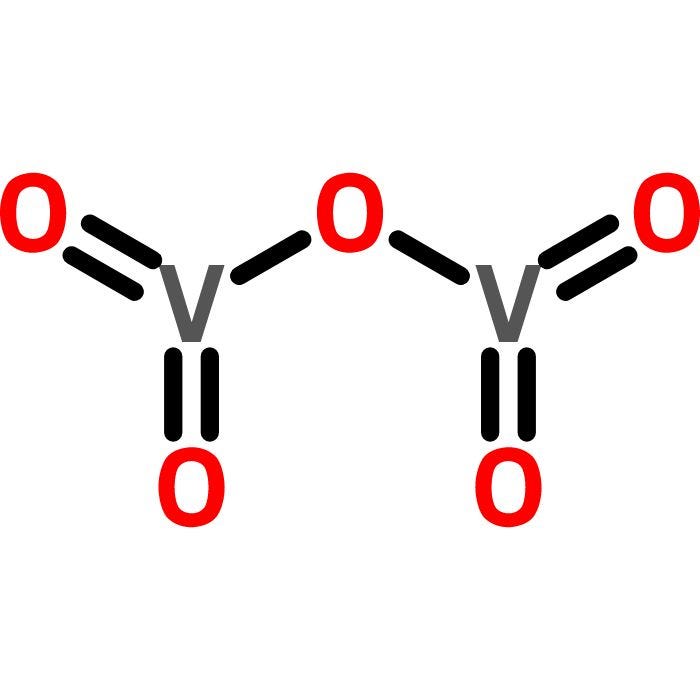
Vanadium(V) oxide (vanadia) is the inorganic compound with the formula V2O5. Commonly known as vanadium pentoxide, it is a dark yellow solid, although when freshly precipitated from aqueous solution, its colour is deep orange. Because of its high oxidation state, it is both an amphoteric oxide and an oxidizing agent. From the industrial perspective, it is the most important compound of vanadium, being the principal precursor to alloys of vanadium and is a widely used industrial catalyst.
The mineral form of this compound, shcherbinaite, is extremely rare, almost always found among fumaroles. A mineral trihydrate, V2O5·3H2O, is also known under the name of navajoite.
Preparation
Technical grade V2O5 is produced as a black powder used for the production of vanadium metal and ferrovanadium. A vanadium ore or vanadium-rich residue is treated with sodium carbonate and an ammonium salt to produce sodium metavanadate, NaVO3. This material is then acidified to pH 2–3 using H2SO4 to yield a precipitate of "red cake". The red cake is then melted at 690 °C to produce the crude V2O5.
Vanadium(V) oxide is produced when vanadium metal is heated with excess oxygen, but this product is contaminated with other, lower oxides. A more satisfactory laboratory preparation involves the decomposition of ammonium metavanadate at 500–550 °C:
2 NH4VO3 → V2O5 + 2 NH3 + H2O
Uses:
Ferrovanadium production
In terms of quantity, the dominant use for vanadium(V) oxide is in the production of ferrovanadium (see above). The oxide is heated with scrap iron and ferrosilicon, with lime added to form a calcium silicate slag. Aluminium may also be used, producing the iron-vanadium alloy along with alumina as a byproduct.
Sulfuric acid production
Another important use of vanadium(V) oxide is in the manufacture of sulfuric acid, an important industrial chemical with an annual worldwide production of 165 million tonnes in 2001, with an approximate value of US$8 billion. Vanadium(V) oxide serves the crucial purpose of catalysing the mildly exothermic oxidation of sulfur dioxide to sulfur trioxide by air in the contact process:
2 SO2 + O2 ⇌ 2 SO3
The discovery of this simple reaction, for which V2O5 is the most effective catalyst, allowed sulfuric acid to become the cheap commodity chemical it is today. The reaction is performed between 400 and 620 °C; below 400 °C the V2O5 is inactive as a catalyst, and above 620 °C it begins to break down. Since it is known that V2O5 can be reduced to VO2 by SO2, one likely catalytic cycle is as follows:
SO2 + V2O5 → SO3 + 2 VO2
followed by
2 VO2 + 1⁄2 O2 → V2O5
It is also used as catalyst in the selective catalytic reduction (SCR) of NOx emissions in some power plants and diesel engines. Due to its effectiveness in converting sulfur dioxide into sulfur trioxide, and thereby sulfuric acid, special care must be taken with the operating temperatures and placement of a power plant's SCR unit when firing sulfur-containing fuels.
Other applications
Due to its high coefficient of thermal resistance, vanadium(V) oxide finds use as a detector material in bolometers and microbolometer arrays for thermal imaging. It also finds application as an ethanol sensor in ppm levels (up to 0.1 ppm).
Vanadium redox batteries are a type of flow battery used for energy storage, including large power facilities such as wind farms. Vanadium oxide is also used as a cathode in lithium-ion batteries.
Vanadium pentoxide is often used as a component in glazes where it produces a wide range of colours from greens and yellows to blues and grays.
Additional Information
Vanadium pentoxide is used in different, industrial processes as catalyst: In the contact process it serves for the oxidation of SO2 to SO3 with oxygen at 440°C. Besides it is used in the oxidation of ethanol to ethanale and in the production of phthalic anydride, polyamide, oxalic acid and further products.
Vanadium pentoxide is a stable oxide of vanadium with an oxidation state of +5. It is extensively used as an n-type semiconductor, a cathode material in lithium batteries, and an industrial catalyst. It is also used in glass and ceramic glazes, as a steel additive, and in welding electrode coatings. Additionally, it is used as a catalyst in chemical reactions and in the manufacture of ceramics.
It appears to me that if one wants to make progress in mathematics, one should study the masters and not the pupils. - Niels Henrik Abel.
Nothing is better than reading and gaining more and more knowledge - Stephen William Hawking.
Offline
#2731 2026-03-23 00:49:35
- Jai Ganesh
- Administrator
- Registered: 2005-06-28
- Posts: 53,931
Re: Miscellany
2530) Amphibian
Gist
Amphibians are cold-blooded, vertebrate animals (possessing a backbone) that inhabit both aquatic and terrestrial environments. The name derives from Greek, meaning "living a double life" because they typically undergo metamorphosis, starting life in water with gills and developing lungs for land-based adult life.
The word amphibian was taken from the Greek “amphi” meaning “double” and “bios” meaning “life” which is quite fitting as these creatures do live a double life. Emerging from eggs that are usually laid in the water, most amphibians begin their life with gills.
Summary
Amphibians are ectothermic, anamniotic, four-limbed vertebrate animals that constitute the class Amphibia. In its broadest sense, it is a paraphyletic group encompassing all tetrapods, but excluding the amniotes (tetrapods with an amniotic membrane, such as modern reptiles, birds and mammals). All extant (living) amphibians belong to the monophyletic subclass Lissamphibia, with three living orders: Anura (frogs and toads), Urodela (salamanders), and Gymnophiona (caecilians). Evolved to be mostly semiaquatic, amphibians have adapted to inhabit a wide variety of habitats, with most species living in freshwater, wetland or terrestrial ecosystems (such as riparian woodland, fossorial and even arboreal habitats). Their life cycle typically starts out as aquatic larvae with gills known as tadpoles, but some species have developed behavioural adaptations to bypass this.
Young amphibians generally undergo metamorphosis from an aquatic larval form with gills to an air-breathing adult form with lungs. Amphibians use their skin as a secondary respiratory interface, and some small terrestrial salamanders and frogs even lack lungs and rely entirely on their skin. They are superficially similar to reptiles like lizards, but unlike reptiles and other amniotes, require access to water bodies to breed. With their complex reproductive needs and permeable skins, amphibians are often ecological indicators to habitat conditions; in recent decades there has been a dramatic decline in amphibian populations for many species around the globe.
The earliest amphibians evolved in the Devonian period from tetrapodomorph sarcopterygians (lobe-finned fish with articulated limb-like fins) that evolved primitive lungs, which were helpful in adapting to dry land. They diversified and became ecologically dominant during the Carboniferous and Permian periods, but were later displaced in terrestrial environments by early reptiles and basal synapsids (predecessors of mammals). The origin of modern lissamphibians, which first appeared during the Early Triassic, around 250 million years ago, has long been contentious. The most popular hypothesis is that they likely originated from temnospondyls, the most diverse group of prehistoric amphibians, during the Permian period. Another hypothesis is that they emerged from lepospondyls. A fourth group of lissamphibians, the Albanerpetontidae, became extinct around 2 million years ago.
The number of known amphibian species is approximately 8,000, of which nearly 90% are frogs. The smallest amphibian (and vertebrate) in the world is a frog from New Guinea (Paedophryne amauensis) with a length of just 7.7 mm (0.30 in). The largest living amphibian is the 1.8 m (5 ft 11 in) South China giant salamander (Andrias sligoi), but this is dwarfed by prehistoric temnospondyls such as Mastodonsaurus which could reach up to 6 m (20 ft) in length. The study of amphibians is called batrachology, while the study of both reptiles and amphibians is called herpetology.
Details
An amphibian is (class Amphibia), any member of the group of vertebrate animals characterized by their ability to exploit both aquatic and terrestrial habitats. The name amphibian, derived from the Greek amphibios meaning “living a double life,” reflects this dual life strategy—though some species are permanent land dwellers, while other species have a completely aquatic mode of existence.
Approximately 8,100 species of living amphibians are known. First appearing about 340 million years ago during the Middle Mississippian Epoch, they were one of the earliest groups to diverge from ancestral fish-tetrapod stock during the evolution of animals from strictly aquatic forms to terrestrial types. Today amphibians are represented by frogs and toads (order Anura), newts and salamanders (order Caudata), and caecilians (order Gymnophiona). These three orders of living amphibians are thought to derive from a single radiation of ancient amphibians, and although strikingly different in body form, they are probably the closest relatives to one another. As a group, the three orders make up subclass Lissamphibia. Neither the lissamphibians nor any of the extinct groups of amphibians were the ancestors of the group of tetrapods that gave rise to reptiles. Though some aspects of the biology and anatomy of the various amphibian groups might demonstrate features possessed by reptilian ancestors, amphibians are not the intermediate step in the evolution of reptiles from fishes.
Modern amphibians are united by several unique traits. They typically have a moist skin and rely heavily on cutaneous (skin-surface) respiration. They possess a double-channeled hearing system, green rods in their retinas to discriminate hues, and pedicellate (two-part) teeth. Some of these traits may have also existed in extinct groups.
Members of the three extant orders differ markedly in their structural appearance. Frogs and toads are tailless and somewhat squat with long, powerful hind limbs modified for leaping. In contrast, caecilians are limbless, wormlike, and highly adapted for a burrowing existence. Salamanders and newts have tails and two pairs of limbs of roughly the same size; however, they are somewhat less specialized in body form than the other two orders.
Many amphibians are obligate breeders in standing water. Eggs are laid in water, and the developing larvae are essentially free-living embryos; they must find their own food, escape predators, and perform other life functions while they continue to develop. As the larvae complete their embryonic development, they adopt an adult body plan that allows them to leave aquatic habitats for terrestrial ones. Even though this metamorphosis from aquatic to terrestrial life occurs in members of all three amphibian groups, there are many variants, and some taxa bear their young alive. Indeed, the roughly 8,100 living species of amphibians display more evolutionary experiments in reproductive mode than any other vertebrate group. Some taxa have aquatic eggs and larvae, whereas others embed their eggs in the skin on the back of the female; these eggs hatch as tadpoles or miniature frogs. In other groups, the young develop within the oviduct, with the embryos feeding on the wall of the oviduct. In some species, eggs develop within the female’s stomach.
The three living orders of amphibians vary greatly in size and structure. The presence of a long tail and two pairs of limbs of about equal size distinguishes newts and salamanders (order Caudata) from other amphibians, although members of the eel-like family Sirenidae have no hind limbs. Newts and salamanders vary greatly in length; members of the Mexican genus Thorius measure 25 to 30 mm (1 to 1.2 inches), whereas Andrias, a genus of giant aquatic salamanders endemic to China and Japan, reaches a length of more than 1.5 metres (5 feet). Frogs and toads (order Anura) are easily identified by their long hind limbs and the absence of a tail. They have only five to nine presacral vertebrae. The West African goliath frog, which can reach 30 cm (12 inches) from snout to vent and weigh up to 3.3 kg (7.3 pounds), is the largest anuran. Some of the smallest anurans include the South American brachycephalids, which have an adult snout-to-vent length of only 9.8 mm (0.4 inch), and some microhylids, which grow to 9 to 12 mm (0.4 to 0.5 inch) as adults. The long, slender, limbless caecilians (order Gymnophiona) are animals that have adapted to fossorial (burrowing) lifestyles by evolving a body segmented by annular grooves and a short, blunt tail. Caecilians can grow to more than 1 metre (3 feet) long. The largest species, Caecilia thompsoni, reaches a length of 1.5 metres (5 feet), whereas the smallest species, Idiocranium russeli, is only 90 to 114 mm (3.5 to 5 inches) long.
Distribution and abundance
Amphibians occur widely throughout the world, even edging north of the Arctic circle in Eurasia; they are absent only in Antarctica, most remote oceanic islands, and extremely xeric (dry) deserts. Frogs and toads show the greatest diversity in humid tropical environments. Salamanders primarily inhabit the Northern Hemisphere and are most abundant in cool, moist, montane forests; however, members of the family Plethodontidae, the lungless salamanders, are diverse in the humid tropical montane forests of Mexico, Central America, and northwestern South America. Caecilians are found spottily throughout the African, American, and Asian wet tropics.
For many years, habitat destruction has had a severe impact on the distribution and abundance of numerous amphibian species. Since the 1980s, a severe decline in the populations of many frog species has been observed. Although acid rain, global warming, and ozone depletion are contributing factors to these reductions, a full explanation of the disappearance in diverse environment remains uncertain. A parasitic fungus, the so-called amphibian chytrid (Batrachochytrium dendrobatidis), however, appears to be a major cause of substantial frog die-offs in parts of Australia and southern Central America and milder events in North America and Europe.
Economic importance
Amphibians, especially anurans, are economically useful in reducing the number of insects that destroy crops or transmit diseases. Frogs are exploited as food, both for local consumption and commercially for export, with thousands of tons of frog legs harvested annually. The skin secretions of various tropical anurans are known to have hallucinogenic effects and effects on the central nervous and respiratory systems in humans. Some secretions have been found to contain magainin, a substance that provides a natural antibiotic effect. Other skin secretions, especially toxins, have potential use as anesthetics and painkillers. Biochemists are currently investigating these substances for medicinal use.
Natural history:
Reproduction
The three living groups of amphibians have distinct evolutionary lineages and exhibit a diverse range of life histories. The breeding behaviour of each group is outlined below. One similar tendency among amphibians has been the evolution of direct development, in which the aquatic egg and free-swimming larval stages are eliminated. Development occurs fully within the egg capsule, and juveniles hatch as miniatures of the adult body form. Most species of lungless salamanders (family Plethodontidae), the largest salamander family, some caecilians, and many species of anurans have direct development. In addition, numerous caecilians and a few species of anurans and salamanders give birth to live young (viviparity).
Anurans display a wide variety of life histories. Centrolenids and phyllomedusine hylids deposit eggs on vegetation above streams or ponds; upon hatching, the tadpoles (anuran larvae) drop into the water where they continue to develop throughout their larval stage. Some species from the families Leptodactylidae and Rhacophoridae create foam nests for their eggs in aquatic, terrestrial, or arboreal habitats; after hatching, tadpoles of these families usually develop in water. Dendrobatids and other anurans deposit their eggs on land and transport them to water. Female hylid marsupial frogs are so called because they carry their eggs in a pouch on their backs. A few species lack a pouch and the tadpoles are exposed on the back; in some species, the female deposits her tadpoles in a pond as soon as they emerge.
Embryonic stage
Inside the egg, the embryo is enclosed in a series of semipermeable gelatinous capsules and suspended in perivitelline fluid, a fluid that also surrounds the yolk. The hatching larvae dissolve these capsules with enzymes secreted from glands on the tips of their snouts. The original yolk mass of the egg provides all nutrients necessary for development; however, various developmental stages utilize different nutrients. In early development, fats are the major energy source. During gastrulation, an early developmental stage in which the embryo consists of two cell layers, there is an increasing reliance on carbohydrates. After gastrulation, a return to fat utilization occurs. During the later developmental stages, when morphological structures form, proteins are the primary energy source. By the neurula stage, an embryonic stage in which nervous tissue develops, cilia appear on the embryo, and the graceful movement of these hairlike structures rotates the embryo within the perivitelline fluid. The larvae of direct developing and live-bearing caecilians, salamanders, and some anurans have external gills that press against the inner wall of the egg capsule, which permits an exchange of gases (oxygen and carbon dioxide) with the outside air or with maternal tissues. During development, ammonia is the principal form of nitrogenous waste, and it is diluted by a constant diffusion of water in the perivitelline fluid.
The development of limbs in the embryos of aquatic salamanders begins in the head region and proceeds in a wave down the body, and digits appear sequentially on both sets of limbs. Salamanders that deposit their eggs in streams produce embryos that develop both sets of limbs before they hatch, but salamanders that deposit their eggs in still water have embryos that develop only forelimbs before hatching. (In contrast, the limbs of anurans do not appear until after hatching.) Soon after the appearance of forelimbs, most pond-dwelling salamanders develop an ectodermal projection known as a balancer on each side of the head. These rodlike structures arise from the mandibular arch, contain nerves and capillaries, and produce a sticky secretion. They keep newly hatched larvae from sinking into the sediment and aid the salamander in maintaining its balance before its forelimbs develop. After the forelimbs appear, the balancers degenerate.
During the embryonic and early larval stages in anurans, paired adhesive organs arise from the hyoid arch, located at the base of the tongue. The sticky mucus they secrete can form a threadlike attachment between a newly hatched tadpole and the egg capsule or vegetation. Consequently, the tadpole that is still developing can remain in a stable position until it is capable of swimming and feeding on its own, after which the adhesive organs degenerate.
Larval stage
The amphibian larva represents a morphologically distinct stage between the embryo and adult. The larva is a free-living embryo. It must find food, avoid predators, and participate in all other aspects of free-living existence while it completes its embryonic development and growth. Salamander and caecilian larvae are carnivorous, and they have a morphology more like their respective adult forms than do anuran larvae. Not long after emerging from their egg capsules, larval salamanders, which have four fully developed limbs, start to feed on small aquatic invertebrates. The salamander larvae are smaller versions of adults, although they differ from their adult counterparts by the presence of external gills, a tailfin, distinctive larval dentition, a rudimentary tongue, and the absence of eyelids. Larval caecilians, also smaller models of adults, have external gills, a lateral-line system (a group of epidermal sense organs located over the head and along the side of the body), and a thin skin.
In anurans, tadpoles are fishlike when they hatch. They have short, generally ovoid bodies and long, laterally compressed tails that are composed of a central axis of musculature with dorsal and ventral fins. The mouth is located terminally (recessed), ringed with an oral disk that is often fringed by papillae and bears many rows of denticles made of keratin. Tadpoles often have horny beaks. Their gills are internal and covered by an operculum. Water taken in through the mouth passes over the gills and is expelled through one or more spiracular openings on the side of an opercular chamber. Anuran larvae are microphagous and thus feed largely on bacteria and algae that coat aquatic plants and debris.
Salamander larvae usually reach full size within two to four months, although they may remain larvae for two to three years before metamorphosis occurs. Some large aquatic species, such as the hellbender (Cryptobranchus alleganiensis) and the mud puppy (Necturus maculosus), never fully metamorphose and retain larval characteristics as adults (see below heterochrony). Tadpole development varies in length between species. Some anuran species living in xeric (dry) habitats, in which ephemeral ponds may exist for only a few weeks, develop and metamorphose within two to three weeks; however, most species require at least two months. Species living in cold mountain streams or lakes often require much more time. For example, the development of the tailed frog (Ascaphus truei) takes three years to complete.
Metamorphosis
Metamorphosis entails an abrupt and thorough change in an animal’s physiology and biochemistry, with concomitant structural and behavioral modifications. These changes mark the transformation from embryo to juvenile and the completion of development. Hormones ultimately control all events of larval growth and metamorphosis, and in many instances, development is accompanied by a shift from a fully aquatic life to a semiaquatic or fully terrestrial one.
Although salamanders undergo many structural modifications, these changes are not dramatic. The skin thickens as dermal glands develop and the caudal fin is resorbed. Gills are resorbed and gill slits close as lungs develop and branchial (gill) circulation is modified. Eyelids, tongue, and a maxillary bone are formed, and teeth develop on the maxillary and parasphenoid bones. Changes that occur in caecilians—the closure of the gill slit, the degeneration of the caudal fin, and the development of a tentacle and skin glands—are also minor.
Skeletal changes are much more dramatic in anurans because tadpoles make an abrupt and radical transition to their adult form. Limbs complete their development, and the forelimbs break through the opercular wall, early in metamorphosis. The tail shrinks as it is resorbed by the body, dermal glands develop, and the skin becomes thicker. As lungs and pulmonary ventilation develop, gills and their associated blood circulation disappear. Adult mouthparts replace their degenerating larval equivalents, and hyolaryngeal structures develop. All anurans except pipids (family Pipidae) develop a tongue. In the newly differentiated digestive tract, the intestine is shortened. The eyes become larger and are structurally altered; eyelids appear. These extreme changes of anuran metamorphosis clearly demarcate the shift from an aquatic to a terrestrial mode of life. Other less obvious yet nonetheless radical modifications of the larval skull and hyobranchial apparatus (that is, the part of the skeleton that serves as base for the tongue on the floor of the mouth) occur to make room for newly developed sense organs. These modifications also facilitate the transition from larval modes of feeding and respiration to those of the adult.
During metamorphosis, the urogenital system of all amphibians is also modified. A mesonephric or opisthonephric kidney—which uses nephrons located either in the middle or at the end of the nephric ridge in the developing embryo—replaces the degenerating rudimentary pronephric kidney. This transition is linked to the shift from production of a large volume of dilute ammonia to a small amount of concentrated urea. Gonads and associated ducts also appear and begin their maturation.
Heterochrony
Neoteny, once a widely used label for the condition of sexually mature larvae, has been discontinued by biologists and replaced by the concept of heterochrony. Heterochrony refers to the change in the timing and rate of developmental events, and it is a widespread feature in amphibian evolution, particularly in salamanders. During development, a structure can begin to develop sooner (predisplacement) or later (postdisplacement) in an organism than it occurred in the ancestral species or parents. Also, a structure may continue to develop beyond the previous embryological sequence (hypermorphosis) or the developmental sequence can stop earlier than normal (progenesis or hypomorphosis). Each of these heterochronic events can produce a structurally or functionally different organism.
The classical “neotenic” salamander, the axolotl (Ambystoma mexicanum), is a paedomorphic species (that is, a species that retains aspects of its juvenile form during its adult phase); it retains its larval gills. In the mole salamander (Ambystoma talpoideum), some populations also display hypomorphic development in which the development of several larval traits to the adult condition is delayed. Since the gonads mature, a population of sexually mature salamanders with a larval morphology is produced. Heterochrony also explains the presence of larval traits in adults of the salamander families Cryptobranchidae (hellbenders) and Proteidae (olms and mud puppies).
Heterochrony is not confined to salamanders. The different sized eardrums in the American bullfrog (Lithobates catesbeianus) are examples of hypermorphism in male bullfrogs. The development of the eardrums in the male extends beyond that of the female.
Life cycle
Many amphibians have a biphasic life cycle involving aquatic eggs and larvae that metamorphose into terrestrial or semiaquatic juveniles and adults. Commonly, they deposit large numbers of eggs in water; clutches of the tiger salamander (Ambystoma tigrinum) may exceed 5,000 eggs, and large bullfrogs (L. catesbeianus) may produce clutches of 45,000 eggs. Egg size and water temperature are important factors that influence an embryo’s development time. Eggs of many anuran species laid in warm water require only one or two days to develop, whereas eggs deposited in cold mountain lakes or streams may not hatch for 30 to 40 days. The development of salamander eggs often requires more time, with hatching occurring 20 to 270 days after fertilization.
Food and feeding
Adult amphibians consume a wide variety of foods. Earthworms are the main diet of burrowing caecilians, whereas anurans and salamanders feed primarily on insects and other arthropods. Large salamanders and some large anurans eat small vertebrates, including birds and mammals. Most anurans and salamanders locate prey by sight, although some use their sense of smell. The majority of salamanders and diurnal (that is, active during daylight) terrestrial anurans are active foragers, but many other anurans employ a sit-and-wait technique. Caecilians locate their underground prey with a chemosensory tentacle and capture their quarry with a powerful bite (see chemoreception). Aquatic salamanders lunge at their prey with an open mouth and appear to drag the victim in by expanding their buccal (oral) cavity. The terrestrial lunged salamander extends its sticky tongue, which is attached anteriorly to the floor of the mouth, to ensnare a meal. In lungless salamanders, the hyobranchial apparatus is not part of the process of buccal respiration; this apparatus is modified so that it can project the tongue from the mouth. The end of the tongue is sticky to adhere to prey, and prey can be captured at distances ranging from 40 to 80 percent of the salamander’s body length.
Primitive anurans have feeding mechanisms that resemble those of the typical terrestrial salamanders. More advanced anurans employ a “lingual flip,” in which the surfaces of the retracted tongue are twisted and inverted in the fully extended tongue. The pipids, which are completely aquatic, are unique among anurans; they lack a tongue and thus must essentially drag food and water into their mouth.
Form and function:
Common features
Although the structure of the muscular, skeletal, and other anatomical systems are specifically modified for each group, amphibians are often set apart from other groups of animals by their characteristic skin, or integument, and evolutionary advances in vision and hearing.
The circulatory and respiratory systems work with the integument to provide cutaneous respiration. A broad network of cutaneous capillaries facilitates gas exchange and the diffusion of water and ions between the animal and the environment. Several species of salamanders and at least one species of frog (Barbourula kalimantanensis) are lungless. Amphibians also employ various combinations of branchial and pulmonary strategies to breathe. The buccal pump mechanism, which involves the pushing of air between the lungs and the closed mouth, is present in amphibians and some groups of fishes.
In addition to its roles in respiration and maintaining water balance, the integument of amphibians contains poison glands that release toxins. Specific toxins are found only in amphibians and are used to defend against predators.
The eye of the modern amphibian (or lissamphibian) has a lid, associated glands, and ducts. It also has muscles that allow its accommodation within or on top of the head, depth perception, and true colour vision. These adaptations are regarded as the first evolutionary improvements in vertebrate terrestrial vision. Green rods in the retina, which permit the perception of a wide range of wavelengths, are found only in lissamphibians.
The amphibian auditory system is also specially adapted. One modification is the papilla amphibiorum, a patch of sensory tissues that is sensitive to low-frequency sound. Also unique to lissamphibians is the columella-opercular complex, a pair of elements associated with the auditory capsule that transmit airborne (columella) or seismic (operculum) signals.
Structural differences
The environment helps to mold the morphology of an organism. The markedly different structural forms of the three living orders demonstrate that each group has had a long, separate evolutionary history.
Salamanders
Salamanders have less-specialized morphologies than do the other two orders. They have small heads and long slender bodies made up of four limbs and a tail. Although the skulls of most terrestrial salamanders consist of more individual pieces than do those of either caecilians or anurans, they are arched, narrow, and not well roofed. These skulls have an extra set of articulations with the vertebral column, a characteristic that may have been an evolutionary strategy for stabilizing the head on the axial skeleton (vertebral column) in terrestrial salamanders; other amphibians developed a specialized trunk musculature to meet this challenge.
The hyoid apparatus in the floor of the mouth enables salamanders to capture prey by projecting their fleshy tongues from the buccal cavity, although most are only able to roll their tongues forward over their lower jaws to snare their dinner. Food is held and manipulated in the buccal cavity by the teeth and tongue. This mechanism does not require adaptations to the mandibular and jaw muscles or sturdy, specialized teeth—features that most salamanders lack. Well-developed eyes and nasal organs, however, are needed to locate prey. Because salamanders do not depend on their vocal abilities, their auditory apparatus is less specialized than that of anurans.
Most salamander species have a generalized mode of locomotion, which is reflected by a lack of specialization in the musculoskeletal system. Salamanders walk methodically and move the limbs in the standard diagonal-sequence gait of quadrupeds. Aquatic salamanders show the greatest divergence from this generalized morphological pattern. Because they are kept afloat by their aquatic environment, they are often larger, devoid of limbs, and swim via the lateral undulation of the trunk and tail.
Caecilians
Of the three living amphibian orders, caecilians show the least divergence in structure and form. All caecilians, except for a few aquatic species, lead subterranean existences and thus have similar specialized morphologies. They have a wormlike appearance, with compact and bony heads in which the centres of ossification have fused to provide a strong, spadelike braincase. While useful in tunneling through the soil, this compact cranium does not allow much room for the jaw muscles to develop. Thus, the lower jaw is attached to the main adductor muscle of the jaw by a retroarticular process outside the cranium, and the caecilian cannot extend its tongue from the buccal cavity.
Vision, of little importance in the caecilian’s environment, is not acute; however, the nasal organs are well developed, and chemosensory perception is greatly enhanced by the existence of a tentacle (see chemoreception). The sense of hearing is probably less sensitive than that of salamanders or anurans. If the operculum (a feature analogous to auditory stapes) is present, it is incorporated into the columella (the rod made of bone or cartilage connecting the tympanic membrane with the internal ear).
Subterranean movement and feeding are aided by alterations of the axial musculoskeletal system. The overlying skin is attached to the axial muscles, and this creates a tough sheath that encases the long, muscular body and covers the posterior part of the skull. Caecilians move through soil by a process called concertina locomotion, in which the body alternately folds and extends itself along its entire length, often occurring within the envelope of skin as well as by flexures of the entire body.
Anurans
Anurans are more widespread, diverse, and numerous than either salamanders or caecilians. Anurans display a broader range of specialization in locomotion, feeding, and reproduction in their adaptation to many different environments and lifestyles. In general, anurans have a broad, flat head—which is almost as wide as their body—and a short trunk that, aside from the sacral area, is relatively inflexible. Long, powerful hind limbs propel the fused head and trunk in a forward trajectory. These leaping movements require more complex pectoral and pelvic girdles than that of salamanders. The pectoral girdle is designed to absorb the shock of the anuran as it lands on its forelimbs; an elastic, muscular suspension connecting the pectoral girdle to the skull and vertebral column provides this ability. The pelvic girdle horizontally flanks the coccyx, the bony rod at the posterior end of the vertebral column. Muscles and ligaments attach the pelvic girdle to the coccyx, sacrum, presacral vertebrae, and proximal part of the hind limb. Thus, when the animal jumps, the pelvic girdle lies in the same plane as the axial column, and, when the animal sits, the posterior end of the girdle is deflected ventrally.
In addition to the specializations for leaping, many anurans have developed structures that allow them to burrow or climb trees. These structures primarily involve modifications in limb proportions and iliosacral articulation. Arboreal (tree-dwelling) anurans have long limbs and digits with large, terminal, adhesive pads; anurans that burrow have short sturdy limbs and large spatulate tubercles made of keratin on their feet. The pipids, specialized for their aquatic environment, have little flexibility in their axial skeletons and instead propel their flat, fused bodies through the water with powerful hind limbs and large, fully webbed feet.
Anurans depend on their visual acumen for feeding and locomotion, and hence the eyes of most species are large and well developed. Because vocalizing is part of their mating and territorial behaviour, their ears are also well developed. Most species have an external tympanum (eardrum), a structure that is absent in salamanders and caecilians.
Additional Information
Amphibians are a class of cold-blooded vertebrates made up of frogs, toads, salamanders, newts, and caecilians (wormlike animals with poorly developed eyes). All amphibians spend part of their lives in water and part on land, which is how they earned their name—“amphibian” comes from a Greek word meaning “double life.” These animals are born with gills, and while some outgrow them as they transform into adults, others retain them for their entire lives.
Amphibians are the most threatened class of animals in nature. They are extremely susceptible to environmental threats because of their porous eggs and semipermeable skin. Every major threat, from climate change to pollution to disease, affects amphibians and has put them at serious risk.
Amphibians live part of their lives in water and part on land. They are vertebrates and are also ectothermic; they cannot regulate their own body heat, so they depend on sunlight to become warm and active. Amphibians also can't cool down on their own, so if they get too hot, they have to find a burrow or some other shade. In cold weather, amphibians tend to be sluggish and do not move around much.
Metamorphosis
Young amphibians do not look like their parents. Generally called larvae, they change in body shape, diet, and lifestyle as they develop, a process called metamorphosis. A frog is a good example, starting out as a tadpole with gills to breathe underwater and a tail to swim with. As the young frog gets older, it develops lungs, legs, and a different mouth. Its eyes also change position, and it loses its tail. At this point it is an adult frog and spends most of its time hopping on land rather than swimming like a fish in the water.
Moist is Best
Most amphibians have soft, moist skin that is protected by a slippery secretion of mucus. They also tend to live in moist places or near water to keep their bodies from drying out. Many adult amphibians also have poison-producing glands in their skin, which make them taste bad to predators and might even poison a predator that bites or swallows them. Some of these amphibians, like poison frogs, are brightly colored as a warning: Don't eat me, or you'll be sorry!
Three Groups
There are about 5,500 known amphibian species, divided into three main groups: salamanders and newts, caecilians, and frogs and toads. The largest amphibian is the Chinese giant salamander at nearly 6 feet (1.8 meters) and 140 pounds (63 kilograms), and the smallest is the gold frog at 0.39 inches (1 centimeter) long.

It appears to me that if one wants to make progress in mathematics, one should study the masters and not the pupils. - Niels Henrik Abel.
Nothing is better than reading and gaining more and more knowledge - Stephen William Hawking.
Offline
#2732 2026-03-24 00:04:56
- Jai Ganesh
- Administrator
- Registered: 2005-06-28
- Posts: 53,931
Re: Miscellany
2531) Manganese Dioxide
Gist
Manganese dioxide (MnO2) is a black or brown inorganic compound occurring naturally as the mineral pyrolusite, which is the main ore of manganese. It is primarily used as a cathodic depolarizer in dry-cell batteries, a catalyst for oxygen production, and as a pigment in ceramics and glass. It is a strong oxidizing agent.
Manganese dioxide (MnO2) is a versatile inorganic compound primarily used as a depolarizer in dry cell (alkaline) batteries, a powerful oxidant in chemical synthesis, and a catalyst for producing oxygen. It is widely used in ceramics, glass decolorization, water purification, and as a raw material for producing manganese steel.
Summary:
Manganese dioxide (Mn02) is a highly versatile compound that is used for water treatment, water softening, iron removal, and other industrial manufacturing processes. Manganese dioxide is an indispensable organic compound for diverse applications across different sectors.
What is Manganese Dioxide?
Manganese Dioxide Chemical Formula: Mn02 : Manganese dioxide is an inorganic compound with the chemical formula Mn02. It is a black or brown-coloured material that naturally occurs as mineral pyrolusite. It is extensively used in different industries for its unique physical and chemical properties. Manganese dioxide is primarily used in groundwater applications. It effectively removes hydrogen sulfide, manganese radium, and iron from water.
What are the Uses of Managese Dioxide?
It finds application in different industries for its excellent chemical and physical properties. The following are the main uses of manganese dioxide.
Application of Manganese Dioxide
* Oxidizing Agent: One of the main uses of manganese dioxide is oxidizing agent. It oxidizes different chemicals and compounds that are essential in the production of batteries. Manganese dioxide is used as a depolarizer in dry-cell batteries to convert gas into water and generate energy.
* Catalyst: It is one of the most powerful catalysts for water treatment. It acts as a filtration agent for water. The catalyst reaction by manganese dioxide during the chemical oxidation reduction process helps to remove math, iron, and radium.
* Production of Ceramic Materials: They are used as a colouring agent to add brown and black pigments to ceramic glazes. They are also used in manufacturing clay to enhance strength and durability.
* Decolouring Agent:Manganese dioxide is used as the decolouring agent in glass production and an oxidizing agent in a chemical agent.
* Steel Production:It is used in the production of steel and other alloys. Mn02 is added to iron during the manufacturing process to remove impurities and improve the quality of the end product.
* Medical Research: Manganese dioxide nanomaterials are explored for drug delivery in cancer therapy.
Details:
What is Manganese dioxide?
* Manganese dioxide is a black-brown solid that occurs naturally with the formula MnO2.
* Manganese dioxide (MnO2), known as pyrolusite when found in nature, is the most plentiful of all the manganese compounds.
* The principal ore of manganese dioxide is pyrolusite which was known to the ancients as a pigment.
Impure manganese can be made by reducing manganese dioxide with carbon. It is the only important compound of quadripositive manganese.
When MnO2 is fused with KOH
When blackish coloured compound MnO2 is fused with KOH in presence of air, it produces a dark green coloured compound potassium manganate.
Uses of Manganese dioxide – MnO2
* Used in Ceramic Industries for making glass, practically all the raw materials used in glass contain some iron, usually in the form of ferric oxide.
* Ores of manganese are not ‘active’ for direct use in dry cell manufacture and many of them need to be activated by physical or chemical treatment.
* Used in glassmaking to remove the green tint caused by iron impurities.
* Used as an important component in batteries. In the Leclanche cell, the positive electrode carbon, is surrounded by manganese dioxide and carbon.
Frequently Asked Questions – FAQs
Q1: What are the uses of manganese dioxide?
A1: MnO2 is primarily used as a part of dry cell batteries: alkaline batteries and the so-called Leclanché cell, or zinc–carbon batteries. For this application, large quantity are consumed annually. Many industrial uses include the use of MnO2 in ceramics and glass-making as an inorganic pigment.
Q2: Is MnO2 a catalyst?
A2: Manganese dioxide, a compound with the formula MnO2, is used as a catalyst for rapid oxidation of dissolved iron and manganese, present in the form of ferrous and manganese powder, in contact filters. These salts are oxidised by dissolved oxygen to an insoluble ferric and manganic acid.
Q3: How is manganese dioxide formed?
A3: By oxidation of the elemental manganese: elemental manganese reacts with oxygen in the environment to form MnO2. Because of this reaction, elemental manganese does not exist in nature – it is usually found as manganese dioxide in nature.
Q4: Is manganese dioxide harmful to humans?
A4: Harmful if inhaled or swallowed. It may cause eye, skin, and respiratory tract irritation. May cause central nervous system effects. Inhalation of fumes may cause metal-fume fever.
Q5: What are the symptoms of manganese toxicity?
A5: Manganese toxicity can result in a permanent neurological disorder known as manganism with symptoms that include tremors, difficulty walking, and facial muscle spasms. These symptoms are often preceded by other lesser symptoms, including irritability, aggressiveness, and hallucinations.
Additional Information
Manganese dioxide is the inorganic compound with the formula MnO2. This blackish or brown solid occurs naturally as the mineral pyrolusite, which is the main ore of manganese and a component of manganese nodules. The principal use for MnO2 is for dry-cell batteries, such as the alkaline battery and the zinc–carbon battery, although it is also used for other battery chemistries such as aqueous zinc-ion batteries. MnO2 is also used as a pigment and as a precursor to other manganese compounds, such as potassium permanganate (KMnO4). It is used as a reagent in organic synthesis, for example, for the oxidation of allylic alcohols. MnO2 has an α-polymorph that can incorporate a variety of atoms (as well as water molecules) in the "tunnels" or "channels" between the manganese oxide octahedra.
Key uses of manganese dioxide include:
Battery Manufacturing: It is a key ingredient (depolarizer) in Zinc-carbon (Leclanché) and alkaline batteries.
Water Treatment: Used for removing iron, manganese, and hydrogen sulfide from water supplies.
Catalyst: Functions as a catalyst in chemical processes, such as the decomposition of hydrogen peroxide and in producing oxygen.
Ceramics and Glass: Used as a colorant to create black or brown pigments and to remove the green tint from glass caused by iron impurities.
Chemical Synthesis: Acts as an oxidizing agent for producing aromatic chemicals and in various organic syntheses.
Other Applications: Employed in the production of fireworks, agricultural fungicides/pesticides, and in paints as a drying agent.

It appears to me that if one wants to make progress in mathematics, one should study the masters and not the pupils. - Niels Henrik Abel.
Nothing is better than reading and gaining more and more knowledge - Stephen William Hawking.
Offline
#2733 2026-03-25 00:04:12
- Jai Ganesh
- Administrator
- Registered: 2005-06-28
- Posts: 53,931
Re: Miscellany
2532) Barium Hydroxide
Barium Hydroxide
Gist
Barium hydroxide, with the chemical formula (Ba(OH)2), is a strong base that appears as a white solid and is highly soluble in water. It is primarily used in industry as a component in lubricants, corrosion inhibitors, and as a stabilizer for plastics, as well as in analytical chemistry for titrating weak acids.
Barium hydroxide (Ba(OH)2) is a strong, caustic alkali primarily used in industry as a precursor to other barium compounds, a sulfate removal agent in water treatment, and a stabilizer for plastics. It is also used in lubricating grease manufacturing, ceramic/glass production, and as an analytical laboratory reagent for titrating weak acids.
Summary
Barium hydroxide is a chemical compound with the chemical formula Ba(OH)2. The monohydrate (x = 1), known as baryta or baryta-water, is one of the principal compounds of barium. This white granular monohydrate is the usual commercial form.
Preparation and structure
Barium hydroxide can be prepared by dissolving barium oxide (BaO) in water:
BaO + H2O → Ba(OH)2
It crystallises as the octahydrate, which converts to the monohydrate upon heating in air. At 100 °C in a vacuum, the monohydrate will yield BaO and water. The monohydrate adopts a layered structure. The Ba2+ centers adopt a square antiprismatic geometry. Each Ba2+ center is bound by two water ligands and six hydroxide ligands, which are respectively doubly and triply bridging to neighboring Ba2+ centre sites. In the octahydrate, the individual Ba2+ centers are again eight coordinate but do not share ligands.
Uses
Industrially, barium hydroxide is used as the precursor to other barium compounds. The monohydrate is used to dehydrate and remove sulfate from various products. This application exploits the very low solubility of barium sulfate. This industrial application is also applied to laboratory uses.
Laboratory uses
Barium hydroxide is used in analytical chemistry for the titration of weak acids, particularly organic acids. Its aqueous solution, if clear, is guaranteed to be free of carbonate, unlike those of sodium hydroxide and potassium hydroxide, as barium carbonate is insoluble in water. This allows the use of indicators such as phenolphthalein or thymolphthalein (with alkaline colour changes) without the risk of titration errors due to the presence of carbonate ions, which are much less basic.
Barium hydroxide is occasionally used in organic synthesis as a strong base, for example for the hydrolysis of esters and nitriles, and as a base in aldol condensations.
There are several uses for barium hydroxide such as to hydrolyse one of the two equivalent ester groups in dimethyl hendecanedioate.
Details
Barium hydroxide is also called as baryta with the formula (Ba(OH)2). It is a clear white powder with no odour. It is poisonous in nature. It is ionic in nature for example, Ba(OH)2 (barium hydroxide) in aqueous solution can provide two hydroxide ions per molecule. Barium hydroxide is the only reagent described for metalizing carboxamidesBarium hydroxide was less degradative as compared to barium oxide.
Physical Properties of Barium hydroxide – (Ba(OH)2)
Odour : Odourless
Appearance : White solid
Covalently-Bonded Unit : 3
Vapour Pressure : 0.48 kPa at 17.6 deg C
pH : 11.27
Solubility : Slightly soluble in cold water.
Uses of Barium hydroxide – (Ba(OH)2)
* Barium hydroxide forms a strong caustic base in aqueous solution. It has many uses, e.g., as a test for sulphides; in pesticides; in the manufacture of alkali and glass.
* Use of barium hydroxide lime rather than soda lime, high sevoflurane concentration, high absorbent temperature, and fresh absorbent use.
* Used in the manufacture of alkalis, glass, oil and grease additives, barium soaps, and other barium compounds.
Health Hazard
* Inhalation of barium dusts can cause irritation of the nose and upper respiratory tract and may produce benign pneumoconiosis known as baritosis.
* Barium ions are toxic to muscles especially heart, producing stimulation and then paralysis.
* It is extremely dangerous neurotoxin. Adverse effect may result like effects on the heart and the function of the central nervous system (CNS).
Frequently Asked Questions - FAQs:
What are the uses of barium hydroxide?
Industrially, barium hydroxide is used as a precursor to several other barium compounds. The monohydrate of this compound is widely used to dehydrate and extract sulfate from different products. The very low solubility of barium sulfate is utilized in this application.
How is barium hydroxide prepared?
Barium hydroxide is usually prepared by dissolving barium oxide (chemical formula: BaO) in water. The chemical equation for this reaction is provided below.
BaO + 9 H2O → Ba(OH)2·8H2O
It can be noted that this compound crystallizes into the octahydrate form, which is then converted into a monohydrate by heating it in air.
What happens when barium hydroxide is heated?
When heated to 800° C, barium hydroxide decomposes to yield barium oxide. Barium carbonate is provided by reaction with carbon dioxide. The strongly alkaline, aqueous solution undergoes neutralization reactions with acids.
Additional Information:
Key Properties
Appearance: White powder or crystals.
Forms: Exists as anhydrous, monohydrate, and octahydrate.
Solubility: Dissolves in water, forming a basic solution.
Basicity: A strong base that dissociates completely in water.
Melting Point: Varies by hydration, from 78 degrees centigrade for octahydrate 107 degrees centigrade.
Common Applications for anhydrous.
* Industrial: Used in barium grease manufacturing, as a heat stabilizer for PVC, and in the production of plastics, pigments, and synthetic materials.
* Chemical/Laboratory: Used to remove carbonate from water, in the titration of organic acids, and for catalyzing organic reactions.
* Processing: Employed in the refining of animal and vegetable oils and in sugar production.
Barium hydroxide is a salt-like compound from the group of alkaline earth metal hydroxides, which is an important laboratory chemical, and is used in the chemical industry as an intermediate for the production of other barium compounds and for various technical applications. To produce the substance, the compounds barium sulfide and barium oxide obtained from heavy spar are mixed with water, with the resulting barium hydroxide precipitating as a crystalline solid.
Barium hydroxide serves, among other things, as a precursor for the use of other barium compounds. In ceramic and glass production, the substance is also used as a substitute for barium carbonate. Because of its ability to form different crystalline structures at different temperatures, barium hydroxide can be used to store thermal energy. In analytical chemistry, the substance is also used as a detection agent for carbonates and carbon dioxide, while in industrial applications it is used to remove sulfates from materials and products.

It appears to me that if one wants to make progress in mathematics, one should study the masters and not the pupils. - Niels Henrik Abel.
Nothing is better than reading and gaining more and more knowledge - Stephen William Hawking.
Offline
#2734 2026-03-26 00:07:18
- Jai Ganesh
- Administrator
- Registered: 2005-06-28
- Posts: 53,931
Re: Miscellany
2533) Liechtenstein
Gist
Liechtenstein is a tiny, wealthy, doubly landlocked constitutional monarchy in the Central European Alps between Austria and Switzerland. With a population of roughly 40,000, this German-speaking country is known for its scenic mountains, medieval castles, strong industrial sector, and high GDP per capita. The capital is Vaduz.
Is Liechtenstein a wealthy country?
Yes, Liechtenstein is considered one of the richest countries in the world. It boasts one of the highest GDP per capita rates globally—estimated at over $200,000 — driven by a strong high-end manufacturing sector, financial services, and low taxes. The tiny Alpine nation has virtually no debt or unemployment.
Summary
Liechtenstein, officially the Principality of Liechtenstein is a doubly landlocked country in the Central European Alps. It is located between Austria to the east and north-east and Switzerland to the north-west, west and south. Formed in 1719, Liechtenstein became fully independent upon the dissolution of the German Confederation in 1866. Liechtenstein is a monarchy headed by the prince of Liechtenstein. Hans-Adam II, Prince of Liechtenstein has reigned over Liechtenstein since 1989. Liechtenstein is Europe's fourth-smallest country, with an area of just over 160 square kilometres (62 square miles) and a population of 41,389. It is the world's smallest country to border two countries, and is one of the few countries with no debt. The official language of Liechtenstein is German.
Liechtenstein is divided into 11 municipalities. Its capital is Vaduz, and its largest municipality is Schaan. It is a member of the United Nations, the European Free Trade Association, and the Council of Europe. It is not a member state of the European Union, but it participates in both the Schengen Area and the European Economic Area. It has a customs union and a monetary union with Switzerland, with its usage of the Swiss franc. A constitutional referendum in 2003 granted the monarch greater powers, including the power to dismiss the government, nominate judges and veto legislation.
Liechtenstein has a strong financial sector centred in Vaduz. It was once known as a billionaire tax haven, culminating in a tax affair in 2008, but the principality has since made significant efforts to shed this reputation. An Alpine country, Liechtenstein is mountainous, making it a winter sport destination.
Details
Liechtenstein, western European principality located between Switzerland and Austria. It is one of the smallest countries of Europe; its capital is Vaduz.
Geography
The eastern two-thirds of the country is composed of the rugged foothills of the Rhätikon Mountains, part of the central Alps. The highest peak is Grauspitz, which rises to 8,527 feet (2,599 metres), and much of the principality is at an elevation above 6,000 feet (1,800 metres). The lower slopes of the mountains are covered by evergreen forests and alpine flowers, while their bare peaks are blanketed by snow. The mountains contain three major valleys and are drained by the Samina River. The western section of the principality is occupied by the Rhine River floodplain, which, together with the valley of the Ill River, forms a triangular lowland widening northward. The river valley was once marshy, but a drainage channel built in the 1930s has made its rich soils highly suitable for agriculture.
The climate of Liechtenstein is mild and is greatly affected by the warm southerly wind known as the foehn. Annual precipitation ranges, according to location, from about 35 to 47 inches (900 to 1,200 mm), though some areas in the mountains can receive as much as 75 inches (1,900 mm). In winter the temperature rarely falls below 5 °F (−15 °C), while in summer the average daily maximum temperature varies from the high 60s to the low 80s F (about 20 to 28 °C). These conditions allow for the cultivation of grapes and corn (maize), which is unusual in a mountainous area.
Liechtenstein has a remarkable variety of vegetation. Water milfoil and mare’s-tail as well as reeds, bulrush, bird’s eye primrose, and orchids can be found. The forests comprise a mixed woodland with copper beeches, common and Norway maple, sycamore, linden, elm, and ash. Liechtenstein is also rich in wildlife, including red deer, roe deer, chamois, hares, marmots, blackcocks, pheasants, hazel grouse, partridges, foxes, badgers, martens, polecats, stoats, and weasels.
Liechtenstein is a constitutional monarchy. Its head of state is the prince, who succeeds to the throne by heredity through the male line as determined by the regulations of the princely house. The constitution of 1921 provides for a unicameral Landtag (Diet), which consists of 25 members elected to four-year terms. The traditional regions of Vaduz and Schellenberg are still recognized as unique regions—the Upper Country (Oberland) and the Lower Country (Unterland), respectively—and they form separate electoral districts. All citizens age 18 or older who live in the principality are eligible to vote in national elections.
The government consists of a prime minister and four other cabinet officials (with at least two officials from each of the two electoral districts), who are appointed by the prince on the recommendation of the Landtag. The 11 Gemeinden (communes) are governed autonomously—but under government supervision—by mayors and city councils, elected every three years. To the south, the more industrial Upper Country contains the communes of Vaduz, Balzers, Triesen, Triesenberg, Schaan, and Planken. The Lower Country, to the north, is divided into the communes of Eschen, Mauren, Gamprin, Ruggell, and Schellenberg. The government maintains a nominal police force, but the standing army was abolished and neutrality proclaimed in 1868 (defense of the principality is the responsibility of Switzerland).
Liechtenstein has no natural resources of commercial value, and virtually all raw materials, including wood, have to be imported. All of the principality’s forested areas are protected in order to maintain the ecology of the mountain slopes and to guard against erosion. There is no heavy industry, but small manufacturing concerns are spread throughout the principality. Production includes metalworking, pharmaceuticals, precision instruments, electronic equipment, food processing, and the manufacture of consumer goods. In 1921 Liechtenstein adopted the Swiss franc as its currency, and in 1923 it joined a customs union with Switzerland.
Few workers are employed in agriculture, but the average farming unit is fairly large, and the biggest concerns concentrate on livestock and dairying. Crops include corn, potatoes, and cereals. Vineyards are few and are split into small units. The Alpine slopes are used for grazing during the summer.
Tourism is a leading sector of Liechtenstein’s economy and is sponsored by the government. Most visitors come from the surrounding European countries and centre their activities on Vaduz. The registration of tens of thousands of foreign firms in Liechtenstein provides a source of tax income. The principality has also become a centre of banking because of its stable political situation and its laws providing absolute bank secrecy. In the late 20th century, however, Liechtenstein became a centre for money laundering, and its laws were subsequently altered to prohibit the opening of accounts anonymously. Pressure from the United States and the European Union (EU) led to the reform of the banking sector in the early 21st century, and the country worked to shed its image as a tax haven.
There is a network of excellent roads connecting Liechtenstein with its neighbours. The railway, part of the Paris-Vienna express route, passes through the northern sections of the country. There is no airport.
Ethnic Liechtensteiners, who compose about two-thirds of the population, are descended from the Alemanni tribe that came into the region after 500 ce. Although the official language is German, most of the population still speaks an Alemanni dialect containing local variations in pronunciation and vocabulary. Walsers, descendants of immigrants from the Swiss canton of Valais, settled in Triesenberg at the end of the 13th century and continue to speak a particularly distinctive form of the language. About four-fifths of the population is Christian (with about three-fourths of the total population identifying as Roman Catholic).
Post-World War II industrialization resulted in a shift of people to the larger communes. The most populous communes are Vaduz, the administrative and commercial centre, and Schaan, the principal industrial community. Nevertheless, almost nine-tenths of the population is classified as rural.
Matters of public health are the responsibility of a committee of public health, which is headed by a state medical officer. Liechtenstein’s small medical institutions are supplemented by the excellent neighbouring Swiss facilities, to which the principality contributes support. Social security is sustained by a variety of compulsory insurance schemes; the financing of these comprehensive plans is shared by employers, employees, and the government.
Education is supervised by the National Board of Education and is compulsory beginning at age 7. The school system consists of primary schools, secondary schools, a vocational school, grammar school, commercial high school, music school, and a technical college. The University of Liechtenstein offers degrees in architecture and business administration.
The world-famous art collections of the princes of Liechtenstein, exhibited in the Engländerhaus in the centre of Vaduz, include outstanding works of many 17th-century Dutch and Flemish painters. There is also a State Art Collection (1969). The Liechtenstein Treasure Chamber (2015) housed a collection that included the world’s largest Fabergé egg, the crown jewels of the royal family, and lunar rocks gifted to the principality by NASA. The Liechtenstein Postal Museum (founded in 1930) exhibits a large stock of stamps, including national issues since 1912. The Liechtenstein National Museum in Vaduz houses primarily early and Roman artifacts. The Hilti Art Foundation building (2015) served as a showcase for one of the most important privately held collections in Liechtenstein. The Liechtenstein National Library was established in 1961 as a public foundation. A large personal art collection of the Liechtenstein family also is displayed at the Liechtenstein Museum in Vienna (which reopened in 2004 after having been closed since 1938). The Liechtenstein Institute conducts research on topics relating to the country, especially in the sciences, economics, and history.
History of Liechtenstein
The Rhine plain has always been the focus of settlement. For centuries the valley was occupied by two independent lordships of the Holy Roman Empire, Vaduz and Schellenberg. The principality of Liechtenstein, consisting of these two lordships, was founded in 1719 and remained part of the Holy Roman Empire. It was included in the Confederation of the Rhine from 1806 to 1815 and in the German Confederation from 1815 to 1866. In 1866 Liechtenstein became independent. Throughout most of its history, Liechtenstein was a quiet, rural corner of the world that was largely unaffected by its European neighbours, maintaining its neutrality in both World Wars I and II. After World War II, however, the country underwent a remarkably rapid period of industrialization, led by Francis Joseph II, who served as prince from 1938 until his death in 1989.
Francis Joseph II was succeeded by his son Hans Adam II, under whom Liechtenstein joined the United Nations (1990), the European Free Trade Association (1991), the European Economic Area (1995), and the World Trade Organization (1995). Relations between the Landtag and the prince were often tense. The prince offered several constitutional amendments that would strengthen his role, and he frequently threatened to relocate to Austria if his wishes were not granted. In a constitutional referendum in 2003, voters endorsed wider powers for the prince, including the right to veto legislation and the ability to implement emergency powers and to dismiss the government (even if it retained majority support in the Landtag); the referendum also gave citizens the right to call a vote of confidence in the prince, which could result in his removal. In 2004 Hans Adam’s son, Crown Prince Alois, assumed the day-to-day responsibilities of royal governance, though his father officially remained head of state. In 2006 the principality celebrated its 200th anniversary.
A massive tax-evasion scheme involving Liechtenstein’s banks came to light in 2008, and the government moved quickly to reassure investors and foreign leaders. A transparency and reform package adopted in 2009 led the Organisation for Economic Co-operation and Development (OECD) to remove Liechtenstein from its “black list” of tax havens. In 2011 Liechtenstein acceded to the Schengen Agreement, one of the EU’s foundational documents. The treaty relaxed border controls between its signatories, enabling passport-free travel within the Schengen area. The powers of the monarchy were reaffirmed in July 2012 when voters overwhelmingly rejected a measure that would have stripped Alois of the right to veto referenda.
Additional Information
The Principality of Liechtenstein is a tiny, doubly-landlocked country tucked away between Switzerland and Austria and with mountain slopes rising above the Rhine valley.
It owes much of its wealth to its traditional status as a tax haven, though it has in recent years taken steps to shake off its image as a tax haven and to reposition itself as a legitimate financial centre.
Economically, it has one of the highest levels of gross domestic products (GDP) per person in the world.
The country has come through a lengthy political wrangle over the role and power of the hereditary monarchy.
After an often bitter campaign, the people voted in March 2003 in a constitutional referendum to give Prince Hans-Adam sweeping new political powers. The following year he handed over practical power to his son, Crown Prince Alois.
Capital: Vaduz
Area: 160 sq km
Population: 38,300
Language: German
Life expectancy: 80 years (men) 85 years (women).
It appears to me that if one wants to make progress in mathematics, one should study the masters and not the pupils. - Niels Henrik Abel.
Nothing is better than reading and gaining more and more knowledge - Stephen William Hawking.
Offline
#2735 2026-03-27 00:07:11
- Jai Ganesh
- Administrator
- Registered: 2005-06-28
- Posts: 53,931
Re: Miscellany
2534) Primate
Gist
A primate is a member of the biological order Primates, which includes lemurs, lorises, tarsiers, monkeys, apes, and humans. These mammals are characterized by highly developed brains, forward-facing eyes for stereoscopic vision, and flexible hands/feet with opposable thumbs, adapted for life in trees.
Primates are an order of mammals that includes humans, apes, monkeys, tarsiers, lemurs, and lorises. They are characterized by large brains, forward-facing eyes for 3D vision, grasping hands with opposable thumbs, and high intelligence. Most species are social and arboreal (tree-dwelling), adapted for complex environments.
Summary
Primates is an order of mammals, which is further divided into the strepsirrhines, which include lemurs, galagos, and lorisids; and the haplorhines, which include tarsiers and simians (monkeys and apes). Primates arose 74–63 million years ago first from small terrestrial mammals, which adapted for life in tropical forests: many primate characteristics represent adaptations to the challenging environment among tree tops, including large brain sizes, binocular vision, color vision, vocalizations, shoulder girdles allowing a large degree of movement in the upper limbs, and opposable thumbs (in most but not all) that enable better grasping and dexterity. Primates range in size from Madame Berthe's mouse lemur, which weighs 30 g (1 oz), to the eastern gorilla, weighing over 200 kg (440 lb). There are 376–524 species of living primates, depending on which classification is used. New primate species continue to be discovered: over 25 species were described in the 2000s, 36 in the 2010s, and six in the 2020s.
Primates have large brains (relative to body size) compared to other mammals, as well as an increased reliance on visual acuity at the expense of the sense of smell, which is the dominant sensory system in most mammals. These features are more developed in monkeys and apes, and noticeably less so in lorises and lemurs. Some primates, including gorillas, humans and baboons, are primarily ground-dwelling rather than arboreal, but all species have adaptations for climbing trees. Arboreal locomotion techniques used include leaping from tree to tree and swinging between branches of trees (brachiation); terrestrial locomotion techniques include walking on two hindlimbs (bipedalism) and modified walking on four limbs (quadrupedalism) via knuckle-walking.
Primates are among the most social of all animals, forming pairs or family groups, uni-male harems, and multi-male/multi-female groups. Non-human primates have at least four types of social systems, many defined by the amount of movement by adolescent females between groups. Primates have slower rates of development than other similarly sized mammals, reach maturity later, and have longer lifespans. Primates are also the most cognitively advanced animals, with humans (genus Homo) capable of creating complex languages and sophisticated civilizations, while non-human primates have been recorded using tools. They may communicate using facial and hand gestures, smells and vocalizations.
Close interactions between humans and non-human primates (NHPs) can create opportunities for the transmission of zoonotic diseases, especially virus diseases including herpes, measles, ebola, rabies and hepatitis. Thousands of non-human primates are used in research around the world because of their psychological and physiological similarity to humans. About 60% of primate species are threatened with extinction. Common threats include deforestation, forest fragmentation, monkey drives, and primate hunting for use in medicines, as pets, and for food. Large-scale tropical forest clearing for agriculture most threatens primates.
Details
A primate, in zoology, is any mammal of the group that includes the lemurs, lorises, tarsiers, monkeys, apes, and humans. The order Primates, including more than 500 species, is the third most diverse order of mammals, after rodents (Rodentia) and bats (Chiroptera).
Although there are some notable variations between some primate groups, they share several anatomic and functional characteristics reflective of their common ancestry. When compared with body weight, the primate brain is larger than that of other terrestrial mammals, and it has a fissure unique to primates (the Calcarine sulcus) that separates the first and second visual areas on each side of the brain. Whereas all other mammals have claws or hooves on their digits, only primates have flat nails. Some primates do have claws, but even among these there is a flat nail on the big toe (hallux). In all primates except humans, the hallux diverges from the other toes and together with them forms a pincer capable of grasping objects such as branches. Not all primates have similarly dextrous hands; only the catarrhines (Old World monkeys, apes, and humans) and a few of the lemurs and lorises have an opposable thumb. Primates are not alone in having grasping feet, but as these occur in many other arboreal mammals (e.g., squirrels and opossums), and as most present-day primates are arboreal, this characteristic suggests that they evolved from an ancestor that was arboreal. So too does primates’ possession of specialized nerve endings (Meissner’s corpuscles) in the hands and feet that increase tactile sensitivity. As far as is known, no other placental mammal has them. Primates possess dermatoglyphics (the skin ridges responsible for fingerprints), but so do many other arboreal mammals.
The eyes face forward in all primates so that the eyes’ visual fields overlap. Again, this feature is not by any means restricted to primates, but it is a general feature seen among predators. It has been proposed, therefore, that the ancestor of the primates was a predator, perhaps insectivorous. The optic fibres in almost all mammals cross over (decussate) so that signals from one eye are interpreted on the opposite side of the brain, but, in some primate species, up to 40 percent of the nerve fibres do not cross over.
Primate teeth are distinguishable from those of other mammals by the low, rounded form of the molar and premolar cusps, which contrast with the high, pointed cusps or elaborate ridges of other placental mammals. This distinction makes fossilized primate teeth easy to recognize.
Fossils of the earliest primates date to the Early Eocene Epoch (56 million to 41.2 million years ago) or perhaps to the Late Paleocene Epoch (59.2 million to 56 million years ago). Though they began as an arboreal group, and many (especially the platyrrhines, or New World monkeys) have remained thoroughly arboreal, many have become at least partly terrestrial, and many have achieved high levels of intelligence. It is certainly no accident that the most intelligent of all forms of life, the only one capable of constructing the Encyclopædia Britannica, belongs to this order.
By the 21st century the populations of approximately 75 percent of all primate species were falling, and some 60 percent were considered either threatened or endangered species. Habitat loss and fragmentation from logging, mining, urban sprawl, and the conversion of natural areas to agriculture and livestock raising are the primary threats to many species. Other causes of widespread population declines include hunting and poaching, the pet trade, the illegal trade in primate body parts, and the susceptibility of some primates to infection with human diseases.
General considerations:
Size range and adaptive diversity
Members of the order Primates show a remarkable range of size and adaptive diversity. The smallest primate is Madame Berthe’s mouse lemur (Microcebus berthae) of Madagascar, which weighs some 35 grams (one ounce); the most massive is certainly the gorilla (Gorilla gorilla), whose weight may be more than 4,000 times as great, varying from 140 to 180 kg (about 300 to 400 pounds).
Primates occupy two major vegetational zones: tropical forest and woodland–grassland vegetational complexes. Each of these zones has produced in its resident primates the appropriate adaptations, but there is perhaps more diversity of bodily form among forest-living species than among savanna inhabitants. One of the explanations of this difference is that it is the precise pattern of locomotion rather than the simple matter of habitat that governs overt bodily adaptations. Within the forest there are a number of ways of moving about. An animal can live on the forest floor or in the canopy, for instance, and within the canopy it can move in three particular ways: (a) by leaping—a function principally dictated by the hind limbs; (b) by arm swinging (brachiation)—a function particularly of the forelimbs; (c) by quadrupedalism—a function equally divided between the forelimbs and the hind limbs. On the savanna, or in the woodland-savanna biome, which substantially demands adaptations for ground-living locomotion rather than those for tree-living, the possibilities are limited. If bipedal humans are discounted, there is a single pattern of ground-living locomotion, which is called quadrupedalism. Within this category there are at least two variations on the theme: (a) knuckle-walking quadrupedalism, and (b) digitigrade quadrupedalism. The former gait is characteristic of the African apes (chimpanzee and gorilla), and the latter of baboons and macaques, which walk on the flats of their fingers. After human beings, Old World monkeys of the subfamily Cercopithecinae are the most successful colonizers of nonarboreal habitats.
The structural adaptations of primates resulting from locomotor differences are considered in more detail in the section Locomotion, but they do not prove to be very extensive. Primates are a homogeneous group morphologically, and it is only in the realm of behaviour that differences between primate taxa are clearly discriminant. It can be said that the most successful primates (judged in terms of the usual criteria of population numbers and territorial spread) are those that have departed least from the ancestral pattern of structure but farthest from the ancestral pattern of behaviour. “Manners makyth man” is true in the widest sense of the word; in the same sense, manners delineate primate species.
Distribution and abundance
The nonhuman primates have a wide distribution throughout the tropical latitudes of Africa, India, Southeast Asia, and South America. Within this tropical belt, which lies between latitudes 25° N and 30° S, they have a considerable vertical range. In Ethiopia the gelada (genus Theropithecus) is found living at elevations up to 5,000 metres (16,000 feet). Gorillas of the Virunga Mountains are known to travel across mountain passes at altitudes of more than 4,200 metres when traveling from one high valley to another. The howler monkeys of Venezuela (Alouatta seniculus) live at 2,500 metres in the Cordillera de Merida, and in northern Colombia the durukuli (genus Aotus) is found in the tropical montane forests of the Cordillera Central.
In habitat, primates are predominantly tropical, but few species of nonhuman primates extend their ranges well outside the tropics. The Barbary “ape” (Macaca sylvanus) lives in the temperate forests of the Atlas and other mountain ranges of Morocco and Algeria. Some populations of rhesus monkey (M. mulatta) extended until the middle of the 20th century to the latitude of Beijing in northern China, and the Tibetan macaque (M. thibetana) is found from the warm coastal ranges of Fujian (Fukien) province to the cold mountains of Sichuan (Szechwan). One of the most remarkable, however, is the Japanese macaque (M. fuscata), which in the north of Honshu lives in mountains that are snow-covered for eight months of the year; some populations have learned to make life more tolerable for themselves by spending most of the day in the hot springs that bubble out and form pools in volcanic areas. Finally, two western Chinese species of snub-nosed monkey, the golden (Rhinopithecus roxellana) and black (R. bieti), are confined to high altitudes (up to 3,000 metres in the case of the former and to 4,500 metres in the latter), where the temperature drops below 0 °C (32 °F) every night and often barely rises above it by day.
Although many primates are still plentiful in the wild, the numbers of many species are declining steeply. According to the International Union for Conservation of Nature (IUCN), more than 70 percent of primates in Asia and roughly 40 percent of primates in South America, in mainland Africa, and on the island of Madagascar are listed as endangered. A number of species, particularly the orangutan, the gorilla, some of the Madagascan lemurs, and some South American species, are in serious danger of extinction unless their habitats can be preserved in perpetuity and human predation kept under control. The populations of several species number only in the hundreds, and in 2000 a subspecies of African red colobus monkey (Procolobus badius) became the first primate since 1800 to be declared extinct.
In the midst of these declines, the populations of some critically endangered primate species have increased. Concerted efforts to breed a type of marmoset, the golden lion marmoset (or golden lion tamarin; Leontopithecus rosalia), in captivity have been successful; reintroduction of that species into the wild continues in Brazil. The estimated number of western lowland gorillas (G. gorilla gorilla), a species thought to be critically endangered, increased when a population of more than 100,000 was discovered in 2008 in the swamps of the Lac Télé Community Reserve in the Republic of the Congo.
Natural history:
Reproduction and life cycle
The stages of the life cycle of primates vary considerably in duration. Among the most primitive members of the group, these stages are broadly comparable to those of other mammals of similar size. Higher in the phylogenetic scale, they are substantially extended. The greatest difference is in the duration of the infant and juvenile stages combined; the least is in the gestation period, which, despite the general belief, cannot be consistently correlated with adult body size. Gibbons, which weigh considerably less than macaques, have a 20 percent longer gestation period.
The clear trend toward prolongation of the period of juvenile and adolescent life is probably to be associated with the corresponding trend toward a progressive elaboration of the brain. The extended period of adolescence means that the young remain under adult (primarily maternal) surveillance for a long period, during which time the juvenile acquires, by example from its mother and peers, the knowledge that will allow it to become properly integrated as a fully adult member of a complicated social system. One might therefore expect a close correlation between the period of adolescence, the brain size, and the complexity of the social system; and, insofar as the latter factor can be assessed, this appears to be the case.
Breeding periods
The reproductive events in the primate calendar are copulation, gestation, birth, and lactation. Owing to the long duration of the gestation period, these phases occupy the female primate (among higher primates anyway) for a full year or more; then the cycle starts again. The female does not usually come into physiological receptivity until the infant of the previous pregnancy has been weaned.
Most lemurs and lorises show one or more discrete breeding seasons during the year, during which time they may undergo more than one reproductive estrous cycle (i.e., period of sexual activity). The breeding seasons are separated by periods of anestrus, which in bush babies and mouse lemurs are accompanied by changes in the skin of the external genitalia (vulva), which closes over, completely sealing the math. When living in the wild in the Sudan, the lesser bush baby (Galago senegalensis) has an estrus that occurs only twice yearly, during December and August. In captivity, however, breeding seasons may occur at any period in the year. In the wild, birth seasons are closely correlated with the prevailing climate, but in captivity under equable laboratory conditions, this consideration does not apply. For instance, in its native Madagascar, the ring-tailed lemur (Lemur catta) has only a single breeding season during the year, conception occurring in autumn (April) and births taking place in late winter (August and September). However, in zoos in the Northern Hemisphere, a seasonal inversion occurs in which the birth period shifts to late spring and early summer. These examples indicate the influence of environmental factors on the timing of the birth seasons.
Reproductive cycles in tarsiers, apes, and many monkeys continue uninterrupted throughout the year, though seasonality in births is characteristic mainly of monkey species living either outside the equatorial belt (5° north and south of the Equator) or at high elevations in equatorial regions, where dry seasons and seasonal food shortages occur. Seasonality of births in macaques (genus Macaca species) has been documented in Japan, on Cayo Santiago in the Caribbean (where an introduced population thrives under seminatural conditions), and in India. Observations of langurs in India and Sri Lanka, of geladas in Ethiopia, and of patas monkeys in Uganda have also demonstrated seasonality in areas with well-marked wet and dry seasons. Those within the equatorial belt tend to display birth peaks rather than birth seasons. A birth peak is a period of the year in which a high proportion of births, but not by any means all, are concentrated. Equatorial primates such as guenons, colobus monkeys, howlers, gibbons, chimpanzees, and gorillas might be expected to show a pattern of births uniformly distributed throughout the year, but population samples are as yet too small to make this assumption, and some equatorial monkeys, such as squirrel monkeys (genus Saimiri), are strictly seasonal breeders. Even in humans, there is evidence of high birth peaks. In Europe, the highest birth rates are reached in the first half of the year; in the United States, India, and countries in the Southern Hemisphere, in the second half. This may, however, be a cultural rather than an ecological phenomenon, for marriages in certain Western countries reach a peak in the closing weeks of the fiscal year, a fact that undoubtedly has some repercussions on the birth period.
Gestation period and parturition
The period during which the growing fetus is protected in the uterus is characterized by a considerable range of variation among primate species, but it shows a general trend toward prolongation as one ascends the evolutionary scale. Mouse lemurs, for example, have a gestation period of 54–68 days, lemurs 132–134 days, macaques 146–186 days, gibbons 210 days, chimpanzees 230 days, gorillas 255 days, and humans (on the average) 267 days. Even small primates such as bush babies have gestations considerably longer than those of nonprimate mammals of equivalent size, a reflection of the increased complexity and differentiation of primate structure compared with that of nonprimates. Although in primates there is a general trend toward evolutionary increase in body size, there is no absolute correlation between body size and the duration of the gestation period. Marmosets, for example, are considerably smaller than spider monkeys and howler monkeys but have a slightly longer pregnancy (howler monkeys 139 days, “true” marmosets 130–150 days).
An extraordinary and somewhat inexplicable difference exists between the dimensions of the pelvic cavity and the dimensions of the head of the infant at birth in monkeys and humans on the one hand, and apes on the other. The head of the infant ape is considerably smaller than the pelvic cavity, so birth occurs easily and without prolonged labour. When the head of the infant monkey engages in the pelvis, the fit is exact, and labour may be a prolonged and difficult affair, as it is generally with humans. Human parturition, however, is generally a much more extended process than that of monkeys. Like the human infant, the monkey is born head first. Twin births are rare in most monkeys and apes, but marmosets and some lemurs and lorises habitually produce twins.
Infancy
The degrees of maturation and mother dependency at birth are obviously closely related phenomena. Newborn primate infants are neither as helpless as kittens, puppies, or rats nor as developed as newborn gazelles, horses, and other savanna-living animals. With a few exceptions, primate young are born with their eyes open and are fully furred. Exceptions are mouse lemurs (Microcebus), gentle lemurs (Hapalemur), and ruffed lemurs (Varecia), which bear more helpless (altricial) infants and carry their young in their mouth. Primate life being peripatetic, it is axiomatic that the infants must be able to cling to the mother’s fur; just a few species (again, mouse lemurs and ruffed lemurs and a few others) leave their infants in nests while foraging, and lorises “park” their young, leaving them hanging under branches in tangles of vegetation. The young of most higher primates have grasping hands and feet at birth and are able to cling to the maternal fur without assistance; only humans, chimpanzees, and gorillas need to support their newborn infants, and humans do so longest.
It seems likely that the difference between the African apes and humans in respect to postnatal grasping ability is related to the acquisition in man of bipedal walking. One of the anatomic correlates of the human gait is the loss of the grasping function of the big toe, which is aligned in parallel with the remaining digits. Such an arrangement precludes the use of the foot as a grasping extremity. The human infant—and to a lesser degree the gorilla infant—must depend largely on its grasping hands to support itself unaided. The fact that humans are habitually bipedal and that, consequently, the hands are freed from locomotor chores may also be a contributory factor; the human mother can move about and at the same time continue to support her infant. Selection for postnatal grasping, therefore, has not had the high survival value in humans that it has in nonhuman primates, in which the survival of the infant depends on its ability to hold on tightly. On the other hand, it is well known that newborn human infants can support their own weight, for short periods, by means of their grasping hands. Clearly then, adaptations for survival are not wholly lacking in the human species. Perhaps cultural factors have had the effect of suppressing natural selection for early infant grasping ability. The first factor may be the social evolution of a division of labour between the sexes and a fixed home base, which has allowed the mother to park her infant with other members of the family as babysitters. A second factor may be more peripatetic communities, in which the invention of infant-carrying devices, such as the papoose technique of North American Indians, has made it unnecessary for the infant to support itself. Whatever the biological or cultural reasons, the human infant is more helpless than the young of all other primates.
Once the primate infant has learned to support itself by standing on its own two (or four) feet, the physical phase of dependency is over; the next phase, psychological dependency, lasts much longer. The human child is metaphorically tied to its mother’s apron strings for much longer periods than are the nonhuman primates. The reasons for this are discussed below. According to Adolph Schultz, the Swiss anthropologist whose comparative anatomic studies have illuminated knowledge of nonhuman primates since the mid-20th century, the juvenile period of psychological maternal dependency is 21/2 years in lemurs, 6 years in monkeys, 7–8 years in most apes (though it now appears to be even longer than this in chimpanzees), and 14 years in humans.
Growth and longevity
The prolongation of postnatal life among primates affects all life periods, including infantile, juvenile, adult, and senescent. Although humans are the longest-lived members of the order, the potential life span of the chimpanzee has been estimated at 60 years, and orangutans occasionally achieve this in captivity. The life span of a lemur, on the other hand, is about 15 years and a monkey’s 25–30 years.
The characteristic growth spurts of human infants in weight and height also occur in nonhuman primates but start earlier in the postnatal period and are of shorter duration. Primates differ from most nonprimate mammals by virtue of a delayed puberty in both sexes until growth is nearly complete; in humans, the peak of the growth spurt in boys comes slightly after the sexual maturity, whereas in girls the growth spurt precedes menarche. There is some controversy over the very existence of an adolescent growth spurt in nonhuman primates. In some species, males are very much larger than females; this extra growth occurs long after sexual maturity and rather rapidly, so it is possibly equivalent to the human growth spurt. The most remarkable case of such postmature growth is seen in orangutans. A male can mature physically in his early teens, or he can spend as much as 20 years as a subadult and then suddenly, within a year, almost double his weight and develop the cheek flanges characteristic of full maturity. It appears that this is related to social conditions; in proximity to a full-grown, dominant male, a subadult male’s development will remain suppressed, and when the dominant male moves away (or, in a zoo, is removed from the vicinity), the subadult undergoes a flush of testosterone and matures rapidly.
Locomotion
Primate locomotion, being an aspect of behaviour that arises out of anatomic structure, shows much of the conservativeness and opportunism that generally characterizes the order. Primates with remarkably few changes in their skeletons and musculature have adopted a bewildering variety of locomotor patterns. The “natural” habitat of primates—in the historical sense—is the canopy of the forest. Although many primates have adopted the ground as their principal foraging area during the day, given the opportunity they will return to the trees to sleep at night. Trees provide cover from the climate and protection from predators; they are of course also a source of food. Only the gelada, the hamadryas baboon of the mountainous regions of Ethiopia, and the chacma baboon, which lives on the rocky coast of the Cape of Good Hope, South Africa, are ground sleepers; yet even these animals seek the protection of the cliffs and rocky precipices of their habitats at night. No primate sleeps totally unprotected; as a consequence of their relative immunity from predation, primates are heavy sleepers.
Four types of locomotion
The essential arboreality of primates has guaranteed the relative uniformity of the locomotor apparatus. Even humans, who have long since abandoned the trees as their principal lodging place, have only partially lost the physical adaptations for tree climbing; their hands, in particular, remain in the arboreal mold. Only the feet have lost their primitive prehensility in adapting to bipedal walking. Primate locomotion can be classified on behavioral grounds into four major types: vertical clinging and leaping, quadrupedalism, brachiation, and bipedalism. Within these major categories, there are a number of subtypes, and within these subtypes, there are an infinite number of variations between species and, by virtue of individual variability, within species. The differences between the four major categories lie principally in the degree to which the forelimbs and hind limbs are used to climb, swing, jump, and run.
Vertical clinging and leaping, for instance, is primarily a function of the hind limbs, as is bipedalism, whereas brachiation is performed exclusively with the forelimbs. Quadrupedalism involves both forelimbs and hind limbs, of course, although not to an equal extent. Some quadrupeds are hind limb-dominated; in others, the forelimb and the hind limb are equally important. The hind limb-dominated primates, such as the langurs and colobus monkeys, employ a large element of leaping in their movements, a less-notable feature of the more generalized quadrupeds such as guenons. The quadrupedal category is inevitably somewhat of a grab bag, and the gaits included in it have not yet been studied critically. One subtype, here designated as slow climbing, differs profoundly from the other subtypes of the category, being somewhat ponderous and devoid of elements of leaping or jumping. The species in this category are lorises and pottos, all of which are arboreal and nocturnal.
As many authorities who have studied locomotion in free-ranging primate species have pointed out, the classifications of locomotion into categories is a somewhat artificial procedure. A chimpanzee shows a variety of different gaits according to the circumstances of the environment: quadrupedalism (knuckle walking), climbing, bipedalism, and brachiation. This holds true also for the langurs and colobus monkeys, which are designated semibrachiators, which means that they mainly move quadrupedally (usually with a “galloping gait” rather than walking) but also jump across gaps and occasionally swing by their arms. Although the categories are phrased in behavioral terms, their implications are also anatomic. Brachiation is the mode of locomotion for which the animal is specifically adapted; the anatomic correlates of brachiation are quite unmistakable and can be determined in fossil bones as much as in living animals. In some instances, it may well be that a particular anatomy is misleading. It has been argued that the anatomy of the great apes (including humans), for instance, is that of a brachiator, yet in fact they seldom brachiate (humans rarely and adult gorillas probably never). Watching gorillas, in particular, suggests that what appeared at first to be a locomotor adaptation may actually be a feeding one; the gorilla sits erect amid its food, reaching all around it to pull it in, and thereby saves an enormous amount of energy. The shortened lumbar spine (giving a lowered centre of gravity), broad chest, enhanced mobility of the shoulder joint, and flexible wrist may be related to this feeding style. The gibbons’ specializations for brachiation may be derived from these same traits, rather than the other way about.
Changes in climate and geography during the evolutionary history of primates may also have led to structural atavisms in the anatomy of living primates. Many chimpanzees now living in woodland-savanna conditions in Africa, where the trees are widely spaced and generally unsuitable for the classic climbing style of forest-living chimpanzees, have adopted a largely ground-living life. Gorillas and chimpanzees are first and foremost knuckle walkers, but, given an environment like that of a zoo with a cage specially designed with lots of overhead bars and ropes, they will brachiate fairly frequently.
When the subject of primate arboreal locomotion is studied in evolutionary terms by using fossils, it becomes clear that locomotor categories are not discrete but constitute a continuum of change from a hind limb-dominated gait to a forelimb-dominated one. The best single indicator of gait, one that has the added advantage of being strictly quantitative, is the intermembral index. Briefly, the index is a ratio expressed as percentage of arm length to leg length; an index over 100 indicates relatively long arms. This provides a model by means of which the locomotion of an early primate can be inferred by determination of the intermembral index of the fossil skeleton. Animals do not necessarily fall discretely into categories. Species with indexes lying between those of clearly recognizable locomotor types represent transitional types, whose style of locomotion really does manifest features of both of the bracketing categories. Some lemurs have indexes that fall between 65 and 75, and their gait is a combination of vertical clinging and quadrupedalism. The South American spider monkeys (genus Ateles), whose index lies between 100 and 108, show a type of locomotion that contains the elements of both quadrupedalism and brachiation.
When the intermembral index is applied to fossil primates, it appears that the earliest primates living in the Eocene Epoch (56 million to 33.9 million years ago) must have moved about somewhat in the manner of modern vertical clingers and leapers. Quadrupedal gaits were well established during the Miocene Epoch (23 million to 5.3 million years ago) when the two major environmental types of quadrupedal gait— terrestrial and the arboreal—were established, with indexes in the region of 85–100 and 75–85, respectively. Brachiation, associated with a high intermembral index, was established as a way of arboreal life at the end of the Miocene, with the small hominid Oreopithecus from Italy. There is direct evidence of bipedalism’s extending back four million years, and certain indirect evidence (see below Evolution and paleontology) suggests that bipedalism might have evolved in a modified form up to a million years before that.
Bipedalism
Some degree of bipedal ability, of course, is a basic possession of the order Primates. All primates sit upright. Many stand upright without supporting their body weight by their arms, and some, especially the apes, actually walk upright for short periods. The view that the possession of uprightness is a solely human attribute is untenable; humans are merely the one species of the order that has exploited the potential of this ancestry to its extreme.
Chimpanzees, gorillas and gibbons, macaques, spider monkeys, capuchins, and others are all frequent bipedal walkers. To define humans categorically as “bipedal” is not enough; to describe them as habitually bipedal is nearer the truth, but habit as such does not leave its mark on fossil bones. Some more precise definition is needed. The human walk has been described as striding, a mode of locomotion defining a special pattern of behaviour and a special morphology. Striding, in a sense, is the quintessence of bipedalism; it is a means of traveling during which the energy output of the body is reduced to a physiological minimum by the smooth, undulating flow of the progression. It is a complex activity involving the joints and muscles of the whole body, and it is likely that the evolution of the human gait took place gradually over a period of 10 million years or so.
The pattern of locomotion of human ancestors immediately preceding the acquisition of bipedalism has long been a matter of controversy, and the question has not yet been resolved. The evidence derived from anatomic, physiological, and biochemical studies for the close affinity of chimpanzees and humans, and the slightly less close affinity of gorillas, would suggest that humans evolved from a knuckle-walking ancestry. There have been claims that the wrist anatomy of australopithecines shows remnant knuckle-walking adaptations. The issue is still hotly debated, and some authorities continue to support a brachiation model for the ancestry of all the apes. Other authorities have proposed other solutions: semibrachiation, for example, and even a form of locomotion similar to that of tarsiers and other clingers and leapers. At the present time, there is insufficient information to elucidate the phylogeny of man’s bipedal gait, except that it can be assumed to have involved a large measure of truncal uprightness.
Diet
The diet of primates is a factor of their ecology that, during their evolution, has clearly played an important role in their dispersion and adaptive radiation as well as in the development of the teeth, jaws, and digestive system. Diet is also closely related to locomotor pattern and to body size.
The principal food substances taken by primates may be divided into vegetable (fruits, flowers, leaves, nuts, barks, pith, seeds, grasses, stems, roots, and tubers) and animal (birds, birds’ eggs, lizards, small rodents and bats, insects, frogs, and crustacea). The flesh of larger mammals (including primates) is not listed as an important item of nonhuman primate diet, with the sole exception of chimpanzees—it is taken by baboons in special circumstances that are not yet fully understood.
While diet is selective and specific to the order in many mammalian groups, among primates it is difficult to establish any hard and fast rules. Although there are decided preferences for certain food items, catholicity is more characteristic than specificity. Generally speaking, primates are omnivorous, as the physiology of their digestive system attests. Relatively few examples of dietary specialization are to be found. The so-called leaf-eating monkeys, a sobriquet that embraces the whole of the subfamily Colobinae, including colobus monkeys and langurs, are by no means exclusively leaf eaters and according to season include flowers, fruit, and (in some cases) seeds in their diet. The howler monkeys of the New World have a similar dietary preference.
Broadly, however, certain overall dietary preferences are discernible. The leaf-eating langurs have already been mentioned. The apes (other than the mountain gorilla) are substantially fruit eaters. Many of the smaller nocturnal primitive species such as galagos, dwarf lemurs, sportive lemurs, the aye-aye, and the slender loris are substantially insectivorous; the tarsier is probably the only primate that is exclusively carnivorous, feeding on insects, lizards, and snakes. The larger diurnal lemurs (e.g., typical lemurs, the sifaka, and the indri) are more vegetarian, including fruit, seeds, and leaves. It seems apparent that size, rather than activity rhythm, governs the nature of the primate diet. The small marmosets of the South American genus Callithrix have exclusively diurnal rhythms and are insectivorous and also eat gums, while the slightly larger, but equally diurnal, tamarins (genus Saguinus) are more omnivorous. An approximate cutoff point of 500 grams (Kay’s threshold, after the primatologist Richard Kay, who first drew attention to it) has been proposed as an upper limit for species subsisting mainly on insects and a lower limit for those relying on leaves. The reason is that insects are small and hard to catch, and a large animal simply would not be able to catch enough to sustain it during its waking hours. The cellulose and hemicellulose components of leaves, on the other hand, require complex digestive processes, and a small animal would be unable to maintain a constant throughput. Fruit, as a dietary component, suffers from neither of these constraints.
Size in evolutionary perspective
In evolutionary terms, increase in size has probably played a large part in determining the direction of primate evolution. Early primates of about 50 million years ago were small forest-living creatures whose molar teeth bore high, pointed cusps but were neither as tall nor as pointed as those of their insectivore-like ancestors, whose molars were ideally adapted for cracking the hard chitinous exoskeletons of insects. This fact suggests that the reduction of the molar cusps was associated with the adoption of a fruit-eating habit. Although this has some validity as a generalization, it should not be taken too literally, as most primates include some insects in their diet and of course there are many almost exclusively insectivorous forms, which have nonetheless reduced the height and acuity of their molar cusps. Increasing body size, a trend that is clearly apparent throughout primate evolution, would have been associated with the adoption of supplementary sources of food. An increase in size and the gradual addition of bulk foods to the diet would in turn have affected the habitat and the pattern of locomotion of primates. Suitable adaptations in this case would have been the facility to climb, leap, and balance in trees.
It is noteworthy that, during evolution, the development of a prehensile foot preceded that of a prehensile hand. Vertical-clinging primates such as the tarsiers or small, squirrel-like quadrupeds such as the marmosets—all of which have prehensile feet but not completely prehensile hands—by remaining or becoming small, have avoided the evolutionary pressures that have impinged on larger primates. A large arboreal primate without entirely prehensile hands is at a considerable disadvantage in moving about in the canopy of trees, but a small one suffers little disadvantage. Amid the large and firm branches, size is no particular hazard, but at the periphery of the crown, where the fruit is most abundant and the branches are slender and flexible, the risk of falling is increased. It is therefore likely that the combination of an increase in body size associated with the inevitable shift toward a bulk diet led first to the evolution of a grasping hand, then to the appearance of a prehensile hand, and finally to an opposable thumb. Four prehensile extremities are obviously more effective than two in defying gravity.
Such adaptations of the forelimbs would have had the effect of equalizing the role of the limbs. The limbs of vertical clingers are functionally disparate, the lower pair being dominantly propulsive and the upper secondary and purely supportive. The limbs of quadrupeds, however, are more homogeneous, both pairs having a propulsive function during running. Thus, it would seem that the transition in locomotor grade between vertical clinging and leaping and quadrupedalism came about as an adaptation to increased body size. Size, diet, ecology, locomotion, and anatomic structure provide a constellation of causes and effects that are critical factors in the evolution of the primates.
Forest and savanna
The chief physiognomic features of rainforests, the ancestral home of the order Primates and the principal habitat of nonhuman primates today, are the evergreen broad-leaved trees that collectively form a closed canopy, so opaque to sunlight that the forest floor is in perpetual twilight. Epiphytes and thick-stemmed lianas drape the trees, linking one crown to another and providing aerial pathways for monkeys to pass from tree to tree through a continuum of interlacing branches, a three-dimensional maze that provides home, restaurant, shopping districts, and highways for primates. Three strata of rainforests are broadly distinguishable: an understory, a middle story, and an upper story. The understory, consisting of shrubs and saplings, is often “closed,” the crowns of the constituent trees overlapping one another to form a dense continuous horizontal layer. The middle story is characterized by trees that are in lateral contact but do not overlap; the highest story, by tall trees, some 50 metres (about 165 feet) or more, that form a discontinuous layer of umbrella-shaped crowns. The occasional “emergent” forest giant may tower above the highest layer of the canopy. There is some evidence, much of it conflicting, that some zonation of forest primates occurs within the forest canopy. The stratification of forest is extremely variable; the number of layers tends to diminish from three to two in secondary forest, dry deciduous forest, and montane forest and from two to one as temperate zone, tropical woodland, or montane woodland supervenes.
Tropical grasslands, or savannas, are also the homes of primates in Africa and Asia; no savanna-living primates exist in South America. Tropical grasslands comprise a mixture of trees and grasses, the proportion of trees to grass varying directly with the rainfall. Areas of high seasonal rainfall support single-story woodlands of tall trees, while lush grasses form the ground vegetation; but, where rainfall is both seasonal and low, the trees consist of stubby xerophilous (dry-loving) shrubs and short, tussocky grasses. The principal primates of the savanna are the ground-living species: in Africa, the vervets, baboons, and patas monkey; and in Asia, the macaques and the Hanumān langur.
Tropical montane forests or tropical rainforests at high altitude also abound in primates in Africa, Asia, and South America. In equatorial Africa, certain primate species have colonized the montane-savanna regions, or moorlands, where the rugged mountainous terrain and seasonal food scarcity support herds of geladas and hamadryas baboons. These high mountaineers of Africa have no ecological counterparts in Asia or South America.
Additional Information
Primates are an order of mammals. It includes all lemurs, monkeys and apes, including humans. Most primates (but not humans) are mainly or entirely forest dwellers.
There are about 400 species of primates. All primates are similar to humans in many ways, but language is an important advantage which only humans have. Other primates have a pattern of calls and gestures, but not language as we know it.
Primates have hands with five fingers and flat fingernails (most other animals have claws or hooves). All primates are covered with fur (hair), but in humans the body hair is only noticeable in two places: on the head and around the genitals.
Primates are split into two groups: Strepsirrhini and Haplorhini. Haplorrhini includes larger monkeys such as, tarsiers and apes including humans. Strepsirrhini includes smaller monkeys such as lemurs, lorises, galagos (also called bush babies) and the aye-aye.
Primates are one of the few mammal groups which re-evolved full color vision. Even so, color vision in birds is better. Color vision was lost in mammals during the long period when dinosaurs ruled the Earth, and mammals were mainly small nocturnal animals.
Close contact between humans and non-human primates creates opportunities for zoonotic diseases to get to humans. Virus diseases transmitted to humans include herpes, measles, ebola, rabies, and hepatitis.

It appears to me that if one wants to make progress in mathematics, one should study the masters and not the pupils. - Niels Henrik Abel.
Nothing is better than reading and gaining more and more knowledge - Stephen William Hawking.
Offline
#2736 2026-03-29 00:02:37
- Jai Ganesh
- Administrator
- Registered: 2005-06-28
- Posts: 53,931
Re: Miscellany
2535) Citric Acid
Gist
Citric acid (C6H8O7) is a weak organic acid, naturally found in citrus fruits and manufactured via fermentation for widespread use as a preservative, flavoring agent, and cleaning agent. It offers health benefits like kidney stone prevention and enhanced nutrient absorption, though it can cause skin/eye irritation or tooth enamel erosion in high concentrations.
Citric acid is generally safe and recognized as safe (GRAS) by the FDA when consumed in normal food amounts. It is a weak acid found naturally in citrus fruits. However, high intake, particularly through supplements or concentrated additives, can cause health issues such as enamel erosion, stomach irritation, and rare allergic reactions.
Summary
Citric acid is an organic compound with the formula C6H8O7. It is a colorless weak organic acid. It occurs naturally in citrus fruits. In biochemistry, it is an intermediate in the citric acid cycle, which occurs in the metabolism of all aerobic organisms.
More than two million tons of citric acid are manufactured every year. It is used widely as acidifier, flavoring, preservative, and chelating agent.
A citrate is a derivative of citric acid; that is, the salts, esters, and the polyatomic anion found in solutions and salts of citric acid. An example of the former, a salt is trisodium citrate; an ester is triethyl citrate.
Details
Citric Acid is a weak acid with a chemical formula C6H8O7. It can occur in two forms – monohydrate or water-free (anhydrous). This acid is usually found in citrus fruits like lemons, oranges etc. It is considered as a tribasic acid. It is odourless, sour in taste, and appears as a white crystalline solid. It has a monoclinic crystal structure. This organic acid was isolated for the first time by chemist Carl Wilhelm Scheele in the year 1784. Since it is similar in resemblance to table salt,it is sold in the market as sour salt.
Properties of Citric Acid – C6H8O7
Chemical formula : C6H8O7. Citric Acid
Molecular Weight/ Molar Mass : 192.124 g/mol
Density : 1.66 g/{cm}^{3}
Boiling Point : 310 °C
Melting Point : 153 °C.
Uses of Citric Acid
* It is used as an antioxidant
* It is used as a cleaning agent – as an ingredient in kitchen and bathroom cleaning solution
* It is used as an emulsifying agent in ice creams
* It is used to add a sour taste to soft drinks and other food items
* It used in shampoo
* It is used in sucrose crystallization in caramel
* It is used in food colouring
* It is used as a natural preservative
* It is used to remove the chalky deposit from evaporators, kettles, boilers etc.
Common Uses of Citric Acid
Food and Beverage: Acts as a preservative, antioxidant, and sour flavoring in candies, sodas, and jams.
Household Cleaning: Effectively removes limescale, rust, and soap scum, and acts as a disinfectant.
Pharmaceuticals/Cosmetics: Used as a pH adjuster in medicines, skin creams, and hair products.
Industry: Used as a cleaning agent for heavy machinery and a chelating agent.
Health Benefits and Nutrition
Kidney Stones: Helps prevent stone formation by making urine less favorable for stone development.
Mineral Absorption: Enhances the absorption of nutrients like calcium and magnesium.
Types of Citric Acid
Anhydrous: Contains no water in its crystalline structure.
Monohydrate: Contains one molecule of water for every molecule of citric acid.
Potential Side Effects and Risks
Skin/Eye Irritation: Concentrated powder or solution can cause irritation.
Tooth Decay: Regular consumption of acidic foods/drinks can erode tooth enamel.
Intolerance/Allergy: While rare, some individuals may have sensitivity.
Molecular Formula
C6H8O7.
Manufacturing
It is largely produced by fermenting sugars (such as molasses or corn starch) with Aspergillus niger (a type of mold).
Frequently Asked Questions - FAQa
Q1: What are the uses of citric acid?
A1: Citric acid is an organic compound that is found in citrus fruits. It is a natural preservative and is also used in foods and soft drinks to imbue an acidic (or a sour) flavour. It is essential in biochemistry as an intermediate in the cycle of citric acid, and thus occurs in the metabolism of almost every living organism.
Q2: Is citric acid dangerous?
A2: Naturally, citric acid is present in citrus fruits, but synthetic forms (generally made from a mold type) are widely added to foods, medications, supplements, and cleaners. While mold residues from the manufacturing process can in rare cases cause allergies, citric acid is generally considered to be a safe substance.
Q3: How to prepare a solution of citric acid?
A3: Combine citric acid crystals (sometimes referred to as sour salt) with 1 or 2 pints of distilled boiling water per pound of citric acid to form the citric acid solution. Put the crystals of citric acid in a non-metal bowl and gradually pour the boiling water into the bowl, stirring with a non-metal spoon.
Additional Information
Citric acid is a colourless crystalline organic compound belonging to the family of carboxylic acids, present in practically all plants and in many animal tissues and fluids. It is one of a series of compounds involved in the physiological oxidation of fats, proteins, and carbohydrates to carbon dioxide and water.
Citric acid was first isolated from lemon juice by Swedish chemist Carl Wilhelm Scheele in 1784 and is manufactured by fermentation of cane sugar or molasses in the presence of a fungus, Aspergillus niger. It is used in confections and soft drinks (as a flavouring agent), in metal-cleaning compositions, and in improving the stability of foods and other organic substances (by suppressing the deleterious action of dissolved metal salts).
Citric acid is an important natural compound that has been known since the late 18th century. The pioneering Swedish–German chemist Carl Wilhelm Scheele isolated it from lemon juice in 1784. It has since been found in other citrus fruits, pineapples, and even animal tissues.
Citric acid is a major industrial chemical, produced at >2 million t/year worldwide. Its main source is not from fruit, but from the fermentation of crude sugars (e.g., molasses and corn starch) by the mold Aspergillus niger. It has a myriad of uses, mostly in foods and pharmaceuticals; these uses include acidifying agent/pH adjustment, antioxidant, flavoring agent, and as metal salts in dietary supplements. In industry and domestic applications, citric acid is a chelating and buffering agent in many cleaning products and a starting material for synthesizing citrate esters, itaconic acid, acetonedicarboxylic acid, and other compounds.
Biochemists are familiar with the citric acid cycle, which is a major life process in all respiring organisms. Also called the Krebs cycle or the tricarboxylic acid cycle, the process begins with sugar-derived pyruvate, which enzymatically generates acetyl-coenzyme A (CoA) to start the cycle. Acetate released from acetyl-CoA reacts with oxaloacetic acid produced at the end of the previous cycle to form citric acid; this is followed by several steps, during which an oxidation reaction releases energy to the body in the form of adenosine triphosphate.
Many scientists contributed to the discovery and establishment of the citric acid cycle. The two key researchers were Albert Szent-Györgyi at the University of Szeged (Hungary) and Hans Adolf Krebs at the University of Sheffield (UK); they were awarded the Nobel Prize in Physiology or Medicine in 1937 and 1953, respectively.

It appears to me that if one wants to make progress in mathematics, one should study the masters and not the pupils. - Niels Henrik Abel.
Nothing is better than reading and gaining more and more knowledge - Stephen William Hawking.
Offline
#2737 2026-03-30 01:22:15
- Jai Ganesh
- Administrator
- Registered: 2005-06-28
- Posts: 53,931
Re: Miscellany
2536) Psychosis
Gist
Psychosis occurs when a combination of genetic vulnerabilities, brain chemistry changes, and high stress or trauma causes a detachment from reality, often marked by hallucinations or delusions. It is not a specific disease, but a symptom triggered by mental illnesses (like schizophrenia or bipolar disorder), drug use, or physical illnesses/injuries.
Psychosis is when people lose some contact with reality. This might involve seeing or hearing things that other people cannot see or hear (hallucinations) and believing things that are not actually true (delusions). It may also involve confused (disordered) thinking and speaking.
Summary:
What is psychosis?
Psychosis refers to a collection of symptoms that affect the mind, where there has been some loss of contact with reality. During an episode of psychosis, a person’s thoughts and perceptions are disrupted and they may have difficulty recognizing what is real and what is not.
Who develops psychosis?
It is difficult to know the number of people who experience psychosis. Studies estimate that between 15 and 100 people out of 100,000 develop psychosis each year.
Psychosis often begins in young adulthood when a person is in their late teens to mid-20s. However, people can experience a psychotic episode at younger and older ages and as a part of many disorders and illnesses. For instance, older adults with neurological disorders may be at higher risk for psychosis.
What are the signs and symptoms of psychosis?
People with psychosis typically experience delusions (false beliefs, for example, that people on television are sending them special messages or that others are trying to hurt them) and hallucinations (seeing or hearing things that others do not, such as hearing voices telling them to do something or criticizing them). Other symptoms can include incoherent or nonsense speech and behavior that is inappropriate for the situation.
However, a person will often show changes in their behavior before psychosis develops. Behavioral warning signs for psychosis include:
* Suspiciousness, paranoid ideas, or uneasiness with others
* Trouble thinking clearly and logically
* Withdrawing socially and spending a lot more time alone
* Unusual or overly intense ideas, strange feelings, or a lack of feelings
* Decline in self-care or personal hygiene
* Disruption of sleep, including difficulty falling asleep and reduced sleep time
* Difficulty telling reality from fantasy
* Confused speech or trouble communicating
* Sudden drop in grades or job performance
Alongside these symptoms, a person with psychosis may also experience more general changes in behavior that include:
* Emotional disruption
* Anxiety
* Lack of motivation
* Difficulty functioning overall
In some cases, a person experiencing a psychotic episode may behave in confusing and unpredictable ways and may harm themselves or become threatening or violent toward others. The risk of violence and suicide decreases with treatment for psychosis, so it is important to seek help. If you find that you are experiencing these changes in behavior or notice them in a friend or family member and they begin to intensify or do not go away, reach out to a health care provider.
Details
Psychosis is the term for a collection of symptoms that happen when a person has trouble telling the difference between what’s real and what’s not. This disconnection from reality can happen for several reasons, including many different mental and physical conditions. It’s usually treatable with medication and other techniques.
Overview:
What is psychosis?
Psychosis is disconnection from reality. People may have false beliefs or experience things that aren’t real. Psychosis isn’t a condition. It’s a term that describes a collection of symptoms.
Two important types of psychosis include:
* Hallucinations. These are when parts of your brain mistakenly act like they would if your senses (vision, hearing, touch, smell and taste) picked up on something actually happening. An example of a hallucination is hearing voices that aren’t there (auditory hallucination).
* Delusions. These are false beliefs that someone holds onto very strongly, even when others don’t believe them or there’s plenty of evidence that a belief isn't true. For example, people with delusions of control believe someone is controlling their thoughts or actions remotely.
Possible Causes:
What are the most common causes of psychosis?
Psychosis is a common symptom of many mental health conditions. The America Psychiatric Association’s Diagnostic and Statistical Manual of Mental Disorders, Fifth Edition (DSM-5) has an entire category devoted to these conditions.
This category, “Schizophrenia Spectrum and Other Psychotic Disorders,” includes the following conditions:
* Schizophrenia.
* Brief psychotic disorder.
* Delusional disorder.
* Schizoaffective disorder.
* Schizophreniform disorder.
* Schizotypal (personality) disorder.
* Substance/medication-induced psychotic disorder.
* Psychotic disorder due to another medical condition.
Psychosis can also happen with certain types of mood disorders. Those include:
* Bipolar disorder.
* Major depression and related conditions.
Medical conditions that can cause psychosis
Psychosis can also happen because of a wide range of other conditions that affect your brain and body. These include:
* Alzheimer’s disease and other types of dementia.
* Hormone-related conditions like Addison’s disease and Cushing’s disease, and when your thyroid gland is too active or not active enough.
* Infections of your brain or spinal cord (encephalitis or meningitis).
* Lupus.
* Lyme disease.
* Multiple sclerosis.
* Postpartum psychosis (a rare, severe mental health emergency related to postpartum depression).
* Stroke and other neurological (brain-related) conditions.
* Vitamin B1 (thiamine) and vitamin B12 deficiencies.
Other causes of psychosis
Psychosis, or symptoms that look very much like it, can also happen under other circumstances. The causes will seem more like triggers in some cases because psychosis develops quickly. In others, it may be a slow process. Some of the circumstances or factors that can cause psychosis include:
* Misuse of alcohol, prescription medications or recreational drugs (the disorder mentioned above is when this lasts for a longer period).
* Severe head injuries (concussions and traumatic brain injuries).
* Traumatic experiences (past or present).
* Unusually high levels of stress or anxiety.
Care and Treatment:
How is psychosis treated?
The treatment of psychosis depends mainly on the underlying cause. In those cases, treating the underlying cause is often the only treatment needed.
For psychosis that needs direct treatment, there are several approaches.
* Medications. Antipsychotic drugs are the most common type of medications to treat psychosis, but other medications, such as antidepressants or lithium, may also help.
* Cognitive behavioral therapy (CBT). This type of psychotherapy can help with certain mental health conditions that can cause psychosis or make it worse.
* Inpatient treatment. For severe cases of psychosis, especially when a person may poses a danger to themselves or others, inpatient treatment in a hospital or specialist facility is sometimes necessary.
* Support programs or care. Many people experience psychosis because of other conditions such as alcohol or substance use disorders and personality disorders. Treating these disorders or helping people with social, work and family programs can sometimes reduce the impact of psychosis and related conditions. These programs can also make
it easier for people to manage psychosis and their underlying condition.
How can psychosis be prevented?
Psychosis is unpredictable. There are many genetic and lifestyle risk factors, but there’s no way to consistently predict if people will experience these symptoms.
There are some things people can do to make them less likely to develop these symptoms or conditions that involve it.
Avoid recreational marijuana use earlier in life. Researchers have linked psychosis with heavy marijuana use during teenage years and early adulthood. However, there’s disagreement on whether or not marijuana use is a direct cause or if it’s just a contributing factor.
Wear safety equipment. Head injuries can result in brain damage that causes psychosis or similar symptoms.
Don’t ignore infections. Untreated infections, especially those that affect your eyes and ears, can spread to your brain and cause psychosis.
Eat a balanced diet and maintain a healthy weight. Many conditions related to your circulatory and heart health, especially stroke, can cause psychosis and related conditions.
Preventing stroke and similar conditions can help reduce your risk of developing psychosis.
Additional Information
What Is Psychosis?
Psychosisaffects the way your brain processes information. It causes you to lose touch with reality. You might see, hear, or believe things that aren’t real. Psychosis is a symptom, not an illness. It can result from a mental illness, a physical injury or illness, substance abuse, or extreme stress or trauma.
Psychotic disorders, like schizophrenia, involve psychosis that usually affects you for the first time in the late teen years or early adulthood. Even before what doctors call the first episode of psychosis (FEP), you may show slight changes in the way you act or think. This is called the prodromal period and could last days, weeks, months, or even years.
Sometimes, you can lose touch with reality even when you don’t have a primary psychotic illness such as schizophrenia or bipolar disorder. When this happens, it’s called secondary psychosis.
These episodes stem from something else, like drug use or a medical condition. Whatever the reason, they tend to disappear in a short time, and they often stay away if you treat the condition that caused them.
Who gets psychosis?
Young people are more likely to get it, but doctors don’t know why. It most often starts when you’re in your teens to late 20s. But it can also affect older people and, rarely, children.
How common is psychosis?
It’s hard to know exactly how common psychosis is. Studies show that it affects about 15 to 100 out of every 100,000 people each year.
Psychosis vs. schizophrenia
Psychosis is a symptom of schizophrenia, a complicated mental illness that also has other symptoms. Psychosis can also be a symptom of other conditions, such as serious depression.
Psychosis vs. neurosis
Doctors used to use the term "neurosis" to describe what they now call anxiety disorders. Symptoms of these disorders may include obsessive thoughts, irrational fears, or compulsive behaviors. But unlike psychosis, they don’t involve losing touch with reality.
Symptoms of Psychosis
Psychosis doesn’t start suddenly. It usually follows a pattern.
It starts with gradual changes in the way you think about and understand the world. You or your friends or family members may notice:
* A drop in grades or job performance
* Trouble thinking clearly or focusing
* Feeling suspicious or uneasy around others
* Lack of self-care or hygiene
* Spending more time alone than usual
* Stronger emotions than situations call for
* No emotions at all
Signs of early psychosis
You may:
* Hear, see, or taste things other* s don’t
* Hang on to unusual beliefs or thoughts, no matter what others say
* Pull away from family and friends
* Stop taking care of yourself
* Not be able to think clearly or pay attention
What does a psychotic episode look like?
Usually, you’ll notice all of the above psychosis symptoms, including:
* Hallucinations. These could be:
** Auditory hallucinations: Hearing voices when no one is around
** Tactile hallucinations: Strange sensations or feelings you can’t explain
** Visual hallucinations: Seeing people or things that aren’t there, or thinking that the shape of things looks wrong
** Olfactory hallucinations: Smelling odors no one else can
** Gustatory hallucinations: Tasting things when there’s nothing in your mouth
* Delusions. These are beliefs that aren’t in line with your culture and don’t make sense to others, such as:
** Outside forces are in control of your feelings and actions.
** Small events or comments have huge meaning.
** You have special powers, are on a special mission, or actually are a god.
You might have persecutory delusions, in which you think a person or group of people wants to harm you. Or you could have grandiose delusions, in which you believe you are all-powerful or in a position of authority. Religious delusions, sometimes called spiritual psychosis, center on spiritual or religious themes.
Unstable thought patterns could cause outward symptoms, like:
* Suddenly losing your train of thought, in conversation or while doing a task
* Speaking quickly
* Talking constantly
Can you be aware of your own psychosis?
Often, people with psychosis don’t know it. Your hallucinations and delusions may seem very real to you.

It appears to me that if one wants to make progress in mathematics, one should study the masters and not the pupils. - Niels Henrik Abel.
Nothing is better than reading and gaining more and more knowledge - Stephen William Hawking.
Offline
#2738 2026-04-05 22:45:52
- Jai Ganesh
- Administrator
- Registered: 2005-06-28
- Posts: 53,931
Re: Miscellany
2537) Canyon
Gist
A canyon is a deep, narrow valley with steep sides, typically carved by river erosion over millions of years. Known for dramatic landscapes like the Grand Canyon or Antelope Canyon, they are often used for hiking and tourism, or in a metaphorical sense, such as "concrete canyons" in cities. Synonyms include gorge, ravine, chasm, and gully.
A canyon (from Spanish cañón; archaic British English spelling: cañon), gorge or chasm, is a deep cleft between escarpments or cliffs resulting from weathering and the erosive activity of a river over geologic time scales.
Summary
A canyon (from Spanish cañón; archaic British English spelling: cañon), gorge or chasm, is a deep cleft between escarpments or cliffs resulting from weathering and the erosive activity of a river over geologic time scales. Rivers have a natural tendency to cut through underlying surfaces, eventually wearing away rock layers as sediments are removed downstream. A river bed will gradually reach a baseline elevation, which is the same elevation as the body of water into which the river drains. The processes of weathering and erosion will form canyons when the river's headwaters and estuary are at significantly different elevations, particularly through regions where softer rock layers are intermingled with harder layers more resistant to weathering.
A canyon may also refer to a rift between two mountain peaks, such as those in ranges including the Rocky Mountains, the Alps, the Himalayas or the Andes. Usually, a river or stream carves out such splits between mountains. Examples of mountain-type canyons are Provo Canyon in Utah or Yosemite Valley in California's Sierra Nevada. Canyons within mountains, or gorges that have an opening on only one side, are called box canyons. Slot canyons are very narrow canyons that often have smooth walls.
Steep-sided valleys in the seabed of the continental slope are referred to as submarine canyons. Unlike canyons on land, submarine canyons are thought to be formed by turbidity currents and landslides.
Details
Bound by cliffs and cut by erosion, canyons are deep, narrow valleys in the Earth's crust that evoke superlatives and a sense of wonder. Layers of rock outline stories of regional geology like the table of contents to a scientific text.
The landforms commonly break parched terrain where rivers are the major force that sculpts the land. They are also found on ocean floors where the currents dig underwater grooves.
"Grand" is the word used to describe one of the most famous canyons of all. Cut by the Colorado River over the last few million years, the Grand Canyon is 277 miles (446 kilometers) long, more than 5,000 feet (1,500 meters) deep, but only 18 miles (29 kilometers) across at its widest yawn.
Layers of rock in the Grand Canyon tell much about the Colorado Plateau's formative years: a mountain range built with two-billion-year-old rock and then eroded away; sediments deposited from an ancient sea; more mountains; more erosion; another sea; a burst of volcanic activity; and the birth of a river that has since carved the chasm by washing the layers away.
Each layer erodes differently. Some crumble into slopes, others sheer cliffs. They stack together like a leaning staircase that leads to the river's edge. A mixture of minerals gives each layer a distinctive hue of yellow, green, or red.
And its immense size has been seen by very few. More people have orbited the Earth than have hked the Grand Canyon from end to end. Follow the trek of Pete McBride and Kevin Fedarko using this interactive map.
Types of Canyons
Other canyons start where a spring sprouts from the base of a cliff. Such cliffs are composed of permeable, or porous, rock. Instead of flowing off the cliff, water seeps down into the rock until it hits an impermeable layer beneath and is forced to leak sideways. Where the water emerges, the cliff wall is weakened and eventually collapses. A box canyon forms as sections of wall collapse further and further back into the land. The heads of these canyons are marked by cliffs on at least three sides.
Slot canyons are narrow corridors sliced into eroding plateaus by periodic bursts of rushing water. Some measure less than a few feet across but drop several hundred feet to the floor.
Submarine canyons are similar to those on land in shape and form, but are cut by currents on the ocean floor. Many are the mere extension of a river canyon as it dumps into the ocean and flows across the continental shelf. Others are gouged from turbid currents that occasionally plunge to the ocean floor.
Additional Information
A canyon is a deep, narrow valley with steep sides. “Canyon” comes from the Spanish word cañon, which means “tube” or “pipe.” The term “gorge” is often used to mean “canyon,” but a gorge is almost always steeper and narrower than a canyon.
The movement of rivers, the processes of weathering and erosion, and tectonic activity create canyons.
River Canyons
The most familiar type of canyon is probably the river canyon. The water pressure of a river can cut deep into a riverbed. Sediments from the riverbed are carried downstream, creating a deep, narrow channel.
Rivers that lie at the bottom of deep canyons are known as entrenched rivers. They are entrenched because, unlike rivers in wide, flat floodplains, they do not meander and change their course.
The Yarlung Zangbo Grand Canyon in Tibet, a region of southwestern China, was formed over millions of years by the Yarlung Zangbo River. This canyon is the deepest in the world—at some points extending more than 5,300 meters (17,490 feet) from top to bottom. Yarlung Zangbo Canyon is also one of the world’s longest canyons, at about 500 kilometers (310 miles).
Weathering and Erosion
Weathering and erosion also contribute to the formation of canyons. In winter, water seeps into cracks in the rock. This water freezes. As water freezes, it expands and turns into ice. Ice forces the cracks to become larger and larger, eroding bits of stone in the process. During brief, heavy rains, water rushes down the cracks, eroding even more rocks and stone. As more rocks crumble and fall, the canyon grows wider at the top than at the bottom.
When this process happens in soft rock, such as sandstone, it can lead to the development of slot canyons. Slot canyons are very narrow and deep. Sometimes, a slot canyon can be less than a meter (three feet) wide, but hundreds of meters deep. Slot canyons can be dangerous. Their sides are usually very smooth and difficult to climb.
Some canyons with hard, underlying rock may develop cliffs and ledges after their softer, surface rock erodes. These ledges look like giant steps.
Sometimes, entire civilizations can develop on and around these canyon ledges. Native American nations, such as the Hopi and Sinagua, made cliff dwellings. Cliff dwellings were apartment-style shelters that housed hundreds of people. The shaded, elevated ledges in Walnut Canyon and Canyon de Chelly, in Arizona, U.S.A., provided protection from hostile neighbors and the burning desert sun.
Hard-rock canyons that are open at one end are called box canyons. The Hopi and Navajo people often used box canyons as natural corrals for sheep and cattle. They simply built a gate on the open side of the box canyon, and closed it when the animals were inside.
Limestone is a type of hard rock often found in canyons. Sometimes, limestone erodes and forms caves beneath the earth. As the ceilings of these caves collapse, canyons form. The Yorkshire Dales, an area in northern England, is a collection of river valleys and canyons created by limestone cave collapses.
Tectonic Uplift
Canyons are also formed by tectonic activity. As tectonic plates beneath Earth’s crust shift and collide, their movement can change the area’s landscape. Sometimes, tectonic activity causes an area of Earth’s crust to rise higher than the surrounding land. This process is called tectonic uplift. Tectonic uplift can create plateaus and mountains. Rivers and glaciers that cut through these elevated areas of land create deep canyons.
The Grand Canyon, in Arizona, is a product of tectonic uplift. The Grand Canyon, up to 447 kilometers (277 miles) long, 29 kilometers (18 miles) wide, and 1.8 kilometers (6,000 feet) deep, is the largest canyon in the United States. The Grand Canyon has been carved, over millions of years, as the Colorado River cuts through the Colorado Plateau. The Colorado Plateau is a large area that was elevated through tectonic uplift millions of years ago. Geologists debate the age of the canyon itself—it may be between five million and 70 million years old.
Canyons Reveal Earth’s History
Canyons are like silent journals of an area’s history over thousands or even millions of years. By studying the exposed layers of rock in a canyon wall, experts can learn about how the climate changed, what kind of organisms were alive at certain times, and perhaps even how the canyon may change in the future.
For example, geologists studying layers of rock in the Columbia River Gorge, in the U.S. states of Washington and Oregon, discovered that the oldest rocks there are at least 17 million years old. They also found out the rocks are dark-black basalt, made from hardened lava. From this, geologists determined that the rocks formed when volcanoes erupted and their lava spilled out onto the land. Over millions of years, the Columbia River and Ice Age glaciers cut through the area and exposed its volcanic beginnings.
Canyons are also important to paleontology, or the study of fossils. Fossils are often best preserved in dry, hot areas. Since canyons usually form under the same conditions, they are good places to examine fossils.
The layers of sediment revealed by a canyon can make it easier to date fossils. For example, a new area of dinosaur tracks was discovered in the U.S. state of Utah at Glen Canyon National Recreation Area in 2009. These tracks reveal new information about a group of dinosaurs called ornithopods. Paleontologists analyzed the layers of rock surrounding the fossils to estimate how old they were. These new dinosaur tracks show that ornithopods were alive 20 million years earlier than scientists thought.
Geologists study canyons to determine how the landscape will change in the future. The erosion patterns and thickness of different layers can reveal the climate during different years. A series of very dry years will have very thin layers of rock, when little erosion took place. The overall pattern of erosion and layering reveals the rate of water flow, from both the river and rain, through a canyon.
Geologists estimate that the Grand Canyon, for example, is being eroded at a rate of 0.3 meters (one foot) every 200 years. The Colorado Plateau, the geologic area where the Grand Canyon is located, is a very stable area. Geologists expect the Grand Canyon to continue to deepen as long as the Colorado River flows.
Submarine Canyons
Some of the deepest canyons lie beneath the ocean. These submarine canyons cut into continental shelves and continental slopes—the edges of continents that are underwater.
Some submarine canyons were carved by rivers that flowed during periods when the sea level was lower, and the continental shelves were exposed. The Hudson Canyon extends 750 kilometers (450 miles) into the Atlantic Ocean, from the mouth of the Hudson River, in the U.S. states of New York and New Jersey. At least part of the Hudson Canyon was the riverbed during the last ice age, when sea levels were much lower.
Submarine canyons can also develop when powerful ocean currents sweep away sediments. Just as rivers erode land, these currents carve deep canyons in the ocean floor. Strong currents of the Atlantic Ocean prevent Whittard Canyon, about 400 kilometers (248 miles) south of the coast of Ireland, from filling with sediment. Scientists studying Whittard Canyon believe glacial water mixed with seawater to rush into the submarine canyon thousands of years ago.
The formation of some submarine canyons is still a mystery. Monterey Canyon is a deep submarine canyon off the coast of the U.S. state of California. It has been compared to the Grand Canyon because of its size. It is 152 kilometers (95 miles) long and 3.2 kilometers (two miles) deep at its deepest point. Geologists still aren’t certain how Monterey Canyon was formed. One theory is that the canyon was formed by an ancient outlet of the Sacramento or Colorado Rivers. Another theory is that it was formed by tectonic activity—an earthquake splitting apart the rock with enormous force. Scientists believe the canyon was formed 25 million to 30 million years ago.
The depth of submarine canyons makes them hard to explore. Scientists usually use remotely operated vehicles (ROVs) to conduct studies. Sometimes, they can use a submersible, a special kind of submarine. The Monterey Bay Aquarium Research Institute (MBARI) uses a vehicle called Ventana to explore Monterey Canyon. Through the Ventana and other research vehicles, MBARI scientists have discovered new species of organisms living in the canyon, from tiny sea anemones to giant squid.
It appears to me that if one wants to make progress in mathematics, one should study the masters and not the pupils. - Niels Henrik Abel.
Nothing is better than reading and gaining more and more knowledge - Stephen William Hawking.
Offline