Math Is Fun Forum
You are not logged in.
- Topics: Active | Unanswered
Pages: 1
#1 2025-12-25 22:56:49
- Jai Ganesh
- Administrator

- Registered: 2005-06-28
- Posts: 53,931
Ventilator
Ventilator
Gist
A ventilator is a life-support machine that helps or takes over breathing for people who can't breathe adequately on their own, delivering oxygen to the lungs and removing carbon dioxide, used during surgery, severe illness (like pneumonia, COVID-19, COPD) or injury, and for long-term conditions, allowing the body to rest and heal. It acts as an "external set of lungs," supporting critical functions until the patient's own respiratory system recovers or for ongoing management.
You can be on a ventilator for a few hours (during surgery) to days, weeks, months, or even years, depending entirely on the reason you need it, with the goal always being to get you off as soon as your lungs are strong enough. Short-term use (days) is common for acute issues, while long-term (weeks/months/years) often involves a tracheostomy (neck tube) for chronic conditions or severe lung failure, like ARDS or muscle diseases.
Summary
Mechanical ventilators have played an important, if controversial, role in the treatment of patients with severe coronavirus disease 2019 (COVID-19)—helping critically ill persons breathe in the near term, but with potentially harmful trade-offs for lung function over the long term. For COVID-19 patients the possibility of long-term harm is only beginning to surface, raising questions about how ventilators work and why they pose a risk to patients.
Mechanical ventilators are automated machines that do the work of breathing for patients who are unable to use their lungs. Ventilators commonly are used when patients are experiencing severe shortness of breath, such as that caused by respiratory infection or by conditions such as chronic obstructive pulmonary disease (COPD). They may also be used in persons with traumatic brain injury or stroke, when the nervous system is no longer able to control breathing.
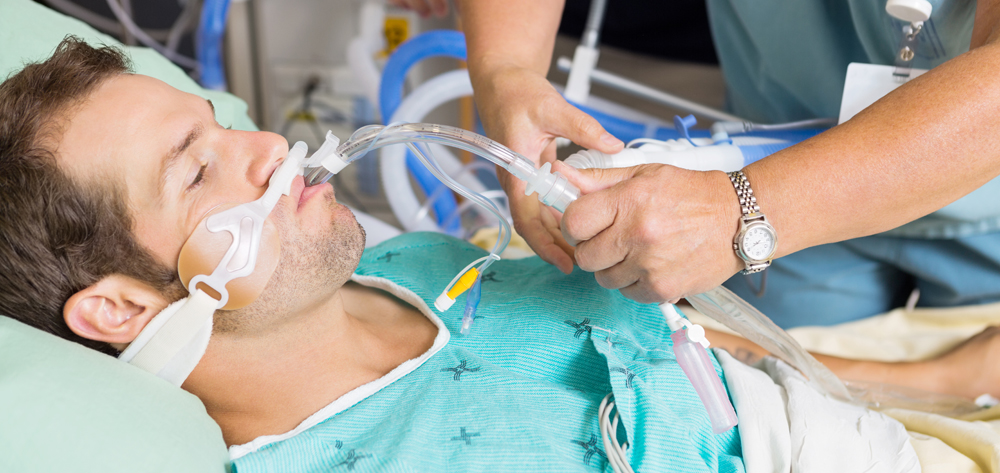
Ventilators work by delivering oxygen directly to the lungs, and they can also be programmed to pump out carbon dioxide for patients who are unable to exhale on their own. The ventilator delivers oxygen via a tube that is inserted through the patient’s nose or mouth in a procedure known as intubation or that is placed directly into the trachea, or windpipe, in a surgical procedure known as tracheostomy. The opposite end of the tube is connected to a machine (the ventilator) that pumps a mixture of air and oxygen through the tube and into the lungs. The air is warmed and humidified before it goes into the body. The ventilator further plays a vital role in maintaining positive air pressure to help prevent small air sacs (alveoli) in the lungs from collapsing.
Ventilators are set to pump air into the lungs a certain number of times per minute. The patient’s heart rate, respiratory rate, and blood pressure are monitored constantly. Doctors and nurses use this information to maths the patient’s health and to make necessary adjustments to the ventilator. When a patient shows signs of recovery from infection or injury, the doctor may decide to begin the process of ventilator weaning, a trial in which the patient is given a chance to breathe on his or her own but is still connected to the ventilator in case it is needed. Once a patient is weaned from the ventilator, the breathing tube is removed.
Ventilators are not cures for infection, and their use poses serious risks to patients. While on a ventilator, patients are unable to cough and clear potentially infectious agents from their airways. As a result, some patients develop ventilator-associated pneumonia, in which bacteria enter the lungs. Sinus infections can also occur. Other problems include oxygen toxicity and excess air pressure, which can cause significant damage to lung tissue. In addition, the longer a person is on a ventilator, the greater the degree of respiratory muscle atrophy that will occur. This can make it difficult for patients to breathe on their own. Activities like climbing stairs or even walking short distances may become impossible, resulting in long-term disability and reduced quality of life.
Details
A ventilator is a type of breathing apparatus, a class of medical technology that provides mechanical ventilation by moving breathable air into and out of the lungs, to deliver breaths to a patient who is physically unable to breathe, or breathing insufficiently. Ventilators may be computerized microprocessor-controlled machines, but patients can also be ventilated with a simple, hand-operated bag valve mask. Ventilators are chiefly used in intensive-care medicine, home care, and emergency medicine (as standalone units) and in anesthesiology (as a component of an anesthesia machine).
Ventilators are sometimes called "respirators", a term commonly used for them in the 1950s (particularly the "Bird respirator"). However, contemporary medical terminology uses the word "respirator" to refer to a face-mask that protects wearers against hazardous airborne substances.
Function
In its simplest form, a modern positive pressure ventilator, consists of a compressible air reservoir or turbine, air and oxygen supplies, a set of valves and tubes, and a disposable or reusable "patient circuit". The air reservoir is pneumatically compressed several times a minute to deliver room-air, or in most cases, an air/oxygen mixture to the patient. If a turbine is used, the turbine pushes air through the ventilator, with a flow valve adjusting pressure to meet patient-specific parameters. When over pressure is released, the patient will exhale passively due to the lungs' elasticity, the exhaled air being released usually through a one-way valve within the patient circuit called the patient manifold.
Ventilators may also be equipped with monitoring and alarm systems for patient-related parameters (e.g., pressure, volume, and flow) and ventilator function (e.g., air leakage, power failure, mechanical failure), backup batteries, oxygen tanks, and remote control. The pneumatic system is nowadays often replaced by a computer-controlled turbopump.
Ventilator pressures labeled
Modern ventilators are electronically controlled by a small embedded system to allow exact adaptation of pressure and flow characteristics to an individual patient's needs. Fine-tuned ventilator settings also serve to make ventilation more tolerable and comfortable for the patient. In Canada and the United States, respiratory therapists are responsible for tuning these settings, while biomedical technologists are responsible for the maintenance. In the United Kingdom and Europe the management of the patient's interaction with the ventilator is done by critical care nurses.
The patient circuit usually consists of a set of three durable, yet lightweight plastic tubes, separated by function (e.g. inhaled air, patient pressure, exhaled air). Determined by the type of ventilation needed, the patient-end of the circuit may be either noninvasive or invasive.
Noninvasive methods, such as continuous positive airway pressure (CPAP) and non-invasive ventilation, which are adequate for patients who require a ventilator only while sleeping and resting, mainly employ a nasal mask. Invasive methods require intubation, which for long-term ventilator dependence will normally be a tracheotomy cannula, as this is much more comfortable and practical for long-term care than is larynx or nasal intubation.
Safety-critical system
As failure may result in death, mechanical ventilation systems are classified as safety-critical systems, and precautions must be taken to ensure that they are highly reliable, including their power supply. Ventilatory failure is the inability to sustain a sufficient rate of CO2 elimination to maintain a stable pH without mechanical assistance, muscle fatigue, or intolerable dyspnea. Mechanical ventilators are therefore carefully designed so that no single point of failure can endanger the patient. They may have manual backup mechanisms to enable hand-driven respiration in the absence of power (such as the mechanical ventilator integrated into an anaesthetic machine). They may also have safety valves, which open to atmosphere in the absence of power to act as an anti-suffocation valve for spontaneous breathing of the patient. Some systems are also equipped with compressed-gas tanks, air compressors or backup batteries to provide ventilation in case of power failure or defective gas supplies, and methods to operate or call for help if their mechanisms or software fail. Power failures, such as during a natural disaster, can create a life-threatening emergency for people using ventilators in a home care setting. Battery power may be sufficient for a brief loss of electricity, but longer power outages may require going to a hospital.
Additional Information
A ventilator, sometimes called a mechanical ventilator, is a machine that helps you breathe when you're sick, injured, or sedated for an operation. It pumps oxygen-rich air into your lungs. It also helps you breathe out carbon dioxide, a harmful waste gas your body needs to get rid of.
Even while they help you breathe, ventilators sometimes lead to complications. These problems can result from the ventilator itself, or from things that are more likely to happen when you're on a ventilator.
Ventilator vs. respirator
People sometimes use the word respirator to mean the same thing as ventilator. The CDC defines a respirator as a mask or device that protects you from dangerous particles in the air. But a respirator can also describe a device that helps you breathe, like a ventilator.
Ventilator vs. intubation
Ventilators and intubation are often used together, but they aren't the same. Intubation is a procedure in which a health care worker places a tube down your throat to move air in and out of your lungs. This tube can then be hooked up to a bag or a ventilator machine.
Types of Ventilators
There are several types of ventilation. Your doctor will determine which is best for your situation.
1. Noninvasive ventilation
Noninvasive ventilation involves using a face mask that connects to the ventilator. You breathe into the mask, which straps around your head. Two common noninvasive ventilation devices are continuous positive airway pressure (CPAP) and bilevel positive airway pressure (BiPAP) machines, both used by people with sleep apnea.
2. Invasive ventilation
With invasive ventilation, you have a tube in your airway that connects to a ventilator machine. The tube can either enter through your mouth (intubation) or through an incision a doctor cuts into your neck (tracheostomy).
3. Mechanical ventilator
A mechanical ventilator is a machine that keeps your airways open and delivers oxygen to help you breathe. It's considered a form of life support.
4. Face mask ventilator
A face mask ventilator is a form of noninvasive ventilation. It essentially means you wear a face mask to get oxygen. It may be used to deliver anesthesia as well as to help you breathe.
5. Manual resuscitator bag
A manual resuscitator bag provides air by hand. Someone pumps the bag to help air go in and out of your lungs. The bag can attach to a face mask ventilator or a tube if you're intubated. This may be an option if a mechanical ventilator isn't available or stops working.
6. Tracheostomy ventilator
With a tracheostomy ventilator, the machine attaches to a tube that doctors have inserted into an opening in your neck.
How Does a Ventilator Work?
A ventilator connects to a face mask or to a tube in your nose, mouth, or throat. It blows oxygen-rich air into your windpipe through the tube. Before it travels to your windpipe, the air passes through a humidifier, which keeps it warm and moist. The ventilator may also breathe out for you, or you may do it on your own.
The machine maintains a constant low pressure to prevent the air sacs in your lungs from collapsing.
The ventilator can be set to take a certain number of breaths for you per minute. Your doctor also may program it to kick in when you need help. In this case, the machine will blow air into your lungs automatically if you haven't taken a breath in a set amount of time.
It appears to me that if one wants to make progress in mathematics, one should study the masters and not the pupils. - Niels Henrik Abel.
Nothing is better than reading and gaining more and more knowledge - Stephen William Hawking.
Offline
Pages: 1